




Today we’d like to introduce you to Elizabeth Azamatov.
Hi Elizabeth, please kick things off for us with an introduction to yourself and your story.
I was born and raised in Mexico City, and dance became part of my life when I was seven years old. I began training at the Institute of Arts of Mexico City, where I had the privilege of studying with Mónica Pizano and Alma Urdapilleta under the guidance of Laura Urdapilleta Trueba, a Prima Ballerina of Mexico’s National Dance Company. Those early years gave me a strong classical foundation, but they also taught me that dance could become a way of expressing who I was and connecting with other people.
By the time I was twelve, I was studying at the National School of Dance in Mexico City, training in both the Vaganova and Cuban ballet techniques. As a child I was fortunate to perform The Nutcracker with Mexico’s National Dance Company at the Auditorio Nacional for three years, and as a young dancer in several ballets productions like La Bayadere, Swan Lake, Sleeping Beauty, Romeo and Juliet, Don Quixote, An American in Paris, Cinderella to name a few. Those experiences gave me a love for the stage, but over time I discovered that I was equally fascinated by what happened behind the scenes—creating, choreographing, and teaching.
While I was still young, I participated in a collaborative choreography with my classmates that was selected for the Mirarte Festival and the Congress of Music at the Superior School of Music of Mexico. These experiences opened my eyes to the creative possibilities of dance and showed me that movement could be used not only to perform, but also to tell stories and communicate ideas.
Eventually, my journey brought me to California. From 2012 to 2015, I danced and taught at South Coast Ballet Theatre, and I continued building my career as an educator, teaching ballet, dance fitness, drama, and creative movement in schools and community programs.
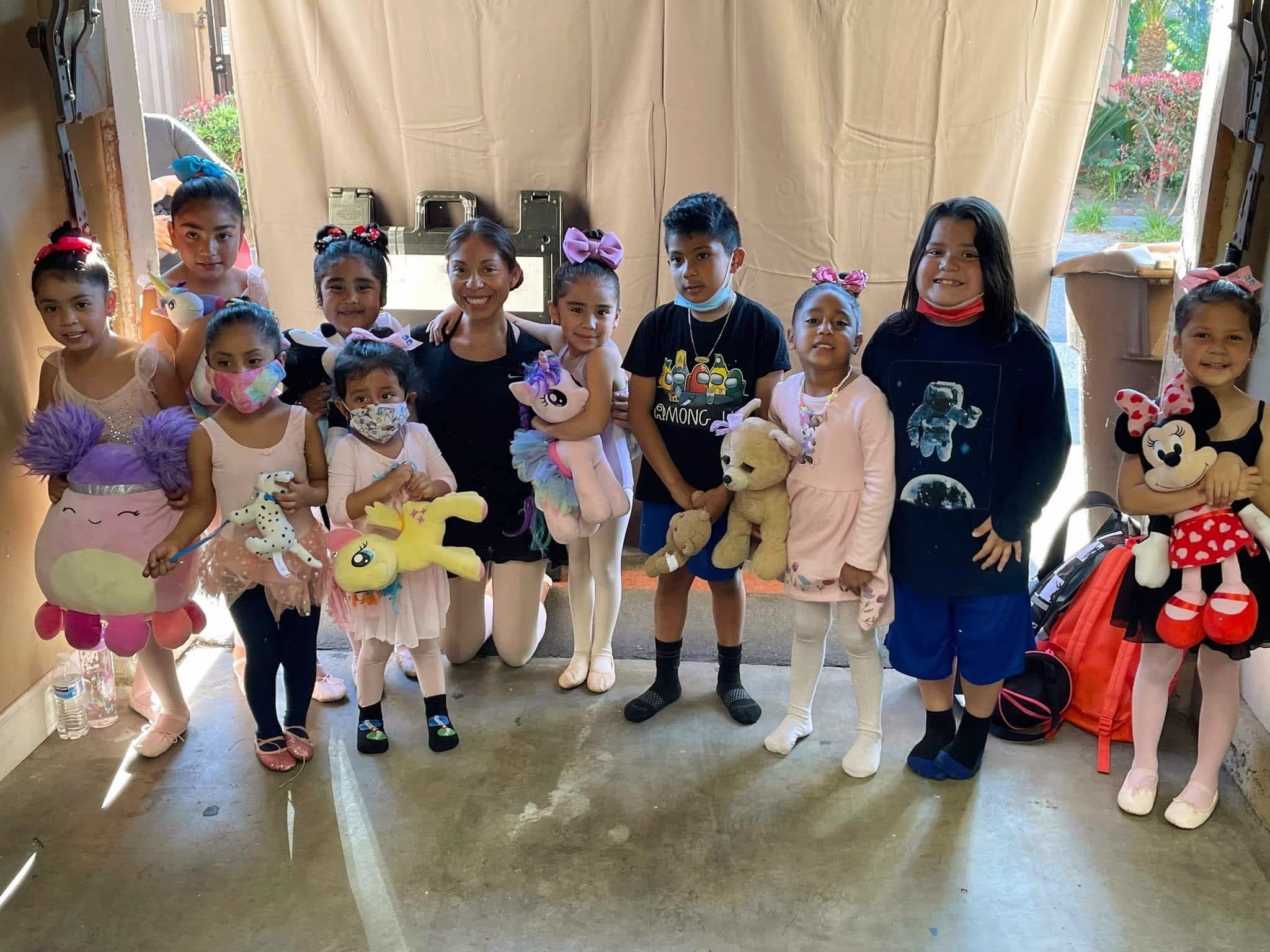
One of the experiences that has stayed especially close to my heart began in 2021. A friend who was working with Unidos South OC at the time invited me to teach ballet there, and together we created a small ballet program in a garage. It wasn’t a traditional dance studio, and we didn’t have a beautiful stage or elaborate facilities. We simply had a space, a shared vision, and children who wanted the opportunity to dance.
What started in that garage grew. Eventually, the program needed more space, and the Boys & Girls Club offered to host it so we could continue expanding. The program is still strong today, giving children access to ballet and dance who might otherwise never have had the opportunity to participate in formal dance training. Watching something that began so simply continue to grow has been one of the most rewarding experiences of my career.
That experience reinforced something I deeply believe: you don’t need a perfect space to make the arts meaningful or accessible. Sometimes you just need someone willing to open the door and say, “Let’s dance.”
My work in arts education has continued to expand through opportunities with organizations including Art-E Foundation and Segerstrom Center for the Arts, where I have worked as a teaching artist bringing dance, theater, and creative movement to children and young people in schools, after-school programs, Boys & Girls Clubs, and other community settings. Some of this work has allowed me to work with underserved youth, which has been particularly meaningful to me.
In 2015, I founded OC DanceFit, which grew from my desire to make dance and movement accessible to more people. I didn’t want dance to be something reserved only for people who wanted to become professional dancers. I wanted children to discover confidence and creativity through movement, adults to feel comfortable dancing regardless of their previous experience, and families to have opportunities to experience the arts together.
Today, I see myself as much more than a dancer. I am an educator, choreographer, performer, writer, and lifelong student. I love finding ways to combine dance, theater, language, and creativity so that learning feels exciting rather than intimidating. Being bilingual has also become an important part of my work, and I enjoy creating opportunities where children can learn and express themselves in both English and Spanish.
When I look back, I think about the little girl in Mexico City who started ballet at seven and could never have imagined where dance would take her. From the studios and stages of Mexico City to California, and from professional performance to teaching children and creating a ballet program in a garage, every chapter has shaped the person and educator I am today.
I’ve learned that a career in the arts isn’t always a straight line. Sometimes you perform. Sometimes you teach. Sometimes you create something from nothing. And sometimes the most meaningful stage isn’t a theater at all—it’s a small room, a school, a community center, or even a garage where a child discovers that they can dance.
And after all these years, I still feel like I’m just getting started.
Alright, so let’s dig a little deeper into the story – has it been an easy path overall and if not, what were the challenges you’ve had to overcome?
It definitely hasn’t been a smooth road. One of my biggest challenges was moving to a new country and learning to navigate life and my career in another language. Although I already spoke some English, becoming truly comfortable communicating professionally was a completely different experience. I had to learn not only the language, but also how to express myself confidently, work through my accent, and sometimes overcome the fear of making mistakes.
There were also challenges that came from wanting to do more for the communities I was serving than my resources always allowed. I have always wanted children to have access to dance and arts education, regardless of their family’s financial situation. That has sometimes meant finding creative solutions when there wasn’t funding, space, or a traditional studio available. The Ballet Garage is a perfect example of that—we started with a garage because we wanted to create an opportunity for children to dance, and eventually the program grew enough that we needed a larger space.
I’ve learned that obstacles don’t necessarily mean you have to stop; sometimes they force you to become more creative. Learning English taught me patience and persistence, while working with limited resources taught me to focus on what I can create rather than what I don’t have.
I still encounter challenges, but I don’t see them in the same way I did when I was younger. They have become part of the process of figuring out how to keep learning, keep creating, and keep opening doors for other people.
Appreciate you sharing that. What else should we know about what you do?
My work sits at the intersection of dance, education, theater, and creative expression. I am a dancer, choreographer, educator, teaching artist, performer, writer, and the founder of OC DanceFit, a program I created to make movement and the arts accessible to a wider community.
My foundation is in classical ballet. I began training in Mexico City as a child and had the opportunity to perform with Mexico’s National Dance Company, as well as train in both the Vaganova and Cuban ballet techniques . Over the years, however, my work has expanded far beyond traditional ballet. I teach ballet, dance fitness, creative movement, drama, improvisation, and theater, and I love finding ways to combine these disciplines.
One of the things I specialize in is making dance approachable. I don’t believe that someone has to dream of becoming a professional dancer to benefit from dance. Movement can build confidence, discipline, creativity, communication, and a sense of belonging. That philosophy guides the way I work with both children and adults.
I’m particularly passionate about arts education for children and young people who may not otherwise have access to it. Through my work with organizations and community programs, I’ve taught in schools, after-school programs, Boys & Girls Clubs, and other community settings. I’ve also had the opportunity to work with underserved youth through arts education programs.
I’m especially proud of the programs I’ve helped create from the ground up. The Ballet Garage is one of the experiences that means the most to me. What began in 2021 when a friend from Unidos South OC invited me to teach ballet became a program that we built together in a garage. When the program outgrew the space, the Boys & Girls Club offered to host it, and it continues to provide children with access to ballet today. Knowing that something we started with very little has continued to grow and serve children is incredibly rewarding.
Being bilingual is another important part of my creative work. I enjoy incorporating English and Spanish into my classes and developing ways for children to learn through movement, storytelling, theater, and play. I think language and the arts can complement each other beautifully, and I want children to feel that learning can be creative rather than intimidating.
What sets my work apart is probably the combination of my professional dance background with my approach as an educator. I understand the discipline and technical side of dance, but I also understand that every student walks into a class with a different personality, background, confidence level, and way of learning. I don’t want to simply teach students steps. I want to help them discover what they can express through those steps.
What I’m most proud of is not necessarily a particular performance or accomplishment. It’s seeing a child who was initially shy become confident, watching a student discover that they are creative, or knowing that a child who might never have had access to ballet is now standing in a dance class learning something they love.
For me, the most meaningful part of being an artist is being able to use what I have learned to open doors for someone else.
Can you talk to us about how you think about risk?
I don’t think of myself as a reckless risk-taker. I think of myself more as someone who is willing to take a chance when I believe strongly in something, even when I don’t have every detail figured out.
Moving from Mexico to the United States was one of the biggest risks I’ve taken. I was leaving behind the environment where I had grown up, trained, and built my identity as a dancer and starting over in a new country. I had to adapt to a new culture, continue building my career, and become comfortable working in another language. There were many moments when I didn’t know exactly what the next step would be, but I learned to keep moving forward.
Starting my own work has also required taking risks. When I founded OC DanceFit, I didn’t have a perfect business plan or a large studio behind me. I simply had a belief that dance and movement could bring something valuable to people’s lives, and I was willing to start small and figure things out along the way.
The Ballet Garage was another example. When my friend and I created the program in 2021, we didn’t wait until we had the perfect studio or all the resources we wanted. We started in a garage because that was the space available to us. It could have been easy to think, “This isn’t how a ballet program is supposed to look.” Instead, we thought, “Why not start here?” Eventually, the program grew enough that the Boys & Girls Club offered to host it, and it continues to give children access to dance today.
I’ve learned that sometimes the biggest risk is waiting for everything to be perfect before you begin.
For me, taking a risk doesn’t mean ignoring reality or jumping without thinking. It means being willing to step outside of my comfort zone, accept that I may make mistakes, and trust that I can learn along the way. Some of the opportunities I’m most grateful for began with a little uncertainty.
I think that is especially true in the arts. You have to be willing to create something that doesn’t exist yet—to take an idea that only exists in your imagination and give it a chance to become real.
Sometimes you have to take the first step before you can see the whole path.
Contact Info:
- Website: https://www.ocdance.fit
- Instagram: Oc DanceFit
- Facebook: OC DanceFit
- Youtube: OC DanceFit


Popular
-

Portraits of the Valley
-

LA’s Most Inspiring Stories
-

Greg Hex Is Turning the Everyday Kitchen Knife Into a Modern Design Object
-

Rick Norris Learned That Building a Successful Business Means Building a Life You Actually Want to Live
-

How Olivia Rush Turned Survival Into a Mission to Help Others Keep Going
-

How Bibi Goldstein Is Helping Entrepreneurs Reclaim Their Time by Embracing the Power of Delegation


