




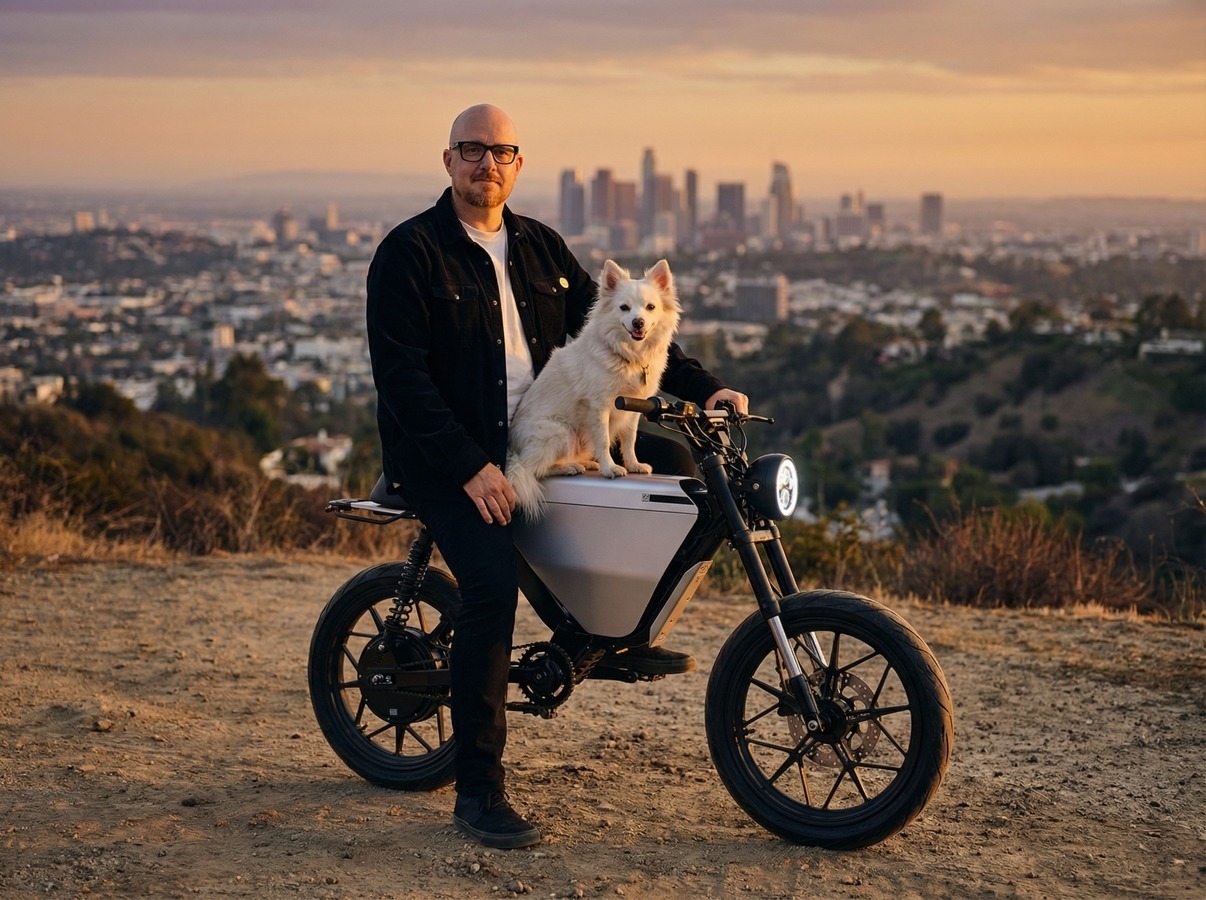
Today we’d like to introduce you to Timothy Seward.
Hi Timothy, we’d love for you to start by introducing yourself.
My path wasn’t exactly linear—it started in design studios rather than garages.
I began my career as an Industrial Designer working in consumer electronics and action sports, designing for major brands like Sonos, Intel, Google, and LG. While the work was exciting, I eventually grew frustrated with the ‘disposable’ nature of that industry—spending months crafting devices that would be obsolete or in a landfill within a year or two. I wanted to create something permanent, something that earned loyalty.
The spark for ONYX actually came from a personal need. Living in San Francisco, I needed a way to navigate the steep hills and parking chaos. I had a soft spot for vintage gas mopeds, but they were messy, unreliable, and didn’t belong in an office. So, around 2012, I started experimenting with electrifying old frames in my spare time. I wasn’t trying to start a company; I just wanted a better commute.
Around 2015 I created the first RCR prototype that looks like the original product and reaction on the streets was undeniable. I couldn’t stop at a red light without someone asking, ‘What is that? And where can I get one?’
That curiosity pushed me to launch an Indiegogo campaign in late 2017 under the name ONYX Motorbikes. We didn’t just want to build an e-bike; we wanted to bring the soul of the 70s and 80s moped culture into the electric era. When orders were officially live in early 2018 the response was overwhelming—we raised nearly a million dollars in 30 days. We had accidentally ignited a new category of ‘moped-class’ electric bikes.
Following that success, I sold the business about a year later and was acqui-hired by a global last-mile ride-sharing company to develop new micro mobility innovations for the world. ONYX was in a strong position and running well under new ownership until tragedy struck, and the owner passed away due to health complications in late 2023. That loss created a leadership void that left the brand in limbo. I couldn’t sit back and let the vision fade.
That brings us to today. I’ve recently resurrected the brand as ONYX Motors, now based here in the Los Angeles area. We are back to our roots, focusing on building machines that are meant to be modified, repaired, and kept for decades—not thrown away. It’s been a wild ride from a single prototype in a San Francisco apartment to leading a revived company in LA, but I’m proud to be back in the driver’s seat, building the future of two-wheeled culture.
We all face challenges, but looking back would you describe it as a relatively smooth road?
It definitely hasn’t been a boring road, but ‘smooth’ isn’t the word I’d use. In the beginning, we faced the classic challenge of any hardware startup: success can actually be your biggest problem. We went from a prototype to raising nearly a million dollars in a month, which meant we had to learn how to manufacture at scale overnight. That initial phase was about pure execution—turning a prototype into a production vehicle that people could actually ride.
The more complex struggles came later, and interestingly, they happened after I had initially moved on. I had sold the business and was acqui-hired by BIRD to help them innovate in the ride-share space. At that time, ONYX was in good hands and doing well.
The turning point was a tragedy beyond anyone’s control—the new owner passed away due to health complications. That loss created a vacuum in leadership that left the brand in a state of limbo. It wasn’t about business failure; it was about the loss of direction. The struggle for me then became personal: watching from the sidelines as the vision I started began to fade, and ultimately making the decision to step back in, acquire the brand, and bring it back to life as ONYX Motors.
As you know, we’re big fans of you and your work. For our readers who might not be as familiar what can you tell them about what you do?
I specialize in what I call “kinetic nostalgia,” taking the soul of 1970s and 80s moped culture—the wood grain, the exposed steel, the raw mechanical feel—and fusing it with high-voltage electric power. I’m known for designing the ONYX RCR, but more broadly, I’m known for rejecting the “plastic appliance” look of modern consumer electronics. My work is heavily influenced by a Cyberpunk / Blade Runner aesthetic; I want to build machines that look like they fell out of a time warp, blending retro analog vibes with modern speed and technology.
Most industrial designers today try to hide the mechanics inside a “black box” that you can’t touch, but I do the opposite. I design for the wrench-turners, not just the riders. I treat the bike as a blank canvas, leaving the hardware visible and using real materials like metal and wood that age and patina rather than crack and fade. I build platforms that invite the owner to hack, modify, and customize them. I don’t just want you to ride my work; I want you to make it your own.
I’m most proud of the fact that the design proved to be immortal. The company went through a chaotic period where it almost disappeared, but the community kept the bike alive because they loved the object itself so much. Seeing riders all over the country customize these bikes—turning them into cafe racers, scramblers, or low-riders—is my biggest point of pride. It proves that if you design something with authentic soul, it earns a loyalty that goes beyond just a brand name.
How do you think about luck?
Luck has played a massive role in my life, but I’ve found that what looks like luck is often just a delayed reaction to maintaining good relationships. I’ve had phone calls come in decades after a job ended that completely changed my trajectory, simply because I never burned a bridge and always kept the lines of communication open.
For example, I originally developed web designs for Mini Cooper early in my career. Five years later, a colleague from that project called me out of the blue to offer me the chance to lead Industrial Design for LG Electronics in the United States. That single call pivoted my entire career.
But the most “insane” stroke of luck was actually how ONYX got its physical start. I received a call from my very first design job in the action sports industry. They were shutting down and needed help selling through their remaining inventory. Because I had maintained that relationship, I was able to step in, help them wind down, and essentially take over their warehouse space to start ONYX. I went from looking for a garage to having a headquarters because of a job I had left years prior. That kind of timing feels like pure luck, but without a history of positive networking and trust, those calls never would have happened.
Pricing:
- ONYX RCR 80V starting at $5199 MSRP
Contact Info:
- Website: https://ONYXmotors.com
- Instagram: https://instagram.com/onyxmotorbikes
- Facebook: https://facebook.com/onyxmotorbikes
- LinkedIn: https://linkedin.com/company/onyxmotorbikes
- Twitter: https://x.com/onyxmotorbikes
- Youtube: https://youtube.com/@onyxmotorbikes
Popular
-

Que Johnson on Building Brands That Last: From Visibility to True Market Authority
-

Christina Wren Steps Into the Director’s Chair to Tell Stories That Feel Like Home
-

Portraits of the Valley
-

LA’s Most Inspiring Stories
-

JordanL on ‘Breathe,’ Belief, and Building a Movement Beyond the Music
-

Megan Birney Rudert on How Access to Light Is Powering a More Sustainable and Equitable Future


