




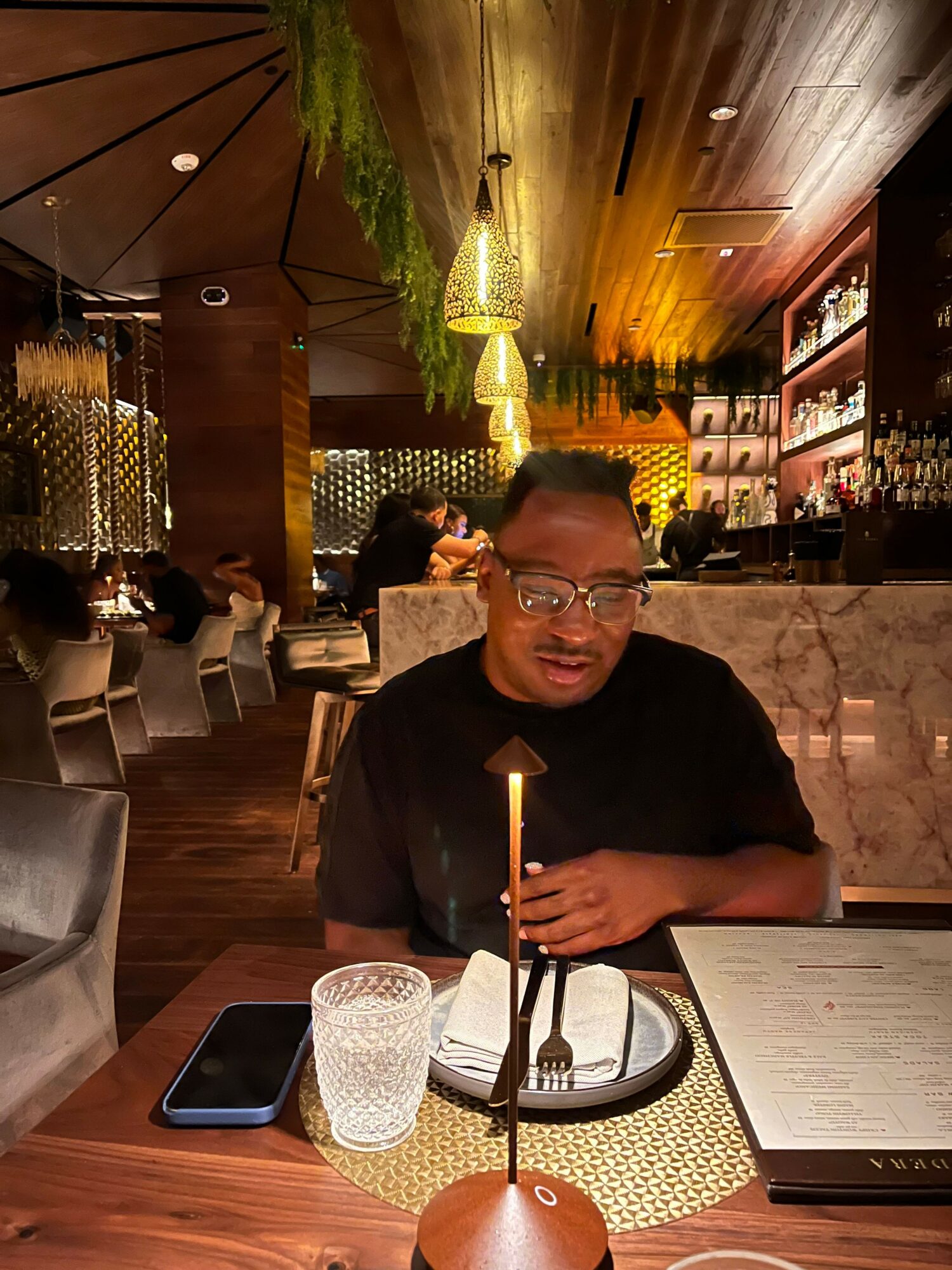
Joseph Benjamin shared their story and experiences with us recently and you can find our conversation below.
Good morning Joseph , it’s such a great way to kick off the day – I think our readers will love hearing your stories, experiences and about how you think about life and work. Let’s jump right in? What are you chasing, and what would happen if you stopped?
For most of my life, I thought I was chasing success, visibility, momentum—forward motion at all costs. But I’ve realized that what I was really chasing was value, disguised as urgency.
I never stopped to question whether the chase itself was the problem. I assumed wanting more meant moving faster. I assumed clarity came from acceleration. I assumed if I didn’t keep going, everything would collapse.
What I hadn’t considered was that I was often chasing what I valued through a lens that wasn’t mine—through perceived perception. Through inherited definitions of success. Through environments that rewarded speed, gloss, and performance over alignment.
At one point, I became aware that everything around me had a film on it. A sheen. A kind of constant polish that suggested movement mattered more than meaning. Even outcomes felt staged—like they only counted if they looked impressive from the outside.
Living in Los Angeles made that impossible to ignore. I didn’t like the performance culture, but I convinced myself I did. I told myself it was ambition. I told myself it was passion. In reality, it was conditioning.
When I stopped chasing—really stopped—things didn’t stabilize. They destabilized. That was the truth.
What followed wasn’t relief. It was discomfort that didn’t resolve quickly. Stillness that felt unfamiliar, even unsafe. Space that didn’t come with instructions.
And in that space, there was no immediate clarity—only confrontation. With my patterns. With the identities I had been using as propulsion. With the realization that movement had been a way to avoid listening.
Stopping didn’t reward me. It exposed me.
It showed me how much of my life had been built around momentum rather than choice, how often I had confused urgency with alignment, and how deeply I had learned to equate worth with motion.
What emerged wasn’t certainty. It was honesty—slow, unglamorous, and sometimes heavy.
But it was mine.
Can you briefly introduce yourself and share what makes you or your brand unique?
I’m Joseph Benjamin. I’m the founder of Prophecy Brand, a narrative-led brand and cultural strategy studio working at the intersection of fashion, beauty, entertainment, and inner development.
What makes my work different is that I don’t treat branding as optics or publicity as output. I treat both as reflections of the inner architecture of the people building them. Over the last decade, I’ve worked across luxury fashion, entertainment, and media—often behind the scenes—shaping narratives, campaigns, and environments that people don’t just see, but feel.
Prophecy Brand emerged as my own relationship to work, ambition, and identity changed. I reached a point where speed, hype, and visibility no longer felt aligned, and I chose to slow down instead of scaling faster. That pause reshaped how I build. Now, the work centers on resonance over reach, nervous-system safety over noise, and long-form narrative over moments of attention.
What I’m working on now is less about expansion and more about precision—clarifying who the work is for, how stories are held, and what it means to build something that can endure without burning the people inside it. Prophecy Brand is not a traditional agency. It’s an evolving framework for building brands, experiences, and futures from a place of internal coherence rather than performance.
At this point, I’m not chasing what’s next. I’m listening for what’s true—and letting the work take shape from there.
Okay, so here’s a deep one: What part of you has served its purpose and must now be released?
The part of me that has served its purpose is the belief that I had to earn my right to have.
Whether it was love, money, security, or something as simple as being okay—I believed I had to work for it, prove myself worthy of it, demonstrate value before it could arrive. I needed to show that I could do it. That I could succeed. That I deserved a seat at the table.
Here’s the truth I had to face:
No one is watching the way we think they are.
No one is measuring us the way we measure ourselves.
What I was really seeking wasn’t success—it was witnessing.
To be seen in moments of lack.
To be validated in struggle.
To have someone confirm that I still mattered when I was alone, uncertain, or without.
The lesson in releasing that belief is this:
What we do is not our value.
What we produce is not our worth.
Value isn’t achieved.
It isn’t earned over time.
It’s recognized the moment you stop outsourcing your sovereignty.
I no longer need to explain myself.
I no longer need to be witnessed.
I am.
What have been the defining wounds of your life—and how have you healed them?
The first was the wound of conditional belonging—learning early that acceptance often came with expectations. Be useful. Be exceptional. Be palatable. I internalized the idea that love, safety, and visibility were things you earned by performing well enough to justify your presence.
The second was the wound of self-abandonment. I became very skilled at overriding my own needs to meet external demands—professionally, emotionally, relationally. I confused endurance with strength and productivity with worth. For a long time, I believed pushing through was the same as moving forward.
The third was the wound of misplaced responsibility—carrying more than was mine to carry. Other people’s expectations. Other people’s discomfort. Other people’s inability to meet me with honesty or depth. I learned to compensate instead of stepping back.
Healing didn’t come through erasing these wounds or reframing them into something inspirational. It came through slowing down enough to notice when I was repeating them.
I healed by building boundaries where I once built tolerance.
By choosing clarity over approval.
By learning to pause instead of proving.
Most importantly, I healed by separating who I am from what I produce. By understanding that my value doesn’t increase with effort or diminish with rest. That I don’t need to be witnessed to be real. That sovereignty isn’t something you arrive at—it’s something you practice when no one is watching.
I don’t consider myself healed in the sense of “finished.”
But I am no longer at war with myself.
And that has changed everything.
Next, maybe we can discuss some of your foundational philosophies and views? What are the biggest lies your industry tells itself?
One of the biggest lies my industry tells itself is that PR, editors, content creators, and influencers are competing roles.
They aren’t. They’re components of the same ecosystem.
The industry keeps treating these roles as if one replaces the other—
PR versus editors.
Editors versus creators.
Creators versus influencers.
That framing is false, and it’s costing brands depth, coherence, and longevity.
What’s actually happening is a shift in the marketing mix, not a collapse of it.
Editors are still editors. They frame culture, context, and meaning.
PR still matters. It builds credibility, pacing, and narrative over time.
Content creators translate stories into lived, repeatable moments.
Influencers move attention through trust and proximity to their audience.
The lie is thinking any one of these works in isolation.
When brands chase one lane—only influencers, only press hits, only viral content—they get noise without memory. Reach without resonance. Visibility without belief.
The brands that endure understand this:
Narrative is the connective tissue.
Community is the multiplier.
And coherence is what turns attention into trust.
This isn’t PR or creators.
It’s PR with creators.
Editors in conversation with community.
Influence that’s anchored in meaning, not metrics.
The industry doesn’t need another replacement.
It needs integration—and the maturity to stop pretending otherwise.
That’s the lie worth letting go of.
Thank you so much for all of your openness so far. Maybe we can close with a future oriented question. What do you think people will most misunderstand about your legacy?
It wasn’t.
It was about building capacity—in myself first, and then in others.
From the outside, it may look like strategy, narrative, visibility, or cultural positioning. It may look like restraint. Or slowness. Or refusal. Some will mistake that for hesitation, or for not wanting success badly enough.
Others will think I was chasing recognition, influence, or proof.
The truth is quieter.
What I was doing—what I am doing—is dismantling the idea that worth is earned through output, urgency, or performance. I was learning how to move without self-betrayal. How to build without abandoning my nervous system. How to create without contorting myself to be palatable, legible, or fast.
People may misunderstand my pauses as absence.
My selectivity as exclusivity.
My refusal to chase as arrogance.
But my legacy isn’t about what I amassed or how loud it became.
It’s about showing that you can build from sovereignty, not survival.
That you can choose coherence over hype.
That you can stop proving and still become.
If there’s a misunderstanding, it will be this:
They’ll think I was withholding.
I wasn’t.
I was listening.
Contact Info:
- Website: https://Prophecybrand.com
- Instagram: https://www.instagram.com/theprophecybrand/
- Linkedin: https://www.linkedin.com/company/theprophecybrand/?viewAsMember=true


Popular
-

Que Johnson on Building Brands That Last: From Visibility to True Market Authority
-

Christina Wren Steps Into the Director’s Chair to Tell Stories That Feel Like Home
-

Portraits of the Valley
-

LA’s Most Inspiring Stories
-

JordanL on ‘Breathe,’ Belief, and Building a Movement Beyond the Music
-
Megan Birney Rudert on How Access to Light Is Powering a More Sustainable and Equitable Future


