




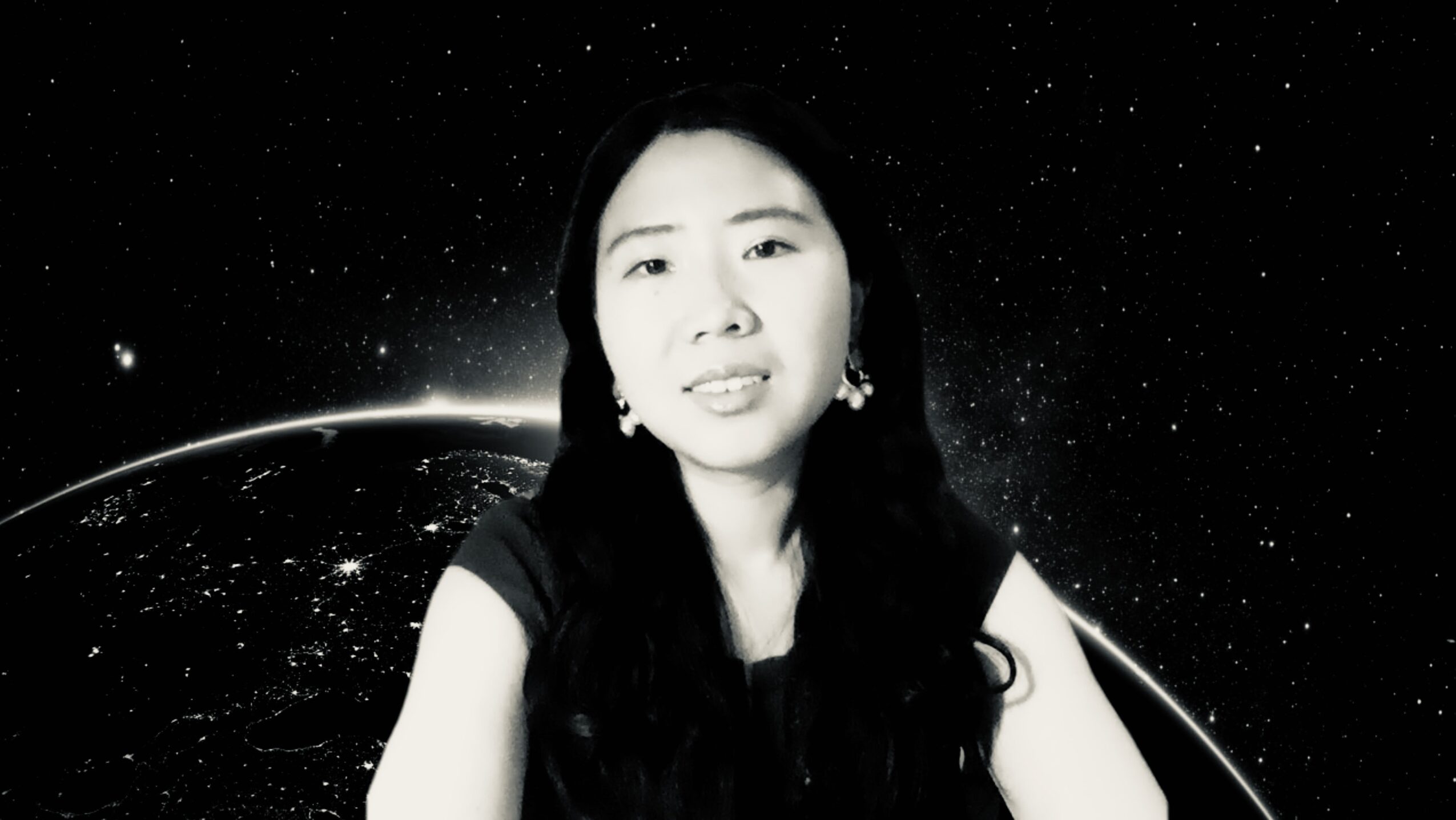
Today we’d like to introduce you to W. Y. Geng.
Can you briefly walk us through your story – how you started and how you got to where you are today. You can include as little or as much detail as you’d like.
Love, life, and light—those are the ideals I pursue through my work.
I want to begin with two works that have deeply inspired me.
The first is a poem I encountered by chance on a train leaving Germany. The woman seated next to me was writing in a small notebook, and when I asked her about it, she told me she was translating a poem by Hafez into English. The poem depicts an elderly man at the end of his life—withered and languid, as if life had already drained out of him. Then light breaks in. A beam of light fills him, and he feels alive again—restored with energy, vitality, and life. I may not remember the poem perfectly, but the image has never left me. That light represented love—not romantic, not bound to one person, but universal: a love that gives life.
For reasons I still can’t fully explain, the poem struck me deeply. I wondered what it would feel like for such a light to pass through a person. What kind of love has the power to restore life? I’ve searched through English translations of Hafez many times, but I’ve never found that exact poem again. Still, the image has stayed with me. Through my work, I think I’ve always been searching for that kind of love—the kind that transcends and brings life. Faith has been part of my inspiration. I sometimes feel that art is a vocation: a spark of creative wisdom is entrusted to the artist, and once it arrives, I’m responsible for carrying it through with discipline and care.
Another story that influenced me is a scene from W. Somerset Maugham’s The Painted Veil. It follows a young woman, Kitty. When cholera breaks out, she works as a nurse in a church-run hospital, alongside other women who care for the dying. Day after day, she sees patients passing away in her arms. Doctors and nurses do everything they can, yet are still unable to save them. Standing so close to life and death, she realizes how small her old worries were—how, as Maugham writes, “their own affairs were trivial.” And in that reckoning, she becomes more fully herself.
“Life” has always been the thread running through my work. I’m drawn to humanist filmmakers like Hayao Miyazaki, and my all-time favorite movie is Casablanca. Miyazaki’s films move steadily toward truth, goodness, and beauty—while exploring humanism, environmental responsibility, and opposition to war. His leads are often young women who are brave, clear-eyed, and stubbornly alive. I’ve watched Casablanca many times. There’s a Hungarian poem that captures that feeling: “Freedom and love—these two are all I need. For my love, I would sacrifice my life; for freedom, I would sacrifice my love.” I guess I’ve always been an idealist.
I sometimes joke that this comes from my Aquarian streak—an instinct for the off-axis and the unconventional. I’m drawn to characters on the margins: the voiceless, the misunderstood, the outsiders—aliens and monsters. That’s why genre speaks to me—forms often dismissed as “childish,” including political fairy tales set in dark times—even as war is treated as the serious, “adult” subject.
In my own work, I return to a few recurring images: a beam of golden sunlight, a small wildflower blooming in a desolate place—meeting the challenge of rocks and stones and emerging into the light. Even in the darkest times, there is still light. No matter how small, that light can ignite—and it can guide.
Looking back, the times I’ve been happiest—moving through school and through the ups and downs of life and work—have almost always been the times I’ve had true love and friendship: family, collaborators, and the people who carried me forward. Once, I was trudging through the desert, exhausted and out of water, and a stranger stopped and offered me a ride. My producing partner visited place after place, simply to find the right location for our film. My production designer rallied friends and family to help build the set, and after we shot the scene, he hugged me and said, “It’s a beautiful story. It’s a beautiful story we told.” Those moments—both in life and in movies—stay with me: the photographer in Roman Holiday handing Audrey Hepburn the photos; Elisa in The Shape of Water deciding, simply, “I’m going to save him,” because it’s the human thing to do; Kiki helping the grandmother bake and deliver a pie. Old-fashioned, perhaps. But sincere.
As an artist, I’m searching for that wildflower—that beam of light, that quiet glow in the dark. Light isn’t the absence of darkness—it’s what I choose to carry through it.
Has it been a smooth road? If not, what were some of the struggles along the way?
In film school, we had a Q&A with Alejandro G. Iñárritu. I remember him looking out at a room full of students and telling us, “This industry might break your heart, but you’ve got to be tough.”
Long before film school, I’d already faced many rejections. I trained as a pianist for 15 years, starting before I was five, with the hope of becoming a professional performer. At 11, I passed the highest-level national qualification available to non-professional piano students in China, but the conservatory track is a different world. My hands are small, which is a real disadvantage for piano, and no matter how hard I worked, I could always feel that limitation hanging over me. I learned what it means to keep going when a path doesn’t open easily.
After I reached the highest “amateur” level, my first piano teacher introduced me to his professor—a renowned faculty member at the Central Conservatory of Music—who became my teacher. I went to her home for lessons; sometimes there would be a line of students waiting outside to play. I played quite stiffly and didn’t yet know how to express myself. Eventually, it became clear to me I wasn’t the kind of prodigy the conservatory track rewards. The realization was painful. At one of my last lessons, I played Liszt’s Liebesträume No. 3, and my professor patted my back and said, “Finally, you play with emotion.”
I remember thinking, who doesn’t have emotions of their own?
Still, I’ve had my own path. Since middle school, I wrote short stories and essays and received early recognition as a young writer. Writing came naturally to me—poetry, fiction, nonfiction—and my literature teachers encouraged me to pursue it professionally.
That path wasn’t smooth either. When I first came to America, suddenly something I’d taken for granted—being able to speak—became the hardest part of my life. Even though writing had always come naturally to me, I had to rebuild myself in a completely new language and start from scratch. I joke that I can relate to King George VI in The King’s Speech. One moment I love is when Logue says, “You still stammered on the ‘W’,” and George VI smiles: “Well, I had to throw in a few so they knew it was me.”
Rejection is part of a filmmaker’s life, and I’ve had my share. I spent a year making a short film—my cast and crew put real trust and hard work into the project, and into me. We applied to many festivals and were rejected. It wasn’t only about my own disappointment. As a director, you’re leading a whole team. People show up for you and put their hearts into the film; when a project doesn’t land the way you hoped, you don’t just feel heartbroken—you’re responsible, looking your team in the eye. And you keep going.
So no, it hasn’t been a smooth road. But each challenge has pushed me to keep improving and keep earning the trust that collaboration requires. I’ve come out of it with more steadiness, more courage, and stronger grounding in the filmmaker’s craft—and in leading and supporting a team. I’m deeply grateful to everyone who has been there for me along the way.
Please tell us more about your business or organization. What should we know? What do you do, what do you specialize in / what are you known for? What sets you apart from others? What are you most proud brand wise? What do you want our readers to know about your brand, offerings, services, etc?
I’m a writer-director and founder passionate about bold, imaginative storytelling. My approach is guided by “Aquarian” qualities—innovation, curiosity, and audacity. I’m committed to reimagining theatrical cinema and the moviegoing experience in a rapidly changing industry.
I take growth seriously—not only in craft, but also in the discipline of directing and the responsibility of leading a team. I continue to refine my technique and communication, aligning collaborators around a shared vision and supporting their best work.
I’m building a company dedicated to creating theater-first movies that are engaging and visionary—made with care, rigor, and a collaborative spirit grounded in shared goals and values.
Contact Info:
- Website: https://wyfilms.blog
Popular
-

Portraits of the Valley
-

LA’s Most Inspiring Stories
-
JordanL on ‘Breathe,’ Belief, and Building a Movement Beyond the Music
-
Megan Birney Rudert on How Access to Light Is Powering a More Sustainable and Equitable Future
-
Linda Kneidinger on Building Lasting Change Through Small Steps and Self-Compassion
-

Jolana Nika on Redefining Modern Connection Through Intentional, Real-Life Experiences


