




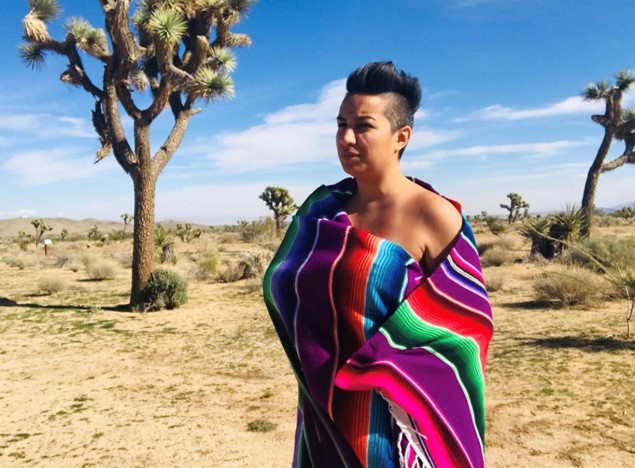
Today we’d like to introduce you to Socorro García.
Socorro, can you briefly walk us through your story – how you started and how you got to where you are today.
Born in Chicago, I spent my entire childhood in Wisconsin. Throughout my years with mi familia (which originated in Mexico), I was raised in a phonocentric society that considered me less than human because I was Deaf and did not use my voice to communicate. This was despite the fact that I communicated in sign languages with love and still laughed heartily. Being part of the Deaf community, I realized during adulthood that my multiple identities were robbed by Eurocentric heteropatriarchal practices, which led to the creation of my pathway towards self-discovery. I went from being a lost soul to being a found, fierce soul. I unlearned and relearned, and still am constantly learning.
I owe this process to being a graduate student in Chicanx Studies, which has ended my identity crisis and has allowed me to learn 500 years worth of Chicanx history that I was only taught a chapter of growing up. That, combined with how Deaf culture and history are primarily white-based narratives, I along with my Chicanx and Latinx Deaf, DeafBlind, DeafDisabled, hard of hearing and late-deafened community members, are reclaiming our existence through collaboration in hosting spaces.
Quite recently, I launched my website (www.socorroxgarcia.com) as a way to share resources acquired through the Chicanx classes that I took within the community. I am doing this because it is a privilege to have this knowledge, one that I want to share with community members collectively. I also co-founded Alma de Muxeristas, a womxn-centered organization for Deaf, DeafBlind, DeafDisabled, hard of hearing and late-deafened womxn who identify as Latina/x and multiracial. We are intentionally inclusive of transgender womxn and those who identify as non-binary and gender non-conforming as well as intersex. To date, I have found the way to healing through various spaces (some of which I initially hosted), and through participation in sister organizations via various events.
Has it been a smooth road?
It has been a fun ride to implement and maintain spaces to validate our existence through our visual and touch languages. Fun doesn’t equate smooth, though; as is true for many new organizations, we experience financial struggles in covering the costs of accommodations, such as sign language/voice and tactile interpreters. We are now collecting resources on how the community can support our accommodations needs not for the sake of inclusion, but rather for the sake of justice.
We’d love to hear more about your work and what you are currently focused on. What else should we know?
In addition to sharing what I’ve learned in my studies, I provide presentations, workshops, and webinars on a national basis and in Mexico. One example of my work was creating a performance for high school students and community members who were Latinx Deaf, DeafBlind, DeafDisabled, hard of hearing, or late-deafened to share their narratives. By doing things like that, our existence is creating visibility in order for the community to change regarding our heritages, histories, and identities. I am very proud of my self-discovery progress and my ability to give back to the community by creating healthier emotions for upcoming generations. Collectively, we can constantly resist a life of assimilation and act accordingly based on our ancestors’ wildest dreams.
With that commitment, I strive for the same for Alma de Muxeristas; the organization is working on its first performance to share our narratives. The funds we earn from admission will support some of our circle members in attending the Deaf Women of Color conference in Chicago this June. I believe in the importance of community support for validation of our lived experiences, with the purpose of individual liberation.
What were you like growing up? Personality wise, interest wise, etc.
I’m the youngest of three children born to very hard-working parents who always found a way to provide for us. I know I annoyed the shit out of my hearing brother, who is seven years older, and my Deaf sister, who is thirteen years older. I spent my days on the street playing ball with a broken tooth and a bunch of bruises. My family freaked out when I first liked a girl (at age 15) but eventually got over it. After having attended public schools, I was so fortunate to attend a Deaf school where everything was so accessible. I never had to worry about feeling down for being Deaf. I was an all-star athlete, the homecoming and the prom queen, and one of the leaders on campus. It was at the school that I really came out of my shell. Even to this day, I love people, especially those who like good times.
Contact Info:
- Website: www.socorroxgarcia.com
- Email: [email protected]
- Instagram: @socorroxgarcia


 Image Credit:
Ali Mojahedi
Getting in touch: VoyageLA is built on recommendations from the community; it’s how we uncover hidden gems, so if you know someone who deserves recognition please let us know here.
1 Comment
Leave a Reply
Popular
-
Maagic Collins on Building a Fearless Publishing Platform for Truth, Advocacy, and Underrepresented Voices
-
Los Angeles Barea on Turning Green Superheroes into a Global Movement for Youth-Led Change
-

Trisha DuVivier on Bridging the Franchisor–Franchisee Divide with Workhero and “Franulate”
-

Portraits of the Valley
-

LA’s Most Inspiring Stories
-
Cedar Boschan on Elevating Black Music Rights and Driving Urgent Conversations Around Credit, Equity, and Artist Protection


Prudence A Shaw
June 4, 2019 at 23:03
Hi Socorro! lOL Glad you include late-deafened people ! though not Latinix, i foudn out Im 11% Native American! And, of course 89% northern European.
Glad to read this article about you. You sound good, deeply thinking, and well integrated.
Prudy