


Today we’d like to introduce you to Jayda Imanlihen.
Thanks for sharing your story with us Jayda. So, let’s start at the beginning and we can move on from there.
I am the founder of Black Girl Film School (BGFS). With over a decade of experience designing online graduate programs for elite private universities such as Columbia University, George Washington University, and the University of Southern California, I noticed that the lack of diversity and inclusion extends to the virtual classroom as well. Over my career, I’ve developed a course with a single Black female professor. This challenged me to dig deeper. I thought about my own film training and education. Then, I began asking my colleagues if they had ever learned film or cinema from a Black woman professor or any women of color and to my surprise, the overwhelming response was: “No!”
The issue with the answer received from my colleagues relating to diversity in their film training indicates a clear societal problem: Black women and other minority groups are not in positions to teach and influence the next generation of students to pursue a career in TV and Film in non-acting roles, and therefore representation of Black women and other minorities in media will always remain minimal.
I thought about my personal experience during the pursuit of my Bachelors and Graduate degrees, my colleagues’ similar experiences and it is for this reason that I took the steps of creating a nonprofit organization that will provide Black women and other minorities the opportunity of learning film making processes from the perspective of other filmmakers that look like them. During my years receiving a formal education, where I have earned over 200 higher education credit hours in film and media, I have had exactly one professor who was a woman of color teach me film. BGFS aims to ensure that my experience becomes a thing of the past and that new filmmakers will have a diverse perspective of what it means to be represented in media production and work in the film and TV industry.
My personal experience confirmed what I learned from my colleagues about their experience learning film or cinema and the lack of representation in the teaching of film needed to be addressed. That one professor, the only one that happened to look like me, the one who mentored me and wrote my recommendation to an Ivy League University, Columbia University- a university that I never imagined attending, forever changed my life. I was just a girl from the south suburbs of Chicago, IL who had never been on a production set nor picked up a camera before, yet, the one time I had the opportunity to learn film from a woman of color, a woman who looked like me, it changed my education, my professional career and life. I was off to New York City to study film with industry leaders. It is this same type of societal impact that BGFS looks to make. An impact that allows any Black or minority girl to be influenced by people that look like them learn film from the perspective of other Black and minority filmmakers and increase the representation of Black women and minorities across the film and TV industry.
Digital literacy is at the core of the BGFS teaching and learning philosophy therefore the beneficiaries of the programs that BGFS creates are numerous. Broadly, the entire film and TV industry will benefit from our work because the lack of diversity and representation in the industry is a known documented issue (Annenberg Inclusion and Diversity report) and our programs train, mentor and support Black and minority filmmakers. A film education changed the trajectory of my life so it has become my mission to share film school with as many girls from my communities as possible. In other words, girls will be greatly impacted by BGFS. In other words, girls will be greatly impacted by BGFS. Girls that progress through our program will have the opportunity to understand the filmmaking process, be introduced to the concept of film school early, and be informed of the skills necessary to get hired in the industry.
I’ve learned that as girls progress through their elementary and high school education there is a diminished opportunity for them to accumulate and benefit from advanced STEAM (Science Technology, Engineering, Arts & Math) skills as they move through high school. Black Girl Film School not only provides these opportunities through our learning experiences rooted in film production, but our programs can also close the achievement gap between young women of color and their counterparts in math and writing. Finally, organizations such as the state Film Offices, The Governor’s Office, The Mayor’s office and various municipalities across the state will benefit from the solution that BGFS has developed to meet the societal problem discussed earlier.
The evidence is clear that girls, especially minority girls, report less interest in a career of STEAM and engineering as early as ninth grade. We know Black Girl Film School can reshape the way girls think about learning STEAM-related topics using the film industry and techniques that require the mastery of math, technology, and engineering skills. BGFS can using an industry that captures their attention such as film, make an impact to improve the percentage of women of color that become interested in learning advanced math, reading, and technology in advance of entering college preparing them for advanced careers in production management. This creates a pipeline that over the next decade can expand training and mentoring opportunities for students to work and after enough training, they become hired on to lead as department heads in film and television productions.
I always knew that even if a situation wasn’t picture perfect if you could just change the lens- just change how you look at things, it could actually become something really amazing that you can learn from. Images, for me are like heartbeats full of whatever emotion you’re feeling. And I thought to myself I wonder if she knows how beautiful she is. So I picked up a camera myself and released the shutter. Then I put images together and those heartbeats become moments and memories full of life that in a way belong to me. But they don’t only belong to me.
Imagine a film school where her stories are celebrated as early as elementary school. Where the faces on the screen look like hers. The instruction is led by women who show her what she can be In a classroom where every inquiry begins with what if? I dream of fully operational physical and virtual institutes of digital literacy aka Film school.
A place where innovation is required not just encouraged. Where we place the black woman in film at the center of the experience or exchange and then go from there.
Here, We speak in images. We engineer technology to tell stories and visualize worlds of the past and the future, real and imagined.
At Black Girl Film School, we plant seeds, tend to our own gardens and we grow magic. One mind at a time.
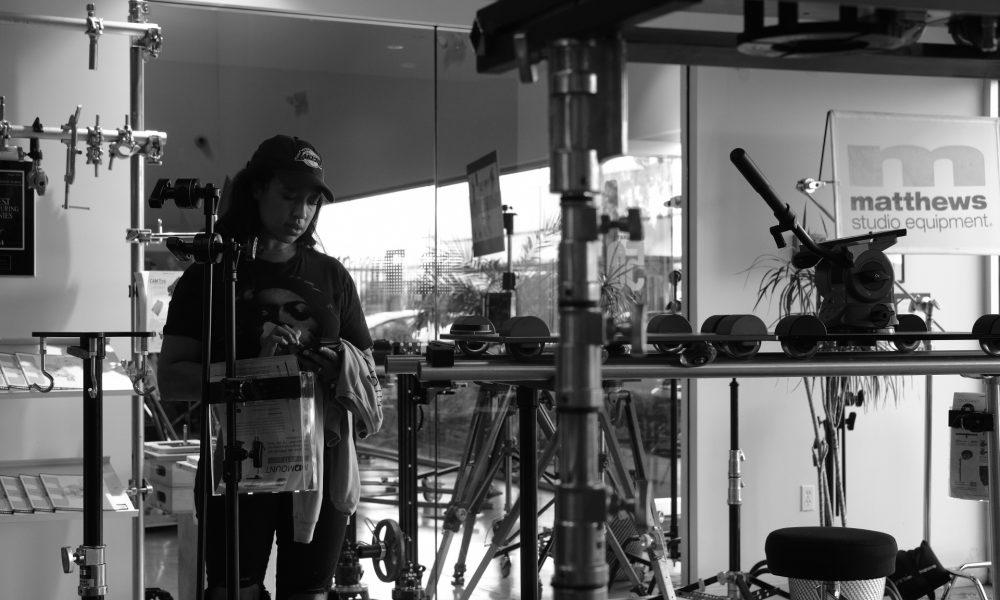
I am a first-gen college graduate turned Ivy League graduate. I’ve spent my entire life in pursuit of education and then how to share that with as many girls as possible. You’ll usually find me early mornings and late evenings. In the lab. Tinkering with equipment. Writing syllabi. Drafting lessons and connecting with Black Women in Film subject matter experts. I’ve been teaching girls film since I was 20 years old.
Founding a nonprofit and building an inclusive curriculum that can be delivered completely online is a big dream.
Keeping it 100% free is an even bigger dream. Our biggest dream? To grow globally and make our film school accessible to Black girls in places like Nigeria and Paris where there are many many girls who are looking for access to a real film education pipeline to become professional filmmakers.
We want to give girls the technical skills and confidence to work above the line and below the line. I personally want to give encouragement to all the founders, educators, advocates, allies, and women making up support systems all over to world to teach our girls.
It seems like an impossible task, an impossible dream and it will be an unimaginable vision for most. Stay the course anyway. Stay consistent and find your tribe. Black girls need everything we’ve got. The filmmakers of tomorrow are ready to begin today. We’re blooming.
Overall, has it been relatively smooth? If not, what were some of the struggles along the way?
Some of the struggles along the way have been:
1. Deciding if BGFS should be Profit vs Non Profit- who pays the cost of Black Girl Film School? Students? Or do we depend on donations to keep our programs completely free of cost since cost could be such a barrier. A nonprofit model means that we can only serve as many learners as we have funds to accommodate. Much of our attention has to be focused to fundraising and that takes us away from program development, education and mentoring.
2. Who do we partner with? How can we partner to support underserved school districts, after school programs and specialized learning initiatives in our communities?
3. Advisory panel of subject matter experts- Finding Black females in film subject matter experts and connecting with them to help inform our methodologies and processes.
4. Battling the misconception that Black girls can’t learn technical below the line positions- Balancing interest with advanced technical training requirements for our demographic that is traditionally represented as not being able to thrive in STEM related film production roles.
5. Developing training that is successful and accessible to the students we serve.
6. Sharing our mission with learners, instructors, stakeholders and executives.
7. Land a sponsor who can support our program slate with equipment, space, and educational/ professional services
Please tell us about Black Girl Film School.
Black Girl Film School is a 501c3 nonprofit education foundation that offers quality online film production programs for females interested in pursuing a career path in TV and film. The goal of our 2020 program development is to introduce learners to non-acting career paths (above the line & below the line) and the skills it takes to work in these roles.
Black Girl Film School is a collection of media experts, filmmakers, screenwriters, cinematographers, executives, producers, directors, teachers, instructional designers, and below the line crew – all with one common goal of increasing the number of Black women department heads in the industry in non acting roles. We work with Black women subject matter experts and use their experiences to shape how we design our programs, courses and teaching methodologies.
The goal of Black Girl Film School’s content development process is to form an expert advisory panel made up of Black women currently working in the industry so that we can keep our finger on the pulse of best practices as we develop programs for our students.
BGFS uses a media platform and an App to deliver remote learning experiences that cover subjects like directing, screenwriting, production design, line producing, cinematography, assistant camera, and DIT. BGFS delivers the instruction and we also train working filmmakers who are local to that specific service area for on the ground support to instruct studio and lab exercises for learners. We’re building a pipeline that will lead to more Black women being hired to lead.
We also design foundational courses like The History of Black Women in Film, Black women TV/film pioneers, Black women producers, and Introduction to the craft of narrative filmmaking, from you guessed it a Black woman subject matter expert.
What sets us apart from others is we place the Black woman in TV/Film expert at the center of the experience or exchange. Even before we knew the impact of COVID-19, we intentionally designed our instructional programs to be delivered completely online in an effort to reach more diverse experts and serve more girls. By making this intentional effort to redesign how Black girls are introduced to filmmaking, Black Girl Film School can help shift the entire lens of how Black girls learn, enter into and eventually matriculate through the television and film industries as experts.
If you had to go back in time and start over, would you have done anything differently?
I think I would have reached out to schools, school districts, libraries and digital labs to connect directly with learners and discover what their needs and interests are in learning film production before I launched my first program.
Contact Info:
- Website: www.blackgirlfilmschool.com
- Phone: 213-304-2744
- Email: [email protected]
- Instagram: Blackgirlfilmschool
- Facebook: facebook.com/blackgirlfilmschool


 Image Credit:
Jayda Imanlihen
Suggest a story: VoyageLA is built on recommendations from the community; it’s how we uncover hidden gems, so if you or someone you know deserves recognition please let us know here.
Popular
-

Maagic Collins on Building a Fearless Publishing Platform for Truth, Advocacy, and Underrepresented Voices
-
Los Angeles Barea on Turning Green Superheroes into a Global Movement for Youth-Led Change
-

Trisha DuVivier on Bridging the Franchisor–Franchisee Divide with Workhero and “Franulate”
-

Portraits of the Valley
-

LA’s Most Inspiring Stories
-
Cedar Boschan on Elevating Black Music Rights and Driving Urgent Conversations Around Credit, Equity, and Artist Protection