


Today we’d like to introduce you to Andrea Chernin.
So, before we jump into specific questions about the business, why don’t you give us some details about you and your story.
I began my career as a fourth grade teacher. Having a class of thirty-four kids, I came across a variety of learners. I became fascinated with tailoring specific creative strategies and techniques to be able to reach all of my students, but I felt that I needed more “tools” to be able to sufficiently address the needs of students with learning differences. I found out about educational therapy, and although leaving the classroom was a difficult decision, I knew that I had to earn my Post-Masters Certificate in Educational Therapy so that I would be able to help my students in a deeper, more impactful way. After completing my post-graduate coursework, I met a fellow educational therapist who took me under her wing. I shadowed her and worked alongside her, preparing to seamlessly take over her practice when she moved to San Diego. Since then, I have been fortunate enough to be working with students in my own private practice in Santa Monica for over ten years.
We’re always bombarded by how great it is to pursue your passion, etc – but we’ve spoken with enough people to know that it’s not always easy. Overall, would you say things have been easy for you?
For the most part, being an educational therapist in private practice has been an incredible journey. Being in private practice, however, can feel somewhat isolating when compared to teaching in a classroom setting, attending staff meetings, and collaborating with other teachers. Luckily, I belong to the Association of Educational Therapists, a professional organization for educational therapists, which offers many opportunities for its members to attend local (and virtual) study groups, conferences, and other networking functions. These events help everyone feel connected and looped in to the latest research. Furthermore, during my years in practice, I have become a working mom to two children, Leo (six) and Rebecca (4). After each child was born, I was back in the office with my students three weeks later trying so hard not to skip a beat with them. I remember feeling torn between needing to be there for my own children and needing to work with my students, but I quickly learned how to achieve an important balance in my home and work life. Just like I teach my students to be kind and patient with themselves, I have had to follow my own advice with a deep love for both my kids at home and for the work that I do with students within my practice.
So, as you know, we’re impressed with Andrea Chernin, Educational Therapist – tell our readers more, for example what you’re most proud of as a company and what sets you apart from others.
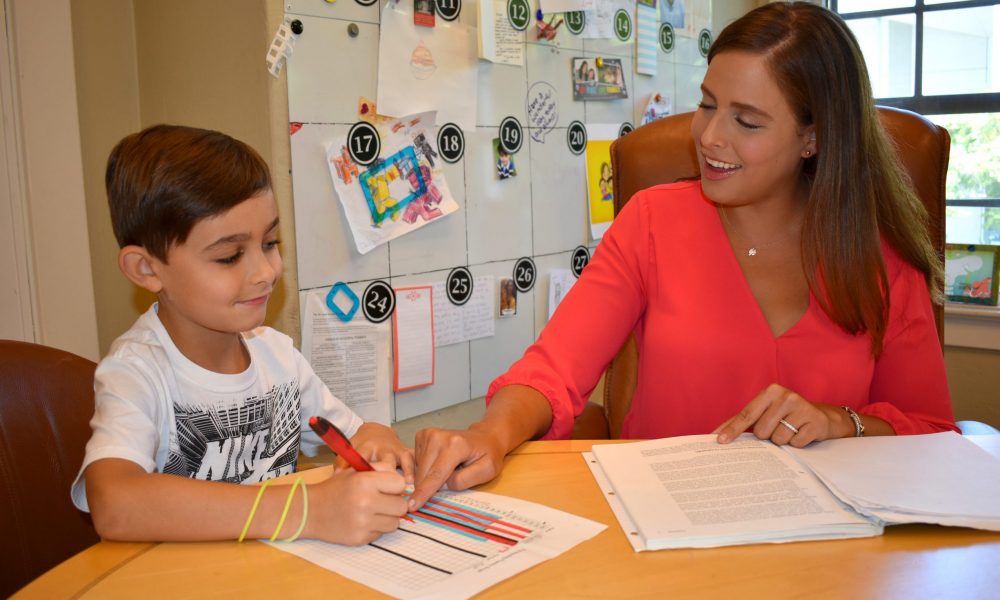
Educational Therapy takes place within specialized, one-on-one sessions that are tailored to meet the specific academic needs of the individual student. Various methods are used to optimize the student’s strengths so that they may subsequently be utilized to fortify his or her weaknesses. Because many students need to have concepts broken down into manageable “chunks,” I approach sessions with methodical organization and structure. Educational therapy also focuses on teaching a student compensatory strategies that provide clarity and thereby allow the student to experience success in the classroom and beyond. In addition to academic remediation and the strengthening of the sub-skills that comprise learning, educational therapy can also improve a student’s underlying processing skills so that learning new material can be facilitated. Many of my students have ADHD, dyslexia, dyscalculia, and other diagnosed learning disabilities, and I also have many students who present with Executive Functioning Disorder, which means that they need to learn certain skills that are imperative for being a successful learner (time management, task initiation, organization of information and materials, etc.), yet these skills may not be taught explicitly in the classroom.
I strongly believe that all children have the innate desire to be successful in school. When a child continues to struggle despite parent-teacher interventions or private academic tutoring, he or she should be evaluated for underlying learning deficits by a licensed neuropsychologist or clinical psychologist who specializes in learning issues. Instead of placing blame on a student for not performing in school, it is imperative that the student is evaluated to discover what is thwarting his or her progress. Unfortunately, children do not “outgrow” learning problems, and it is important to begin intervention as soon as possible to mitigate and potentially prevent self-esteem problems and unnecessary daily stress. I look forward each day to my engaging sessions, led with warmth and a strong desire to help every student I come across reach their psychoeducational goals, bolster one’s self-concept, and become a demystified self-advocate who knows what he or she needs for academic and personal success.
So, what’s next? Any big plans?
In the future, I plan to continue my work with students, perhaps open a second office in the west valley, and someday possibly write a book about tips, tricks, and “life hacks” for those with learning differences and their families who go through so much to provide the best academic experiences for their children.
Contact Info:
- Address: Andrea Chernin, M.Ed., ET/P
Educational Therapist
610 Santa Monica Boulevard
Suite 221
Santa Monica, CA. 90401 - Website: www.educationalcareapist.com
- Phone: 310.458.0373
- Email: [email protected]
- Facebook: www.facebook.com/educationalcareapist
- Yelp: https://yelp.to/qTKq/qTIBUZwM3E


Getting in touch: VoyageLA is built on recommendations from the community; it’s how we uncover hidden gems, so if you know someone who deserves recognition please let us know here.
Popular
-

Maagic Collins on Building a Fearless Publishing Platform for Truth, Advocacy, and Underrepresented Voices
-

Los Angeles Barea on Turning Green Superheroes into a Global Movement for Youth-Led Change
-

Trisha DuVivier on Bridging the Franchisor–Franchisee Divide with Workhero and “Franulate”
-

Portraits of the Valley
-

LA’s Most Inspiring Stories
-

Cedar Boschan on Elevating Black Music Rights and Driving Urgent Conversations Around Credit, Equity, and Artist Protection