




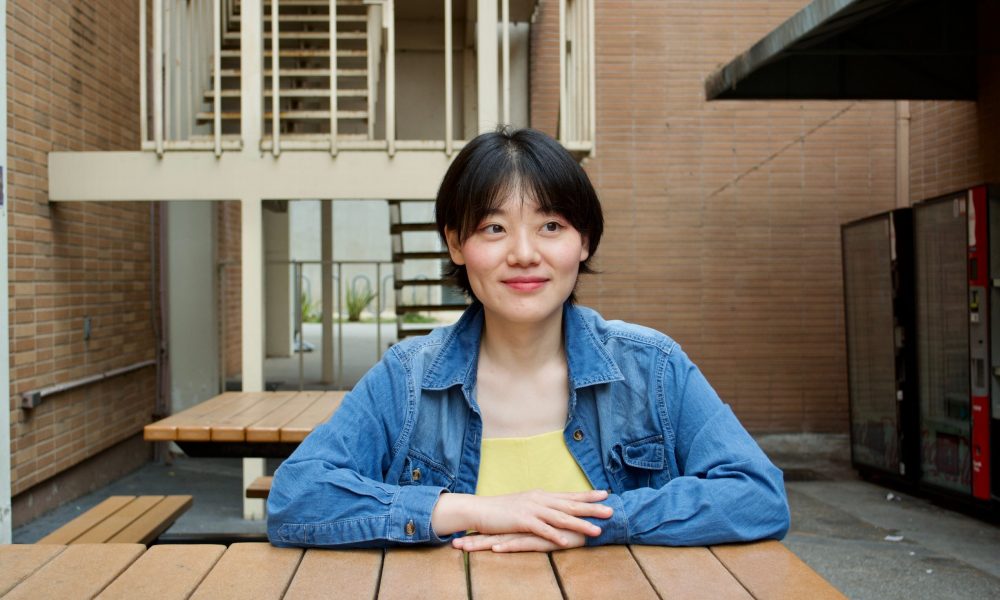
Today we’d like to introduce you to Ziyao Liu.
Hi Ziyao, thanks for sharing your story with us. To start, maybe you can tell our readers some of your backstory.
Transplanted from the “West Virginia” of China, I grew up in a small city known for its coal mining industry and historical remains. I moved to the U.S. from China alone with two suitcases when I was 18. It’s been a decade since, and those suitcases have now ballooned to an accumulation of belongings that fill an entire apartment. I label myself as a filmmaker based on Earth, and the necessity for clarification results from my current tax filing status as a “Resident Alien.” So a lot of my inspiration comes from reflecting upon the drastic changes both my family and the surrounding world have gone through within the past decades, as well as my struggles to ground myself with meaning constantly feeling somewhere placeless, everywhere, and nowhere all at once.
After graduating from the University of Wisconsin-Madison, I moved to Los Angeles to work before I decided to continue my MFA studies at UCLA to further my craft in writing and directing. This turning point resulted from my father passing away in 2018, which led me to reevaluate how I can best embrace the finite nature of life and reflect on what kind of stories I create. Since then, I shifted my focus to explore underrepresented stories with intersected themes of womanhood, immigration, and grief in my work, experimenting with different genres and formats. I just hope to engage my audience with humor and empathy for the collective human experience beyond language and cultural barriers.
Can you talk to us a bit about the challenges and lessons you’ve learned along the way. Looking back would you say it’s been easy or smooth in retrospect?
Filmmaking is a collaborative art, and it’s very much so about problem-solving. You face obstacles and challenges with each new project, but solving these puzzles with a supportive team is part of the process of learning to get better at your craft. You just feel so accomplished once you manage to make something work or simply amazed by movie magic when things work out better than we originally planned. For example, when we panicked so much about losing our original beach location in Long Beach to fake it as a beach in San Francisco for my first feature film, Outbound, my producers and I expanded the search and found a new location with an even better rocky beach with no palm trees in the background. Dealing with uncertainty is definitely a big aspect of the challenges you have to embrace in filmmaking.
I believe that It’s a privilege to make films, and I find myself incredibly fortunate to have the opportunity to create some of the stories I care about deeply with some incredibly talented people. That’s why another aspect of the challenge comes from really knowing your intention behind the story as an anchor point so you can encourage creativity within your team and make better decisions under pressure. Because oftentimes you’ll find yourself being the only person or the few people who know the materials and the bigger picture best, and it can be a challenge to not let the rapidly changing production logistics and chaos distract you from focusing on what the story is about.
But the truth is, the biggest challenge of all is always funding your films. Maybe it’s because we are in Los Angeles, but one thing you get asked a lot is what’s the selling point of the story – as in if it’s a genre film or if it’s about a trendy topic. While I do believe that a film is a film only when it reaches an audience, not when it’s sitting in a hard drive somewhere in a corner, I want to create stories of a personal nature that stay true to what I believe is meaningful, while taking my audience into consideration to meet them halfway. For example. I experimented with my short film, Daisy is Gone, which deals with the themes of grief, a heavy and serious subject for many. To ease the daunting nature of death, I wrote and directed it as an absurdist Sci-Fi comedy instead of a sentimental drama. But in other cases, the stories may not quite meet the “sellable” standards, but I have strong urges to tell the story, so it becomes even more challenging to make the film in a creative way with a limited budget.
Thanks – so what else should our readers know about your work and what you’re currently focused on?
I believe that a film is a mosaic made with time and a medium of shared experience, both of which make it the perfect way to use my own voice to better engage with the world as a visual storyteller. I question through my work what reconnects us when that sense of village is lost in concrete jungles. I find humor in the absurdity of existence in order to generate empathy for the collective human experience beyond language and cultural barriers. As a transplant and a woman of color, I am fascinated by stories that have intersected themes of loss, memory, immigration, and womanhood.
I’m currently working on my first feature film, Outbound, with an amazing editor for post-production. It’s also fiscally sponsored by Film Independent as we also just started our fundraising campaign. The film follows a Chinese marine biologist as she reunites with her mother in the U.S. for a road trip up the Pacific Coast in an attempt to fulfill the dying wish of her father and mend their seemingly irreconcilable gap. Loosely based on a road trip I took with my mom after my father passed away, it’s a story that transcends nationality, borders, and identity. We’d appreciate any support or connections that can help us bring this story to life to reach a wide range of audience.
What quality or characteristic do you feel is most important to your success?
As an artist, I embrace challenges for continuous growth and create opportunities for myself when they are not often given to people like me as a woman of color who transplanted to a foreign land. I dedicated my time at UCLA TFT to hone my craft for both writing compelling narratives and directing actors for natural performances. I gained a deeper appreciation for the power of film as a medium that can captivate and inspire people from different backgrounds. Being able to develop my own projects and work on others’ projects equipped me with invaluable knowledge and understanding of story structure, character development, and more importantly, how to communicate effectively and collaborate with diverse personalities.
Living in the U.S. as an “alien” gave me the advantage of exploring the boundaries between alienation and assimilation across cultures as an international artist. Being bilingual has provided me with a profound appreciation for both cultures, thus allowing me to authentically reflect upon where they intersect and conflict. Such perspective prepared me to create films of a unique voice, revealing contemporary social conflicts in ways that people everywhere can identify with, in hopes that viewers empathize and find comfort that they are not alone in this world.
Contact Info:
- Website: https://ziyaoliu.com
- Instagram: https://www.instagram.com/yaoeeew/


 Image Credits
Merry May Ma, Marnie Salvani, Visual Communications, Posters by Prairie Trivuth
Popular
-

LA’s Most Inspiring Stories
-
Maagic Collins on Building a Fearless Publishing Platform for Truth, Advocacy, and Underrepresented Voices
-
Los Angeles Barea on Turning Green Superheroes into a Global Movement for Youth-Led Change
-

Trisha DuVivier on Bridging the Franchisor–Franchisee Divide with Workhero and “Franulate”
-

Portraits of the Valley
-
Cedar Boschan on Elevating Black Music Rights and Driving Urgent Conversations Around Credit, Equity, and Artist Protection


