





Today we’d like to introduce you to Sherman Wellons.
Hi Sherman, we’re thrilled to have a chance to learn your story today. So, before we get into specifics, maybe you can briefly walk us through how you got to where you are today?
My early years were spent with my nose in a comic book. Both my father and I were passionate about comics and together, we explored the worlds of Spider-Man, Batman, X-Men, IronMan, Hulk, Conan, GhostRider, and Spawn. At the time, I thought I was just lost in a good story, but looking back, I realized it was also my first exposure just how much power images can have.
In 11th grade, I won a scholarship to a summer graphic design program at Carnegie Mellon University. This is when I really came to understand the impact of design – from how color illicits human emotion to how the simple shape of a letter can communicate an entire idea. That exposure to graphic design sealed the deal – the hibernating natural artist finally came to life and I decided to try to be a modern day Donatello.
After high school, I headed for University of Georgia to study graphic design and have never looked back. During junior year, I won a juror’s award in 1997 for a portfolio campaign that promoted the autobiography of rock star Marilyn Manson.
Most of my spare time was spent on Graphic Design Club activities during college. There I explored all the newly emerging multimedia applications, such as Flash, Director, and Quark Express Media. The Graphic Design club was also the perfect way for me to understand some of the more practical aspects of design, like taking a concept and actually producing something from it. I became increasingly focused on multimedia, which ultimately led me to begin an independent study program in animation and motion programming during my last two years.
After graduation from UGA, I served as Media Director for IBM Global Services. This is a period that I consider to be my real-world graduate school. Managing a team of designers, programmers and animators helped me gain a ton of valuable insights on the importance of balancing creativity within technology’s practical limitations. Our team even scored several Telly Awards for our hard work in 1999 and 2002.
IBM also provided an ideal playground for exploring the latest interactive design and programming technologies. Late nights in the office let me get more hands-on experience in Flash, Director, XML, Javascript, Lingo, Actionscript and After Effects.
In 2003, I began freelancing as a Creative Technical Director. I worked at a number of Atlanta agencies, including Avenue A|Razorfish and Moxie Interactive. I also worked in Monterey, California for McGraw-Hill during that time, completing a series of online education applications for use in middle and high school testing and classroom learning.
I think one of the highlights of my career has been working as a designer and developer on a collaborative project between Philips Design and General Motors. Alongside GM’s engineers and Philips Design’s product designers, I used Adobe Flash and Director to inject life into an user dash interface located in a concept car. The resulting interactive module mimicked the user experience of this high-tech car and helped promote the idea that your car can be used to simplify your life.
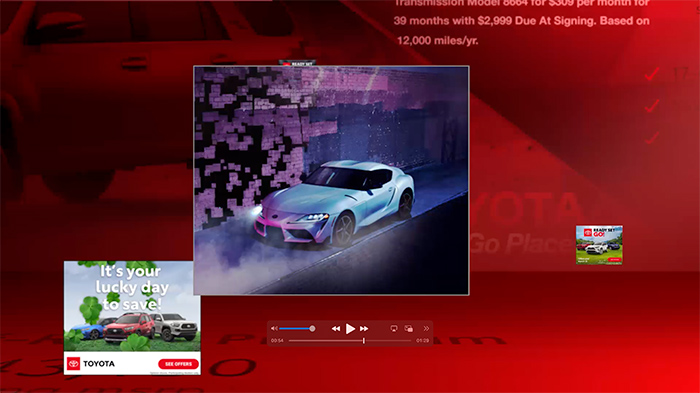
It was in 2003 that I decided to formalize my business: Inertiart Studios. Based in Atlanta, Georgia, I continue to focus on research, design and development to address the practical visual communication challenges for both large clients like Coca-Cola, UPS, Mercedes-Benz, Toyota, AT&T, International Hotel Group, and Verizon, as well as small non-profits and businesses like Georgia.org and the Patriot Museum of Atlanta.
I’m sure it wasn’t obstacle-free, but would you say the journey has been fairly smooth so far?
No road is ever smooth for an artist, and that is part of the journey. Visual communication has shaped human connection since the first cave paintings were discovered in Sulawesi, Indonesia, more than 45,000 years ago. Yet even today, I still find myself explaining what visual communication truly is, why it matters, and how design influences behavior in a world driven by commerce.
I once told a business leader, “I am a graphic designer. I combine art and technology to communicate ideas across digital platforms.” He smiled and said, “Oh, you make pretty pictures.” So I asked what kind of car he drove. He said, “A Range Rover.” Then I asked how he first learned about Range Rovers. He said he saw a commercial and later noticed one on the road. I explained that a designer created the visuals that sparked that emotional connection and influenced his decision to purchase the vehicle. He paused for a moment, nodded slowly, and then understood.
That moment captures one of the biggest challenges of being a visual communicator. Our work speaks directly to the subconscious. People see the outcome but rarely understand the psychology, storytelling, and strategy behind it. Many believe a logo is the brand, when in truth, the logo is only a symbol. The brand is the experience, the emotion, and the perception it creates in the customer’s mind.
I often work with startup companies that struggle to see design as an investment rather than an expense. Competing on price alone is not a sustainable path. Differentiation is the key to growth and longevity. Helping founders understand that takes patience, education, and empathy.
As an independent creative, I also face the challenge of wearing many hats. Balancing the creative process with business development and marketing is not easy. But I continue because the work itself fuels me. Every project, every visual, and every idea I share reinforces one simple truth: design is not decoration. It is communication that creates emotion, inspires action, and builds lasting value.
Appreciate you sharing that. What else should we know about what you do?
I am a creative who loves blending art and technology to tell stories that connect people and ideas. My career began in 2003 as a multimedia designer and independent freelancer. Over the years, I have collaborated with respected agencies in Atlanta, including Avenue A Razorfish and Moxie Interactive, where I contributed to digital work that pushed the boundaries of what design and technology could achieve.
I also partnered with McGraw-Hill on a long-term basis, spending weeks at a time in Monterey, California, to help develop a suite of online learning applications for middle and high school students. That experience strengthened my passion for building digital tools that make complex subjects accessible and engaging, especially in the education space.
One of the most defining moments of my career came when I served as both designer and developer on a collaboration between Philips Design and General Motors. I worked closely with engineers and product designers to create an interactive dashboard prototype for a concept vehicle. Using Adobe Flash (now called Animate) and Director Lingo, our team brought the interface to life, demonstrating how thoughtful design and technology can simplify daily living and create a more intuitive driving experience.
What sets me apart is my ability to think with both sides of my brain. I am as comfortable writing code and building functionality as I am designing visuals and crafting narratives. This combination allows me to bridge creative, production, and development teams, translating ideas into usable, meaningful experiences.
What I am most proud of is my ability to help clients and teams understand that creativity and technology are not separate disciplines. They are partners in problem-solving. Whether it is a digital campaign, a brand story, or an interactive product, I focus on creating work that resonates emotionally and delivers measurable value
In terms of your work and the industry, what are some of the changes you are expecting to see over the next five to ten years?
Here is a clean, modern rewrite in your **Sherman – Efficiency and Process Expert** voice:
—
AI is becoming a standard layer inside the software I use every day to build digital media. Adobe and other platforms are already integrating tools that remove friction, automate repeatable steps, and speed up production. Over time, the same efficiency gains will show up inside advanced 3D applications, taking tedious engineering tasks off the table so creators can focus on the work that actually moves projects forward.
The challenge right now is the narrative being pushed by the tech-bro crowd. They position AI as a replacement for creative people because it can generate impressive visuals, but those visuals rarely function as real production assets. They break the moment a client asks for edits, variations, or versioning. In our world, revisions are not optional. They are the process. And AI is not yet able to hold up under that level of real client workflow.
When the hype cycle cools, what will matter is not replacing people but giving professionals better tools that reduce bottlenecks and make production more efficient. The goal is progress, not building robots that accelerate our extinction.
Contact Info:
- Website: https://inertiart.com
- Instagram: @inertiart_studio
- LinkedIn: https://www.linkedin.com/in/sherman-wellons-40291a4/
- Youtube: https://www.youtube.com/@shermanwellons






Popular
-
Inside the Future of Search: Robb Fahrion on Building a Global Team and Leading the Rise of GEO
-

From Supporting Local Boutiques to Building Brand Partnerships: Cinthia Jensen’s Creative Marketing Journey
-

Building Community Through Curiosity: Nathanial and Samantha Rowe on the Vision Behind UNEARTHED
-

Portraits of the Valley
-

LA’s Most Inspiring Stories
-

Building Creative Bridges: Torrey Tayenaka on Community, Collaboration, and the Future of Sparkhouse


