




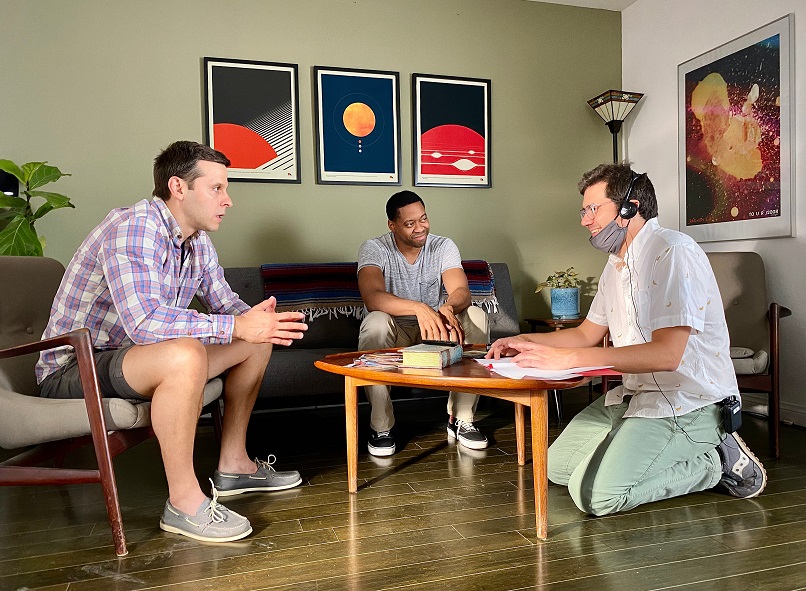
Today we’d like to introduce you to Matthew Mullen.
Matthew, we appreciate you taking the time to share your story with us today. Where does your story begin?
I moved from New Jersey after college (Rutgers) wanting to be a screenwriter and/or filmmaker. I ended up in San Francisco for a few years where I met my current writing/creative/business partner Micah Cohen and I edited a feature he had wrote and acted in. We both moved to LA and stayed friends but weren’t working together. In 2008 I had my first short script made for real (as in, not me alone as the crew and my friends as the cast). That was “Some Boys Don’t Leave” made through AFI’s Directing Workshop for Women, directed by Maggie Kiley and starring Jesse Eisenberg. I moved back to the east coast for a few years, then came back to LA in 2013. Micah and I were talking in a bar one night and unexpectedly outlined the first thing we would make together a spec pilot about commercial actors called “:30 Second Somebodies”. That lead to us getting representation and pitching to networks for the first time. We followed that up with a web series called “New Mommies” inspired by our lives as “single with furbabies”. We started our production company Baby Bird Worldwide for this project and have now produced five more :30 Second Somebodies episodes, four short films, and have another short and spec pilot in pre-production. We continue to write feature and TV pilot scripts together and plan to make a feature film based off of one of our shorts in 2022.
Can you talk to us a bit about the challenges and lessons you’ve learned along the way. Looking back would you say it’s been easy or smooth in retrospect?
Our biggest struggle has been getting noticed. Our first pilot :30 Second Somebodies screened at Seriesfest (a great TV pilot festival), which lead to us getting a selling agent and pitching it to networks. New Mommies led us to getting a manager at Untitled, which was a huge step for us, but nothing came from it. Since then, we’ve been producing short films to get someone to notice we create high-quality, funny content – which will hopefully lead to someone wanting to make one of our features or shows.
Appreciate you sharing that. What else should we know about what you do?
For writing, we do comedies that we shoot and have acted like dramas (so never playing anything for laughs). We’re often told they’re funnier on second viewing – which is my favorite compliment to get but doesn’t always translate well commercially in a low attention span world.
The most important thing to us to telling the truth – that meaning the audience must believe what they’re seeing on screen is could be happening to a real person and isn’t forced conflict (either comedic or dramatic).
We haven’t yet been able to film the scripts we’re most proud of, but if I had to share one thing it would be the last episode of “New Mommies” we made; it’s a great example of our comedy style and it allowed me to write and direct a scene where a guy meows a Whitney Houston song to his date.
On the side, I do video art; running old camcorders through old televisions (with tubes), photographing the feedback that is created and often compositing a few images together. I discovered the process by accident in college (2000) and forgot about it. Then one night in 2008, I was bored at home and started playing around with the process, this time adding mirrors and Monopoly houses (see the image “Tuscon”). Since then, I’ve tried more mirrors, shooting through water and materials of different opacities. It’s great having a completely different creative outlet from writing and one I really just do for myself. I’m when I’m spinning my wheels on a writing project, it allows me to get my head out of it while still being creative. Lately, I’ve been updating the images now that I know a little bit more about Photoshop for the composite images – and getting an actual website up for all my work in this medium (www.sufico.net)
What has been the most important lesson you’ve learned along your journey?
1. You’ve got to do the work – only a tiny fraction of your work ends up on the page or screen or canvas; most of the work is behind the scenes, either trial and error or freewriting about your characters live so you can find their voice, or the nine bad ideas it took to find the good one, and then
2. You got to trust your stuff. It’s a phrase I hear in baseball, but for art, for me, it translates to trusting that you may be telling a story that been told many times, but you have to believe (if you’ve done the work) that your way of telling it will be unique and entertaining.
So, do the work and trust your stuff.
Contact Info:
- Website: www.babybirdww.com
- Instagram: https://www.instagram.com/sufico_art


Image Credits:
“Matt directing Jackson & Micah”, “Matt directing BP_2”, “Matt directing BP_3” by Brett Baldridge, remaining photos by Matthew Mullen
Popular
-

LA’s Most Inspiring Stories
-
Maagic Collins on Building a Fearless Publishing Platform for Truth, Advocacy, and Underrepresented Voices
-
Los Angeles Barea on Turning Green Superheroes into a Global Movement for Youth-Led Change
-

Trisha DuVivier on Bridging the Franchisor–Franchisee Divide with Workhero and “Franulate”
-

Portraits of the Valley
-
Cedar Boschan on Elevating Black Music Rights and Driving Urgent Conversations Around Credit, Equity, and Artist Protection


