


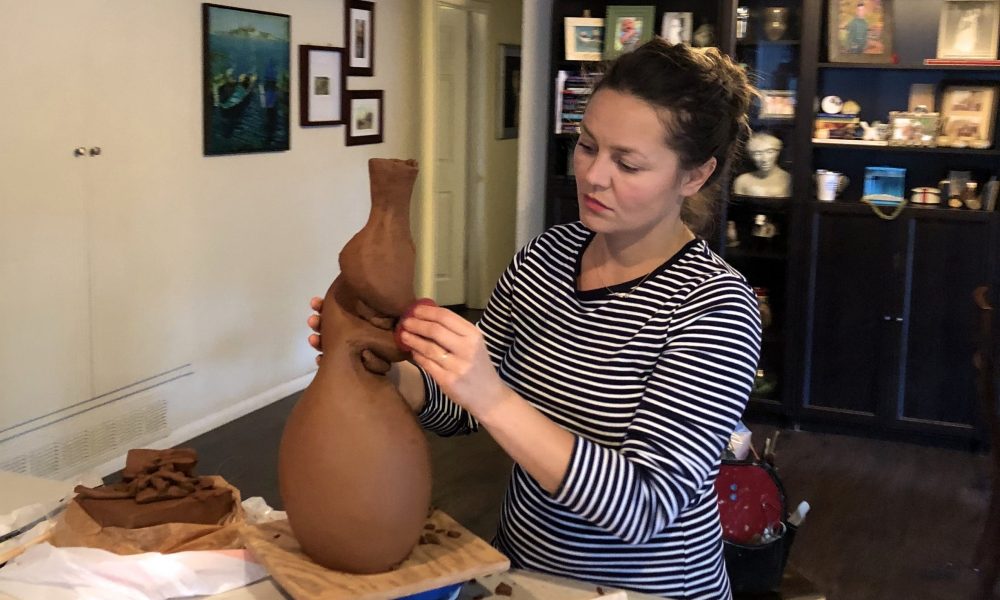
Today we’d like to introduce you to Alina Hayes.
Alina, please kick things off for us by telling us about yourself and your journey so far.
Are you sure? Well Ok, you asked.
My family and I emigrated from Kharkov, Ukraine, which was a part of the former Soviet Union at the time. I grew up in a Russian neighborhood of Brighton Beach in Brooklyn and attended an all-girl Catholic school. Being an only Russian kid in a sea of Italian and Irish American girls had its challenges. I was very self-conscious of my accent, which I shed as quickly as possible. My mother was a single parent and couldn’t really advise me on the college application process. Having very little guidance, I brought my 20-slide art portfolio to an interview and was accepted into School of Visual Arts in 1997. In the second year, my loans fell through, and I used it as an excuse to take a leave of absence only not to return. In reality, I was so overwhelmed by the amount of talent at SVA. I felt that my work could never compete. In 2005, freshly married, I attained my dream of moving to Los Angeles. Looking for a creative outlet, I took a wheel-throwing class at a local Community Art Center. Clay spoke to me like no other medium, and I knew that this was the career path for me. Returning to college as an adult with a family only pushed me to work harder. With blinders on and much determination, I completed my degrees at California State University, Northridge. Studying with Professor Patsy Cox allowed me to see how a professor’s dedication motivates and challenges her students, bringing out their best work. I am now able to pay it forward as a Ceramics Professor at Ventura Community College.
Can you give our readers some background on your art?
In my daily studio practice, my work moves between form and function as I think about the fluidity of materials, process and time. Evoking Marguerite Wildenhain, a female potter from the 1950s, who aptly described in Jenni Sorkin’s book titled Live Form: Women, Ceramics, and Community the beauty of “live form” as I shape clay from the inside and out — drawing on parallels between ceramic processes and my own life as an immigrant, a woman, wife, mother, and educator. My obsession with succeeding, of becoming something of value, and the realization of the direct connection as I sit and shape small, highly crafted clay objects, fragile yet resilient to time and change in hopes that the shiny exterior will prevent them from being thrown away. Discarded as remnants of their maker.
I use white gold luster, asking the viewer and user to take a moment to be present. With digital images all around us, it is easy to get lost. These objects, ask us to acknowledge our existence in one place, at one time. The size reflects an individual, and the use of the luster reinforces the preciousness of time and the value of the reflection. The act of sitting down and enjoying a cup of tea further reinforces the idea of slowing down.
What responsibility, if any, do you think artists have to use their art to help alleviate problems faced by others? Has your art been affected by issues you’ve concerned about?
I am a woman and an immigrant. I can personally relate to a lot of the current events happening in our country and internationally. I am also a mom, who is concerned for the well-being and success of her son. I feel a tremendous love for our country and feel extremely lucky to be an American despite the politics. I feel that the world is already doing a pretty great job at dividing us, so in my work, I aim to connect us as a people. With the aid of familiar metaphors, language, and visual abstraction, I aim to connect individuals by expressing certain universal truths, serving as a reminder of a common human condition shared by all in today’s divisive climate. Wheel-thrown sections combined and blended together as part of the whole. With the aid of lusters, I aim to draw attention to the small and the intimate, creating a pause in the viewers’ stride. Functional objects further invite interaction. My art history professor Mario Ontiveros used to say that if people were treated the way objects are treated in a museum; it would be a very different world. I don’t think the role of the artists has changed. I believe that the role of the artists always was and continues to be one of the cultural producers. As a professor in a community college, I am lucky to have a wonderfully diverse population of students in my class. I make sure that my lectures reflect this including a diverse group of contemporary ceramic artists like Roberto Lugo, Steven Lee, Kevin Snipes, and Zemer Peled who are successfully working in the field of ceramics today.
What’s the best way for someone to check out your work and provide support?
I maintain an active presence on Instagram @alinahayes, where you can view photos and videos of in-process as well as finished work. Some of my work can be purchased at American Museum of Ceramic Art (AMOCA) in Pomona, CA, as well as on my website www.alinahayes.com. Inquiries about larger sculptural work can also be directed to my website.
Contact Info:
- Website: www.alinahayes.com
- Email: alinahayes@yahoo.com
- Instagram: https://www.instagram.com/alinahayes/?hl=en
- Facebook: https://www.facebook.com/Alina-Hayes-Ceramics-205999672250/?eid=ARAI1LxJIax2uHz4DnABQb9gt76ZV2AFDxIuwRmqw6J3wUTI-VxytWsZ2glkaZAGEnOHe-2jt31lrnCv


 Image Credit:
Alexandra Papoban, Peter Hayes
Getting in touch: VoyageLA is built on recommendations from the community; it’s how we uncover hidden gems, so if you know someone who deserves recognition please let us know here.
Popular
-

Portraits of the Valley
-

LA’s Most Inspiring Stories
-
Maagic Collins on Building a Fearless Publishing Platform for Truth, Advocacy, and Underrepresented Voices
-
Los Angeles Barea on Turning Green Superheroes into a Global Movement for Youth-Led Change
-

Trisha DuVivier on Bridging the Franchisor–Franchisee Divide with Workhero and “Franulate”
-
Cedar Boschan on Elevating Black Music Rights and Driving Urgent Conversations Around Credit, Equity, and Artist Protection