




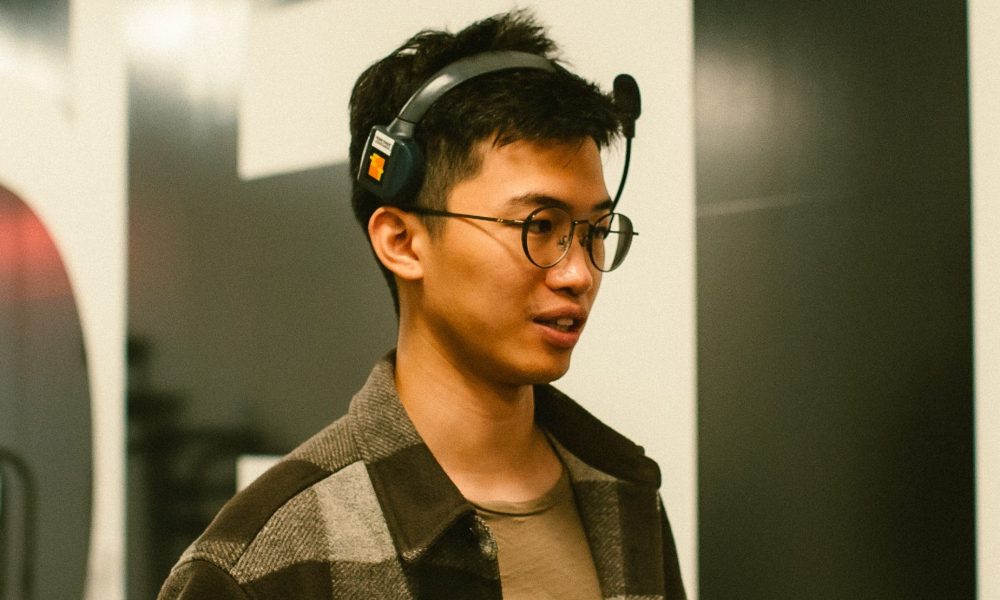
Today we’d like to introduce you to Xingyu Chen.
Hi Xingyu, so excited to have you with us today. What can you tell us about your story?
To be honest, my journey into the world of filmmaking and directing wasn’t initially part of my plan. I was born and raised in Beijing, China, where music, rather than film, played a significant role in my childhood. My path began with joining the elementary school choir in the first grade, setting the stage for more than a decade of invaluable choir & acappella singing experiences. Both my elementary and middle/high school choirs were among the best in Beijing. We would perform at some of the most prestigious venues in Beijing like the National Centre for the Performing Arts, compete in the highest level of group and win first place, etc. Singing became an indispensable part of me, which is why I was pretty determined when I came to the US for my sophomore year of high school that I would do something related to music in the future. Indeed, it evolved into my “special talent,” allowing me to surprise audiences on various stages during talent shows and singing competitions throughout my high school and college years. However, over the years, it eventually became evident that both my parents and I shared a mutual understanding: I needed to direct my focus towards a more “concrete” career path for my future, especially since I don’t make my own original music.
My U.S. high school was a small boarding institution nestled in the mountains of New Hampshire. The combination of the occasional boredom I experienced in school and the lengthy flights between the U.S. and China somehow ignited two passions within me: electronic (dance) music and films. The former propelled me into the vibrant world and subgenres of electronic music, plus tons of music festivals, continually shaping and expanding my music taste. The latter would pave the way for my career, albeit after several years of exploration. Horror films, in particular, sowed the seeds of fascination in me, as there’s nothing quite like watching horror movies with a group of friends during those long winter nights in New England. I could hardly say at that point that I would make films in the future, but it certainly gave me the possibility of what I would love to do in the future. In my senior year, I was accepted into the film and digital media program at UC Santa Cruz, a moment when I decided to venture to the West Coast for a taste of a “different kind of America.”
During my time at UCSC, my studies primarily centered around film theories and studies, along with some digital media coursework. The breathtaking landscape of Santa Cruz lured me into the world of photography by picking up my first camera, which, over the years, has evolved into a substantial component of my side gig. For moving images, however, it wasn’t until my third year that I had the opportunity to dive into film production. It was in one of these classes that I created my first no-budget horror short film, “Snap,” drawing inspiration from my childhood memories. Despite being very cheaply made and lacking in production quality, it brought genuine delight to my heart to hear the screams of both my classmates and professors, knowing that it had struck a chord with them. As I delved deeper into filmmaking, it became evident that I yearned for a more comprehensive and focused education in film production and narrative storytelling. Simultaneously, I was on a quest to find my unique voice and the stories I wanted to tell. In the fall of 2019, I decided to take a bold step and applied to five graduate schools in Los Angeles. Eventually, amidst the backdrop of an unprecedented pandemic of March 2020, I received an offer from Loyola Marymount University’s MFA Film Production program. With graduation just a few months away and facing the uncertainty of the lockdown, the choice to remain in the United States and relocate to LA appeared as the most sensible path forward. In August 2020, I made the move to LA.
My three years at LMU marked a pivotal turning point in my career. It was a bittersweet journey, with the pandemic causing nearly our entire first year to be adapted to online and hybrid classes, which inevitably means making films at home. On the flip side, this period allowed me the time to immerse myself in my craft and create the films I had always dreamed of making. In the fall season of 2021, I finally brought my vision to life by filming my first “proper” short film during the program — a 10-minute body horror/dark comedy titled “Attached”, which talks about a college student struggling with a horrific side-effect of his cell-phone obsession while taking his final exam that he cannot risk failing. The film received accolades from Academy-Award qualifying film festivals like Urbanworld Film Festival and Rhode Island International Film Festival and was eventually released on Omeleto this year. This marks the first time my work has been recognized nationwide, and I’m extremely grateful for all my cohorts, friends, and professors I have met along the journey.
As of now, I’ve successfully completed my thesis film and graduated from LMU with my Master’s Degree. My directing journey has temporarily paused as I focus on developing my first feature script, as well as shifting my attention to a series of freelance roles in editing, color grading, and behind-the-scenes photography in order to feed myself. The film industry presents new challenges with the arrival of AI and unfair wages. The ongoing strike by writers and actors has also it more difficult than ever to secure employment. This situation has prompted me, as an international student, to reconsider my position, especially when I’m permitted to engage only in film-related work under my current student OPT 1-year work visa. Drawing upon my years of accumulated post-production experience, especially in color science and color correction, I aspire to become a well-rounded director/colorist in the future. While it may appear to be an unconventional combination, as color grading is highly technical and distinct from directing, my passion for color grading is as strong as my enthusiasm for creating films as a writer-director. In the short term, my goal is to accumulate more credits and achievements to support my proper work visa application next year. Ultimately, I aim to finish and refine my first feature script with the hope of seeing it produced. That’s the plan!
We all face challenges, but looking back would you describe it as a relatively smooth road?
While it’s not hard to dive into the world of filmmaking and get started, maintaining a consistent presence at the professional level and securing continuous work in Los Angeles is undeniably demanding. I touched on some of these challenges in the previous section, particularly my experiences as an international student striving to secure film-related gigs and cover my living expenses. In reality, financial struggles are a shared experience for many within the film industry, if not the majority. For crew members, for example, the challenges include enduring long 12-hour workdays, facing the uncertainty of freelance hires, and dealing with fluctuating pay rates. These obstacles are particularly pronounced if you haven’t yet made it into the unions, which demands a substantial accumulation of work hours and reporting. The financial problem also exists in productions, especially for smaller non-studio indie films. I remember when making my MFA thesis film “Flatuence: The Origin” last December, we had a regional power outage on day 2. While the unpredictability of filmmaking does lead to all kinds of incidents every day on set, this one is particularly catastrophic as the location is on the second floor of a sealed office building, and we can’t use any generators even if we rented any. We had to cancel our day after a series of attempts to continue production, resulting in losing a full production day thousands of dollars… and I had to start a crowdfunding for my pick-up shoot this spring.
So yes, although I’ve encountered challenges related to my craft and workload, such as managing my schedule and overcoming my procrastination to get things done in between freelance work, my primary struggle at the moment revolves around the age-old problem — making money! I was fortunate to have my parents in Beijing, who supported me both financially and emotionally throughout my college years as an international student. However, after graduation, and especially in the current global economic climate, financial stability has proven to be quite a challenge, not to mention it’s in LA, where everything is pretty expensive. To sum it up, filmmaking is quite a rollercoaster, filled with highs and lows. So, if you’re reading this, hold on tight and cherish your film friends — they’re the unsung heroes of this wild ride!
Appreciate you sharing that. As a director/colorist, what else should we know about what you do? What sets you apart from others?
Yes! In my roles as a film or creative director on set, I view myself as the linchpin or anchor that connects various departments instead of just simply working with actors (which is equally important!). Filmmaking is inherently collaborative. Although in theory a director would usually have creative control over everything you see and hear on the screen, it’s impossible for a director to handle every aspect of the production. Effective pre-production preparation is crucial, and it involves placing trust in department heads, actors, and the entire crew. Therefore, it naturally becomes the director’s job to create an environment where people from different departments can do their best work harmoniously. This will allow me to better articulate my “vision”, and the key is always communication. I wouldn’t necessarily say there’s something that uniquely “sets me apart” from other directors, as each director brings their own strengths and areas of expertise to the table. In my case, I tend to place a strong emphasis on cinematography and post-production, including the feasibility of editing, color, and sound design – These are domains I’m intimately familiar with and passionate about, and I thrive when I have greater control in these areas. On the flip side, some of my colleagues may come from backgrounds like production design or costume design, and they might channel their focus accordingly.
When I’m working as a colorist, communication is also key. As a colorist, I collaborate closely with the Director of Photography (DP) and the director to achieve the desired look of the film. There are usually lots of nuances to be aware of, such as monitor calibration, understanding color spaces and color science, color management when grading in general, and handling tasks like conforming and final delivery, etc. At the end of the day, however, it’s all about working with other people collaboratively to achieve something beautiful together!
We love surprises, fun facts and unexpected stories. Is there something you can share that might surprise us?
I have a pet chinchilla! They truly have the softest and densest fur on the land.
Contact Info:
- Website: xingyu-chen.com
- Instagram: https://www.instagram.com/stareo.xy
- Linkedin: https://www.linkedin.com/in/xingyu-chen-harry/
- Other: My colorist reel on Vimeo: https://vimeo.com/811185455/48bc4dcdc0?share=copy


 Image Credits
Po Wei Su, Mingyang Li, Film Poster for “Attached” (designed by myself), Film Still from “Flatulence: The Origin”
Popular
-

Maagic Collins on Building a Fearless Publishing Platform for Truth, Advocacy, and Underrepresented Voices
-

Los Angeles Barea on Turning Green Superheroes into a Global Movement for Youth-Led Change
-

Trisha DuVivier on Bridging the Franchisor–Franchisee Divide with Workhero and “Franulate”
-

Portraits of the Valley
-

LA’s Most Inspiring Stories
-
Cedar Boschan on Elevating Black Music Rights and Driving Urgent Conversations Around Credit, Equity, and Artist Protection


