




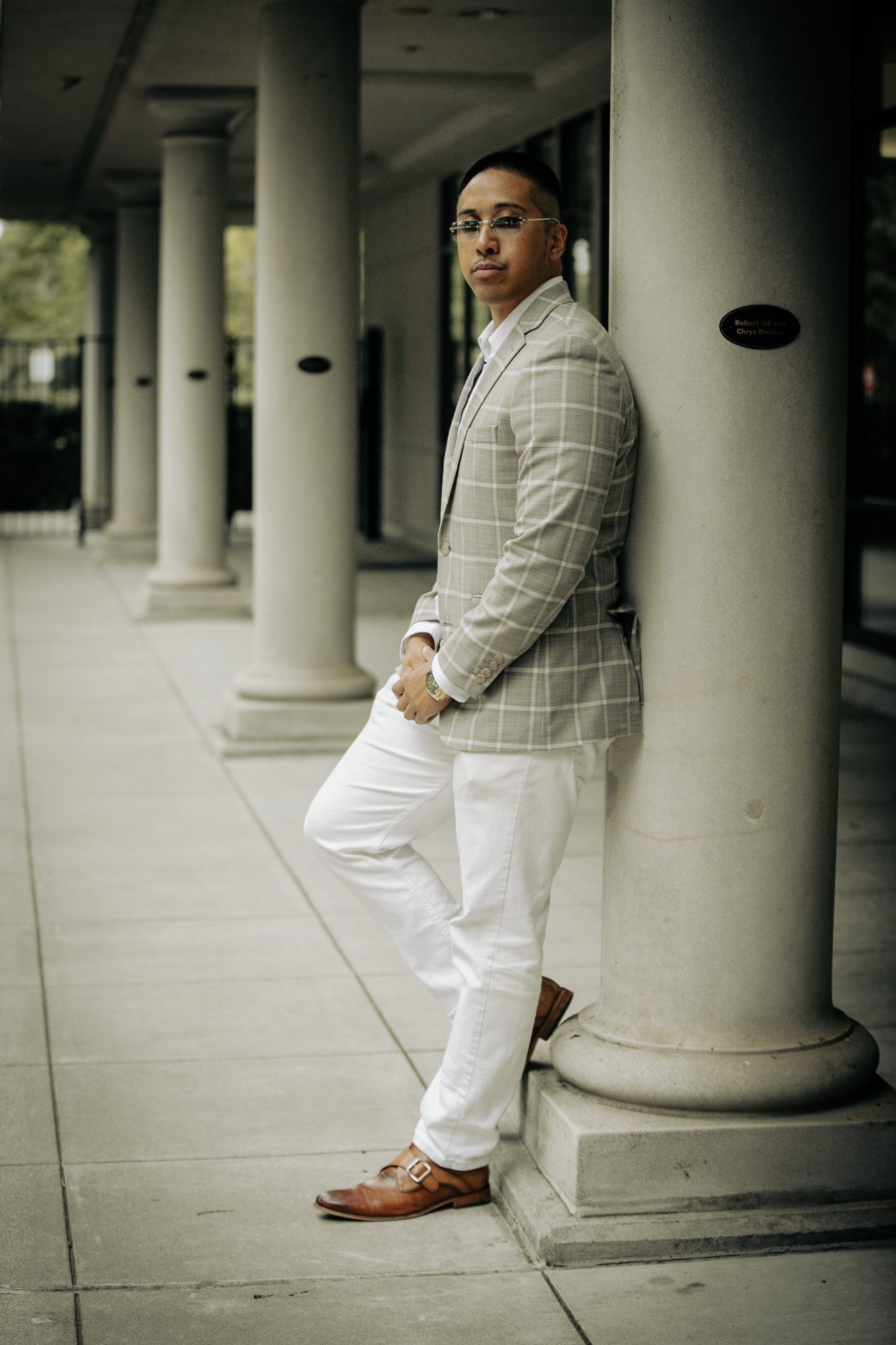
Today we’d like to introduce you to Bernard Reyes.
Hi Bernard, can you start by introducing yourself? We’d love to learn more about how you got to where you are today?
I pride myself as a “first-generation everything.” I’m a first-generation college student, first-generation American, and the first in my family to open a business (nonprofit). Basically, anything that I decide to do, I’ll be the first in my family to do it. So I had to navigate all these spaces through constant trial and error, even until this day. As with many parents who have originated from outside of the United States, my Filipino parents were no different in emphasizing the importance of education and graduating from college. I was born and raised in the Bay Area in Daly City, CA, a neighboring city of San Francisco often referred to as “Fog Town” and “Little Manila” given its high concentration of Filipino residences in the area. Sounds fitting for my family to touch down there, right?
Fast forward to a few years later, I moved to Sacramento where I attended Sacramento State and eventually got my Bachelor’s Degree in Psychology and Master’s in Curriculum & Instruction. And recently, I moved here in Los Angeles in 2019 to pursue my Ph.D. in Higher Education and Organizational Change at UCLA, where I also earned my Master’s Degree in Education in 2020 en route to my doctorate. It’s weird that I ended up in the field of Higher Education. Typically when you hear about someone getting their Ph.D., you would usually think of the hard sciences like biology or engineering. But it all goes full circle back to me being a first-generation college student. One of my first jobs ended up being at Sacramento State, working in the Educational Opportunity Program with low-income, first-generation students of color; students who reminded me of myself. Slowly, my passion for serving these students increasingly grew throughout the years I worked there. And eventually, I moved up to being a full-time counselor and program coordinator at Sacramento State. But I felt I could always do more. And that’s when I decided to pursue a Ph.D. in this field.
A common question people ask me is, “What do you plan to do after you graduate? Do you plan on being a professor?” And my answer to that question is that I’d like to primarily focus on doing research. Research in my field doesn’t involve a specimen under a microscope, so people usually put me through a game of 21 questions when they ask me about my research. Research in my field, and in the social sciences in general, involves studying human behaviors for the purpose of diagnosing and addressing important social issues. In my case, I am interested in researching social mobility and the racial wealth gap of college graduates, which I am actively doing through my dissertation. As someone who’s worked at a university, I found that we are often presented with the issue of “closing the gap” of graduation rates, where we would push for our Black and Brown students to graduate in a “timely manner.” But I personally find this problematic. The biggest issue I find here is that regardless of the amount of time someone graduates, the predicated salary and wealth trajectories will still be the same. Our Black and Brown students still lag behind their white and Asian counterparts socioeconomically even when you account for a college degree. And contrary to what many people out there might think, it has more to do with inequities in our social structures rather than particular groups lagging in effort or some other stereotypical deficiency.
So fast forward, this led me to starting my nonprofit, HigherRoots Socioeconomic Solutions, where I plan to continue my dissertation research and push for the proliferation of paid college internships to aid in increasing wages for our students of color. I also recently started a podcast with two close friends of mine, Elliot Woods (UCLA Masters of Public Policy student) and Dr. Brandon Harris (USC and CSU Fullerton Professor), called G’d Up and Degree’d Up University, where the “G” stands for graduate. The two projects are actually very much related. While HigherRoots is focused on college students’ socioeconomic outcomes after college, G’d Up and Degree’d Up University is focused on highlighting similar student populations, particularly focusing on the success stories of nontraditional college students. The name is based off of a song by Long Beach West Coast Hip Hop group Tha Eastsidaz (headlined by Snoop Dogg), who had a song called “G’d Up.” So the name of the podcast was a way to bridge the two worlds of being “gangsta” and being a college “graduate.” So there is a hip-hop subtheme to the podcast where I recently started a project called “Gz on Beatz” where our guests, primarily comprised of college students and graduates, step into the booth and spit their best rhymes. Think of it as a way to help increase the reach of aspiring artists but also changing the simultaneous stigmas of coming from nontraditional backgrounds and the “uncoolness” of attending college. They are not mutually exclusive and our platform is the space to be both. It was also fitting that we did this as a part of our continuing celebration of the 50 years of hip hop.
Alright, so let’s dig a little deeper into the story – has it been an easy path overall and if not, what were the challenges you’ve had to overcome?
Hmm, where do I start? We actually moved to Sacramento because we couldn’t afford the apartment we were living in in Daly City. Trust me, you wouldn’t have wanted to live there. So we bought our first home in Sacramento. But that would be short-lived after we discovered that my father wasn’t faithful to my mother over the course of their 27-year marriage. He would eventually leave us and initiate the divorce (and add some chaotic family dynamics on top of that). So we lost our home and I lost my car. My mother and I would eventually move to four different residences before I left to move to Los Angeles. It’s so frustrating, and many family and friends until this day, didn’t expect my mother and I to do as well as we are today. It’s truly a blessing.
Growing up in the Bay Area, my dream school was always Stanford University. But the misinformation about the weight of standardized test scores kept me from applying. I was concerned about being able to afford to go there and live away from home. So I ended up only applying to one college, which was Sacramento State. I was so happy when I got my acceptance letter. So I attended Sacramento State for two semesters before I dropped out to attend American River College. This decision was motivated by my pursuit to run track again, which I briefly did in my senior year in high school. The decision didn’t yield much success on the track, where because of my good grades, I was under the impression that I can transfer to another four-year college to compete there. But this was when I learned the hard way to rely on your own gut and decisions. Because of this, it ended up taking me seven years to graduate with my Bachelor’s degree from Sacramento State. After three years at American River College and hoping to hear about transferring to another college, I eventually made the decision to transfer back to Sacramento State.
So while still healing from the wounds of the divorce, I had to act quickly to help with my mother’s and my finances by finding a job. After almost two years of actively seeking employment and over 100 job applications, I eventually found my way into working at EOP at Sacramento State.
Applying to UCLA wasn’t easy either. I applied in 2018 with my primary focus on making it to Stanford’s Ph.D. program in Higher Education. I applied to six top-ranked universities that year, one of which included UCLA. I didn’t get into either, but did get accepted to an institution that was out-of-state. I couldn’t picture myself there. For those who have been through the grad school application grind, one of the gold standards of getting into a top-ranked graduate program at that time was scoring high on the Graduate Record Examination (GRE). The test wasn’t exactly cheap, which I had to retake three times just to raise my scores in hopes of increasing my chances of acceptance. Paying for the test and for all the test prep didn’t pay off (though it boosted my confidence when I consistently scored among the top with my writing scores). So I decided to apply one more time the next year, using the best scores I had from the three test attempts. I was so happy when I was offered an interview at Stanford, but seeing “Thank you for applying” as the first words of the next email from them was crushing. Fortunately, I heard back from UCLA. That changed everything and was probably one of the best things to ever happen in my life. Not to mention that UCLA’s grad program was the top in the nation at that time, so it only helped to know that my program outranked a university that rejected me twice.
Thanks for sharing that. So, maybe next you can tell us a bit more about your work?
Being able to step away from the 9-5 mindset has allowed to me pursue my interests and goals on my own terms. I have over five years of experience working in higher education. So I’m still new, but it doesn’t take any more time to figure out that higher education is a business and that business decisions are what drive each college and university. That’s what pushed me to start HigherRoots, even though I still don’t know what the hell I’m doing. And I think that’s exactly what keeps me on my toes and what constantly keeps me being creative. So I intend for HigherRoots to optimize how college and universities spend their money when it comes to maximizing its services to its students, particularly when it comes to the job market. There are creative ways I plan to use my research in advocating for policies that draw resources to make paid internships a more normalized thing in higher education.
I think overall, people who have known me in Sacramento just know that I love serving the community and connecting the dots, especially when it comes to utilizing my existing resources that aren’t typically shared outside of a college or university. I did a lot of networking and projects with small business owners of color in Sacramento, which eventually led to these same small businesses being able to use our space on Sacramento State’s campus to sell their products and services while expanding their clientele. It was also great to see some unintended outcomes; many of these small business owners were also invited to be mentors and speakers on campus. And that is why I love the power of representation. It’s not a silver bullet to all of our social problems, but it’s still a game-changer nonetheless.
So I also think my passion and ability to make connections is what sets me apart. Whether it’s making connections between people, organizations, or ideas, I’m always thinking of ways to make sure that everybody at the table has something to benefit from. So hopefully in the coming months, we will all get to see the full impact of HigherRoots and G’d Up and Degree’d Up University in changing the landscape of higher education and the communities and businesses that surround each college and university.
Networking and finding a mentor can have such a positive impact on one’s life and career. Any advice?
From personal experience and in working heavily with data and statistics, I can say that life is a numbers game. The more people you meet, the more likely you are able to find a mentor. But you also have to take note of when and where you look and what your general success rates are in those environments. Maybe you’ve tried reaching out to several faculty members on your campus but still haven’t received any responses back. So ask yourself, have I tried reaching out to them in person? In the instance of faculty members, there is no time when there are not busy, especially for those who are tenure track. If you are someone who is applying to grad school, one of your best bets would be to attend national conferences in your field (if you can afford them). One way to address registration and travel and lodging costs is to see if your employer is willing to fund you for professional development. That was something I was able to do in 2018 when my job was able to fund my expenses to attend the national conference for the Association for the Study of Higher Education.
But also remember that you are not bound by your limitations. The world is your oyster. If you don’t have the resources to attend national conferences (which are not cheap), there is power in networking. So get to know people in general because you never know who knows who. But to be more intentional, take some time to research who might know the mentors you’d like to reach out to. If you’re trying to reach out to a faculty member, maybe reaching out to one of their current advisees would yield a more favorable response. And that’s the general advice I like to give others: find a middle person to introduce you to the person you’d like to meet. People are more receptive to people they know. So sometimes it’s better to have a mutual contact connect you and your mentor (or anyone for that matter) than it is to directly reach out to them. So try it. Think of it as having a wingman/wingwoman. Don’t let your ego hold you back; we could all use them!
Contact Info:
- Website: www.higherroots.org
- Instagram: www.instagram.com/gdup.university
- Linkedin: https://www.linkedin.com/in/bernard-reyes/
- Youtube: https://youtube.com/@gdup.university/
- Other: https://linktr.ee/gdup.university


 Image Credits
Fowler Photography (www.instagram.com/fowlerphotography831)
Popular
-

Robin Olive on Building an Inclusive Performing Arts Movement and Expanding Opportunities for Every Student
-

Portraits of the Valley
-

LA’s Most Inspiring Stories
-

Que Johnson on Building Brands That Last: From Visibility to True Market Authority
-

Christina Wren Steps Into the Director’s Chair to Tell Stories That Feel Like Home
-

JordanL on ‘Breathe,’ Belief, and Building a Movement Beyond the Music


