




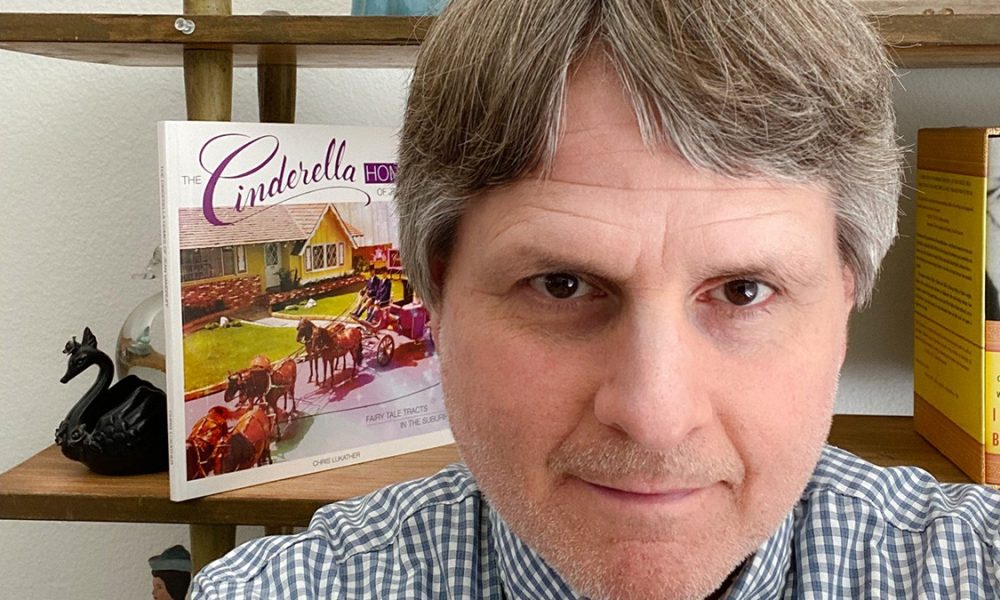
Today we’d like to introduce you to Chris Lukather.
Hi Chris, can you start by introducing yourself? We’d love to learn more about how you got to where you are today.
I was born in Burbank, CA. We moved around a lot but mostly lived in the vicinity of North Hollywood and Studio City. After high school, I studied art and design at Cal Arts. It was quite an eye-opening education. I learned things they would never teach at a traditional four-year college. Once I graduated, I worked for different magazine publishers as a graphic designer and art director. Print was my passion. I loved magazines, books, and posters. I also wrote short stories. I self-published a book many years ago. It was a humorous take on modeling schools.
A few years ago, while attending open house events with my wife, we came upon a listing for a home called a Mellenthin Birdhouse. Fascinated by the name and description, I became obsessed with learning all about Mellenthin Birdhouses. These are Mid-century homes that have a cupola built into the roof of the home as an attractive design element. Two years later, I wrote a book on William Mellenthin and his Birdhouse Ranch Homes in the San Fernando Valley. That lead me to discover Cinderella Homes designed by Jean Vanrduff—also built in the Valley. And that lead me to the Homes of Robert Byrd, who built some amazing ranch homes in the Valley. I’ve written three books on home builders and designers, who built homes here in the Valley. I’ve always been interested in local history and architecture. This sort of combines my interests in those subjects.
I haven’t really focused on a particular direction in my career, as I’ve sort of stumbled upon things unexpectedly, and followed the path to its conclusion. In the case of these books, I’ve been happy with the outcome.
I started a literary journal, The Writing Disorder, about ten years ago. We publish new fiction, poetry, nonfiction, and art. It’s a quarterly online publication that has a small but dedicated staff and has received some industry recognition for its work.
We all face challenges, but looking back would you describe it as a relatively smooth road?
My professional career has seen ups and downs. I’ve been fortunate enough to work for one company for many years and then move to another company for another long period. Work stability offers a comfortable and collaborative environment. But it wasn’t until I started working as a freelance designer, that I began to work on my own projects.
It’s hard to find time for your own thoughts and ideas when you’re working full-time for someone else. Although, when you freelance, you sometimes worry about your next job and paying the bills. Many people are now working from home and office—the hybrid model—so perhaps there’s more time for your own thoughts and ideas.
Thanks for sharing that. So, maybe next you can tell us a bit more about your work?
I’m a graphic designer who also writes. When I started working on these books, I would write them first and then start working on the design. I often discuss my designs with other designers, and I work with an excellent copy editor. Having other people review and evaluate your work is invaluable.
Before the writing began, though, the first step was being able to photograph these homes. I would grab my camera, get in the car, and drive out to these neighborhoods where these particular homes were. I just started knocking on doors. Once I explained to the homeowner what I was doing, most of them would invite me in and tell me all about their beloved home. Sometimes people would tell me to go away and to NOT photograph their home. That’s fine too.
I would just move on to the next house. A lot of people I met had documented the entire history of their homes, including original papers, photographs, and blueprints. And these were made available to me.
I’m not the most outgoing person, but for some reason, I became very sociable and enthusiastic when going out and seeing all these different homes. I was on a mission. Each encounter was an opportunity to learn something new about the history of these homes—and the Valley. People remember everything that was around back then, this being in the 1950s, 1960s, and 1970s. So you learn that there was this particular store or restaurant on this particular street or corner, or some special event occurred at that time—things you never knew about. It’s fascinating to learn all these things about a place you grew up in and never knew about. That’s fun!
What quality or characteristic do you feel is most important to your success?
Patience. Being patient, and knowing when to let things go. Also when to push forward in spite of any obstacles or challenges that may arise. I had all the material to write a book but found it difficult to put it all together. I thought it was never going to happen.
Then one day, I just started working on one particular aspect of the book, and then the next, and suddenly there it was. I could see it—the finished book. Designing a book doesn’t mean I have to start on page one. I can start in the middle or at the end. When working on a project, I work on the part that is working for me and then move on to the next part.
Pricing:
- $30.00 The Cinderella Homes book
- $44.00 The Homes of Robert Byrd book
- $49.00 Mellenthin Birdhouse Ranch Homes book
Contact Info:
- Website: http://williammellenthin.com/
- Facebook: https://www.facebook.com/thewritingdisorder
- Other: https://robertbyrdhomes.com/


Popular
-

Portraits of the Valley
-

LA’s Most Inspiring Stories
-

Rick Norris Learned That Building a Successful Business Means Building a Life You Actually Want to Live
-
How Olivia Rush Turned Survival Into a Mission to Help Others Keep Going
-

How Bibi Goldstein Is Helping Entrepreneurs Reclaim Their Time by Embracing the Power of Delegation
-

Victoria Hasson is Redefining Voice Coaching Through Community and Collaboration


