




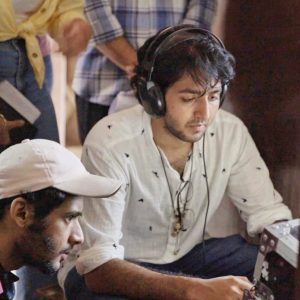
Today we’d like to introduce you to Kabeer Khurana.
Hi Kabeer, please kick things off for us with an introduction to yourself and your story.
I grew up in an artistic environment. My grandfather, Bhimsain, was the pioneer of the animation industry in India and one of the major figures in the Indian parallel cinema movement of the 70s. He was a Sufi and a poet at heart and would break out into a song every time he walked into a room. It was almost like he saw the world from a certain spiritual distance, observing from life and creating lyrical cinema that captured the beauty in the madness of the world. If he could narrate a story with just a fallen twig or a few autumn leaves, he would do so happily. And, he donned many hats. He was a painter, musician, singer, writer, and of course, a filmmaker.
Thereafter, my father took forward his legacy and established himself as an animation filmmaker, mostly directing commercials and a few features as well. Having studied animation in Canada, his skills, craft, and understanding of technique were far more refined and polished. My mother, too, is an animation educator for children. Over the last couple of years, my father transitioned to more independent cinema and social impact documentaries. I think this transition was partly due to the fact that both he and I were largely influenced by the avant-garde filmmaker Saeed Mirza, who is my mentor and our neighbour. Saeed uncle, as I fondly call him, is a subversive voice who largely makes protest cinema with extremely strong themes, mostly socio-political, capturing the angst and struggles of the marginalized, disenfranchised, and minority elements in India.
It was in multiple conversations with Saeed uncle and an influence of my undergraduate education in the liberal arts that I saw myself transition from being an idealist to a materialist. It was almost coming of age for me and the beginnings of my search for my voice as a filmmaker. I began to see cinema as not just self-constructed worlds set in a vacuum of time and space but very much grounded with a certain kind of reality. Philosophically too, I began to understand that there is a Truth that exists outside the mind. I guess this is what has shaped me — the perfect blend of exposure to high-flying imaginative animation filmmaking juxtaposed with an understanding of the harsh realities of a fundamentally iniquitous world.
Would you say it’s been a smooth road, and if not what are some of the biggest challenges you’ve faced along the way?
Initially, my parents were apprehensive about my decision to be a filmmaker. My father had become cynical after his producer was killed in a terrorist attack in Istanbul, and I saw the struggles that he had to go through to put himself forward, pitch for work, and land opportunities. However, it was always his tenacity that I admired greatly. It was during this period of his struggle that I decided that filmmaking was an uncertain profession (just as any creative field is) and decided to study architecture to keep a contingency plan in place.
After a year of architecture education, I dropped out but decided I wanted to study something more serious during my undergrad. I moved to a school in north India and majored in history in my undergrad, also taking myriad courses in political science, philosophy, sociology, and even cinema studies. It was here that I discovered my voice and developed a worldview. Thankfully, my struggles so far haven’t been in finding funding for my projects or landing jobs, but more creative struggles. What is the next story I am going to tell? How am I going to make this scene more interesting? How do I navigate this production roadblock? How do I convince my financiers about my vision? However, these are the struggles that I enjoy. It’s positive stress.
On a non-work front, my struggles growing up had been mostly existential struggles. I struggled with being socially awkward, being heartbroken by insensitivity and injustice (and not just with me), and having all these ruminating obsessions about why the world worked the way it did, most of which had no answers. I have also struggled greatly with my mental health and anxiety. In retrospect though, I am fortunate to have led so many lives and had such a colourful childhood. It has greatly shaped the convictions I have about the world today.
Thanks for sharing that. So, maybe next you can tell us a bit more about your work?
I’m a genre-agnostic filmmaker from Mumbai, India. Just as every artist is on a constant journey of self-discovery, I am too still finding my voice, signature style, and aesthetic sensibilities. At this point, I do want to make magical realism films that show the world the mirror and call the world out on its hypocrisies. As a filmmaker, I believe that it is never about trying to change the world through cinema but raising questions that make people challenge their pre-conditions. I do also like to play with new and creative forms of imaginative visualization and technology to make the storytelling more unique and interesting. In that sense, I would like to push boundaries with the language of cinema.
I started my career at 16, with a high-concept documentary film (Project Oneness) which conceptually spoke about the universal consciousness to which we all belong and the common thread that connects us as human beings. The 6-minuter won several accolades at international film festivals, which further encouraged me to direct subsequent films in a similar space. I followed it up with a film on our ideological pre-commitments (entitled ‘ism’) and moving beyond our conditioning to a space of empathy and understanding.
My third film, Religion for Dummies, which was a mockumentary on the state of religious affairs in India and farcical godmen that make their religion into a business. It was done in a unique stop-motion style, hand-painted frame-by-frame as murals on walls to make a 3-minute film. It was one of my most challenging projects and entered at top global festivals and won 5 international awards. It was after this that I shifted from concept cinema to more narrative work. My film Karma Cafe is about an estranged lover who enters a curious cafe where he will be served only what he deserves, according to his Karma. This leads to a cathartic unraveling of his past.
This was followed by a short musical on the life of Salvador Dali. The film was an experiment in capturing anamorphic sculptures on film, and this was the first time that something of this nature was being done in the Indian context. We also used McLaren’s chronophotography technique to emotionally recreate Dali’s surrealist world. This is the film I am most proud of. It has been preserved in the National Film Archives of India (NFAI) and will be releasing in a few days online. The music was composed by LA-based composer and student Oscar finalist Emiliano Mazzenga and recorded at the USC School of Cinematic Arts.
I’ve also directed and written a few commercial short films for independent production houses. I directed a short film which was the launchpad for former Miss Universe 1994, Sushmita Sen’s daughter, Renée. It was released briefly on Disney+ Hotstar. Another film, Hangout, shot remotely during peak Covid lockdown in India, is on Amazon Prime US and UK.
What’s next?
I’m currently based in Orange, California, and studying film direction formally at Chapman University’s Dodge College of Film and Media Arts. I would like to settle in LA after my course and find opportunities in the advertising and music video world before I transition to feature films. My concern as a person of colour and as a filmmaker from another culture is that I will be pigeonholed into telling stories only about Indian people in the US. I do believe that despite cultural barriers, emotionally people are the same everywhere in the world. The basic human instinct is what connects us all. I would like to tell stories about all kinds of cultures and people, not just my own.
Contact Info:
- Email: kabeerk@gmail.com
- Website: www.kabeerkhurana.com
- Instagram: www.instagram.com/kabeerkhuranaofficial
- Facebook: https://www.facebook.com/kabeerkkhurana
- Youtube: https://youtube.com/playlist?list=PLI1urPeKsGZjogdN56OTpOENM3HuxyYwR
- Other: https://www.imdb.com/name/nm8787781/?ref_=nv_sr_srsg_0


 Image Credits
Rutvij Reddy Seelam (for the last picture)
Popular
-

Robin Olive on Building an Inclusive Performing Arts Movement and Expanding Opportunities for Every Student
-

Portraits of the Valley
-

LA’s Most Inspiring Stories
-

Que Johnson on Building Brands That Last: From Visibility to True Market Authority
-

Christina Wren Steps Into the Director’s Chair to Tell Stories That Feel Like Home
-

JordanL on ‘Breathe,’ Belief, and Building a Movement Beyond the Music


