




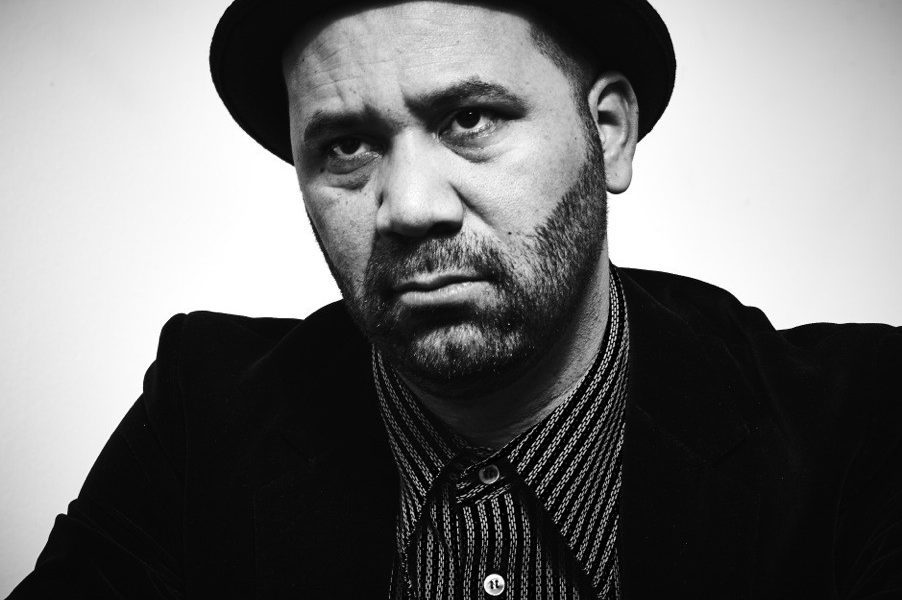
Today we’d like to introduce you to Jesse Carzello.
Hi Jesse, so excited to have you on the platform. So before we get into questions about your work-life, maybe you can bring our readers up to speed on your story and how you got to where you are today?
I grew up an MTV-obsessed music fan in the 80s in a suburb, then exurb, of Washington, DC. In addition to the current pop music of the day, I was simultaneously shaped by the music tastes of my mother who exposed me to a lot of the R&B of the previous generation as well as more adult-oriented artists that might’ve otherwise escaped my notice. Add to this the consistent backdrop of Go-Go, a beloved regional style of hard Funk driven by cacophonous percussion.
My initiation into skateboard culture, the videos in particular, got me interested in underground music: initially the punk and punk-adjacent bands of SST records and later the 90s underground Hip-Hop coming out of New York and jazz. By the mid-90s as the first wave of so-called Grunge had run its course and MTV (outside of the “120 Minutes” late-night program) was becoming populated with lesser, more commercial iterations of that sound, I drifted further out of the mainstream. This was around the time that I started trying my hand making music with high school friends, propelled by the clichéd mix of angst and ennui as well as our nascent DIY convictions. A few years and bands later, I moved from Manassas, Virginia to Long Beach, California more or less on a whim. I had been wanting a change of scenery for a few years and my friend Reid Kinnett (former bandmate and current winemaker in Petaluma, CA) and I let a coin toss determine that we’d come to California instead of New York. Long Beach was a pragmatic decision since it was a relatively affordable beach city that had a university (that way I had something to tell my family about my ‘reason’ for moving).
Once in Long Beach, I became enamored of the vast and varied music, arts, and nightlife scene in the city; as well it’s proximity to the larger cultural hub of LA. I was reveling in the opportunity to sort of remake myself, unhindered by the expectations of those who I had grown up around. It was a great period of discovery. I was drinking an unhealthy amount of coffee, reading lots of books, and getting deeper into more esoteric music. In 2002 another friend from the east coast Chris McKinnon (AKA Beegs Alchemy), a rapper/musician/writer, strongly urged me to start a band with him (Bless him for that, I was in a period of being a lapsed musician with not much direction creatively in spite of a rich cultural diet). That band, mostly instrumental psych-funk outfit Luke Warm Quartet (a trio at the time of its inception), led to gigs with Coaxial (briefly, as a live auxiliary member) and an almost decade-long stint with Free Moral Agents, the brainchild of Isaiah “Ikey” Owens (a Long Beach legend who played with The Mars Volta, Jack White, Long Beach Dub-Allstars and countless others). I made two albums and several EPs with Free Moral Agents and toured nationally for several years, as well as trips through Europe and Canada. Working with Ikey was very much an education, even an apprenticeship of sorts, though I hoped (and briefly had reason to believe) it might become a full-time job. These hopes were dashed in 2014 when Ikey tragically passed away of a heart-attack in Mexico while on tour with Jack White, a couple of months shy of his 40th birthday.
In 2006, shortly after the time I began performing with both Free Moral Agents and Coaxial, projects while vastly divergent otherwise each had me firmly in my experimental bag, utilizing and emphasizing the more ‘out’ aspects of my musicianship; I felt that I had a creative itch that wasn’t being scratched. Also, both projects were also completely controlled by other people’s calendars. In my free time, I began making 8-track home-recorded demos in earnest. Initially, I imagined the demos to be references to court other musicians for playing in a large, somewhat freewheeling, rhythm-centric ecstatic ensemble. My main points of reference were War, Sly and the Family Stone, Funkadelic, as well as further afield things like Sun Ra, Fela Kuti, and Gnawa music. After a few rehearsals with various musicians, I realized I didn’t have the organizational or leadership prowess at the time to steer a big band.
As I got busier with the live bands, I began to value home recording as an end it itself. Instead of viewing these vignettes as an outline for a larger ensemble to extend into a long-form musical vamp, I began trying to make them into succinct and stand-alone pieces, pockets of magic of sorts. As more adult responsibilities crept in and I had generally less discretionary time, I began more to appreciate concise and direct expression in music. I didn’t abandon my more expansive or wild artistic impulses. I merely attempted to couch them in short-form, more accessible music. Thus, rascally pop-outsider ‘bobby blunders’ was born; well bobby has always been here but more on that later.
After several years of prolific bedroom-recording where I performed all of the music and handled the recording duties, in 2010 I assembled more than 30 musicians that from the Long Beach community to make a proper debut album, “best neighborhood band”, with engineer J.P. Bendzinski. Once the album was finished, in early 2012 I assembled a live quintet featuring Michael J. Salter, Tiffany Semoy Davy, Pastor ‘AJ Freeman, and Jens Clawson with the goal of performing a release show for the album. The live show from the beginning was conceived as a buoyant entertainment-inclined show that would serve as a Trojan Horse for the serious songs of spiritual inquiry that comprise the album. Plus, after so many years of going to see local music, it was imperative to have a presentation that would not feel like just another group or worse, a task to endure. We’ve been refining our performances, which we refer to as ‘ecstatic services’, for almost a decade (we celebrate the ten years anniversary of our first live appearance in May of 2022). The goal of these ecstatic services is to provide a sort of transcendental experience that may not be accessible outside the realms of religious or spiritual practice or without the use of psychedelics (bobby neither advocates for nor admonishes against these other methods of inquiry).
In addition to honing our live show, we’ve been working to make records that are accessible but expansive, earthy and ethereal, firmly rooted and futuristic, jubilant but able to deal with the whole spectrum of emotions. Our second full-length album “character/witness” will be released in early 2022. Everything we do is for our namesake myth, the utilitarian advocate of ecstasy.
We all face challenges, but looking back would you describe it as a relatively smooth road?
There has certainly been trials. I don’t believe you can do something for this long and be missed by adversity entirely. Fairly early in the life of our band, we lost Ikey Owens, a mentor and great supporter of the band. There has also been many line-up changes over the course of our history. They happened for a variety of reasons: shifting personal goals and responsibilities, out-of-town moves, personal chemistry and creative differences. Several times I’ve reconfigured, even rebuilt the band, often in ways that were fairly divergent in terms of style or instrumentation, but still attempting to stay true to initial mission of the project.
I started the group when I was over 30 and I’ve generally recruited from my own age group, mostly for similar musical reference points and shared cultural touchstones. I also hoped to avoid some of the folly of youth (which, obviously are not exclusive to that demographic) such as flakiness, over partying, outsized egos). In the process, I’ve run into a host of other challenges. Most of these stem from the finite amount of time that an adult with a full-life can dedicate to an art project with an increasingly narrow path to solvency. Like with many artists, cash flow is always a hurdle. There is a fair amount of overhead being in a band: instruments and equipment, rehearsal space, studio time (engineering, mixing, mastering), artists and designers, marketing and promotion, etc. Everyone individually in my group has to make rent to boot.
Can you tell our readers more about what you do and what you think sets you apart from others?
I’m a bandleader of recording artist and ecstatic services provider bobby blunders. With my recordings and live performances, I strive to facilitate the listener or witness reaching a state of ecstasy, or at least elation. Each song is an orchestrated sequence of tension and release that attempts to deliver this effect. Our seemingly disparate musical inputs such as Gospel, Disco, Sufi music, psychedelic music share a thread of liberation, transcendence, and jubilation.
What I’m most proud of is our shared experience with those who attend our ecstatic services. It’s been extraordinarily rewarding to see people in the audience dancing, singing along, hooting, kissing, crying, and so on.
I also believe the quality of our work is consistently improving. We keep trying to outdo our previous writing, musicianship, and production.
We have a distinctive rhythm-centric, non-genre (or perhaps poly-genre) approach to music-making that we (somewhat facetiously) refer to as cosmic comfort music. We’ve also been referred to as art-funk, psychedelic soul, indie R&B. Though I’m personally ambivalent about all of these terms, they may be instructive.
As a long-running project, bobby blunders has grown and evolved while maintaining our core identity and carving out a particular lane. While we certainly don’t create in a vacuum and are deeply engaged with and inspired by currently working artists both hyper-local and International, we have little interest in simulating any established sounds or assimilating into any scenes.
We’d love to hear about how you think about risk taking?
I believe that risk is inevitable. Many choices, big or small, involve risk. There is so much in life that is out of our control. Although I try to exercise consideration and a principle of cooperation, I’ve always felt compelled to wield whatever agency or power I’ve had access to. Complacency, to me, always seemed like the biggest risk of all.
I moved out of my mom’s house in Virginia to come to Long Beach at 20 years old with one month’s rent paid and around $200 in my bank account. Five years later, I dropped out of school and moved out of a comfortable situation with a single roommate and privacy to live in cramped quarters with my bandmates so we could lower our overhead and go on a month-long national tour as a relatively unknown band. This was followed by several years of less than ideal lodging situations so that I could pursue being a touring musician. I’ve sidestepped and turned down career opportunities so that I could protect my creative time. On paper, these were obviously foolish risks, but they also turned out to be foundational.
Contact Info:
- Email: bobbyblunders@gmail.com
- Website: https://www.bobbyblunders.com
- Instagram: https://www.instagram.com/bobbyblunders/
- Facebook: https://www.facebook.com/bobbyblunders
- Twitter: https://twitter.com/bobbyblunders
- Youtube: https://www.youtube.com/channel/UC65jaiUKXoKc_-zaKQjLM3A
- SoundCloud: https://soundcloud.com/bobbyblunders
- Other: https://www.bandsintown.com/a/1353285


 Image Credits
Leti Gomez Lynda Bui Nick Edwards Patrick Miller Tiffany Davy Joy Tiu Kimberly Davis
Popular
-

Robin Olive on Building an Inclusive Performing Arts Movement and Expanding Opportunities for Every Student
-

Portraits of the Valley
-

LA’s Most Inspiring Stories
-

Que Johnson on Building Brands That Last: From Visibility to True Market Authority
-

Christina Wren Steps Into the Director’s Chair to Tell Stories That Feel Like Home
-
JordanL on ‘Breathe,’ Belief, and Building a Movement Beyond the Music


