





We’re looking forward to introducing you to Mehran Java. Check out our conversation below.
Good morning Mehran, it’s such a great way to kick off the day – I think our readers will love hearing your stories, experiences and about how you think about life and work. Let’s jump right in? What are you chasing, and what would happen if you stopped?
I’m chasing the gap between what science knows and what people can actually use.
Most well-being research, most self-help, most wellness tech, brilliant work, aimed at the top of the pyramid. People who already have the basics handled. But the median person, the 90-95%, is making decisions every day about health, money, time, and relationships without a framework to see what each one costs.
That’s the gap. That’s what I’m chasing. A framework that’s pragmatic enough for people who don’t have time to read fifty books, and rigorous enough that it actually holds up under pressure.
If I stopped? The gap doesn’t close. Someone writes a louder, worse book. We get another decade of wellness advice that only works if your life already works. And we hand an entire generation over to AI systems that optimize for engagement, not their well-being, because they never learned to optimize for themselves.
Can you briefly introduce yourself and share what makes you or your brand unique?
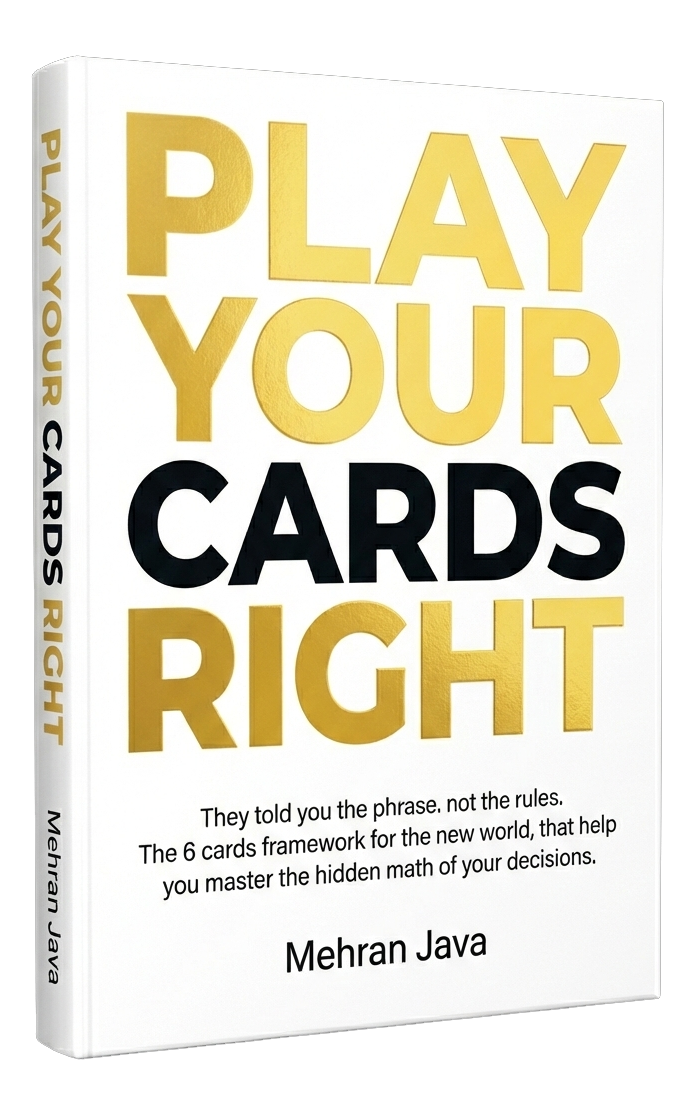
I’m Mehran Java, author of Play Your Cards Right.
Over the last decade I’ve been inside several startups. One was Happiem, a mental wellness app built on the premise that if we understood the science of happiness, we could scale it to millions. A few others in AI. Different products, same pattern: the tech almost always outruns the people it’s supposed to serve.
Happiem is where this book started. In 2020 I went deep into Yale’s Science of Well-Being, the most popular course in the university’s history. After I finished it, I thought: we have the science, now go build it.
So I did the research first. Visited the happiest cities in America. Hawaii made sense. But Fresno was ranked number one? I asked locals. Nobody owned that happiness. The data was flawed.
I traveled to Europe’s happiest cities next and realized we weren’t even talking about the same thing. Two definitions of happiness. Two different worlds. In the US, most people need prerequisites handled before “happiness optimization” is even on the table.
That’s the gap self-help skips over. The other 99% are making invisible trades between health, time, money, and relationships every day — without a framework to see what each one costs.
That’s why I wrote Play Your Cards Right. It’s the decision-making manual for the next 25 years, how to allocate your six core resources (Mind, Vitality, Time, Money, Connection, Meaning) before life, or AI, allocates them for you.
Thanks for sharing that. Would love to go back in time and hear about how your past might have impacted who you are today. What’s a moment that really shaped how you see the world?
I went through a stretch where I dove headfirst into positive psychology. The research was clean, the case studies were inspiring, and I convinced myself that optimism was a skill I could just install and run.
It worked. Until it didn’t.
I spent four years making the worst financial decisions of my life. Not because I was reckless, because I had trained myself to look at every risk through a sunshine filter. Optimism became a blindfold. I was optimizing one card, my mood, while bleeding another one to zero. And I couldn’t see it, because nobody had ever named the trade for me.
Then inflation hit. The math caught up. I woke up one morning and realized I’d been playing a hand I’d never actually looked at.
That’s the moment the book started. Not as a theory. As a reverse engineering of my own mistake. If I’d had a framework that showed me what positivity was costing me across the other five cards, I’d have seen the bleed three years earlier. I’d still have the money.
Most self-help tells you to be more positive. Nobody tells you what positivity costs when it’s untethered from the rest of your life. Play Your Cards Right is for the people who did the work on one card and woke up years later wondering what happened to the rest.
What fear has held you back the most in your life?
For a long time I told myself I was just “selective” about what I committed to. Careful. Strategic. I dressed it up as discipline. The truth is simpler and less flattering: I was afraid of being evaluated and found wanting.
I used to say “if she’s smart enough, she’ll see it” on dates. I used to say “if the product is good enough, it’ll sell itself” in business. I called it humility. It wasn’t. It was avoidance, rationalized as integrity. Real humility is knowing exactly what you’re good at. I didn’t. And the cost of that confusion was that I spent years under-communicating the value of what I was building, because communicating it meant putting it on the table for someone to reject.
The book forced me to fix it. When you write something you genuinely believe can help people, staying quiet isn’t humble, it’s withholding. You’re prioritizing your own discomfort over their benefit.
So that’s the fear I’ve been unlearning. Turns out, the version of me that’s willing to be evaluated is also the version that ships books, builds companies, and actually connects with people.
Alright, so if you are open to it, let’s explore some philosophical questions that touch on your values and worldview. Where are smart people getting it totally wrong today?
Smart people think they have time to figure out AI.
They don’t.
A few weeks ago, OpenClaw crossed a hundred thousand GitHub stars, and overnight an entire economy emerged around it, new startups, new workflows, new security vulnerabilities, all in days. We’re building the plane while flying it, and the runway keeps shrinking.
Here’s what the industry won’t say out loud: we’re possibly months, not years, away from the dystopia we’ve seen in movies. Lonely people outsourcing their relationships to AI companions. Agents making decisions on your behalf that you never fully understood. Your time, money, health, and relationships managed by systems optimized for engagement, not your well-being.
The smart people are focused on capability. Faster models. Better agents. They’re getting the what right and the why completely wrong.
You can’t negotiate with AI about what matters to you if you’ve never figured that out for yourself.
Thank you so much for all of your openness so far. Maybe we can close with a future oriented question. What do you understand deeply that most people don’t?
The window is closing.
There’s a brief moment, maybe a year, maybe a few months when humans still have the chance to understand their own decision-making before outsourcing it to AI. Most people don’t see it. They’re busy optimizing productivity, chasing engagement metrics, letting algorithms decide what they watch, buy, date, believe.
Every decision is a trade between six resources: Mind, Vitality, Time, Money, Connection, Meaning. Most people make these trades invisibly, without seeing the exchange rates. They optimize one card while bleeding another to zero.
Here’s what I understand deeply: once AI agents start making those trades for you, you won’t get a second chance to figure out what you actually value. The algorithms will decide. And they’ll optimize for engagement, not your well-being.
Figure out your cards before someone else plays them for you.
Contact Info:
- Website: https://mehranjava.com/
- Linkedin: https://www.linkedin.com/in/mehran-java/
- Twitter: https://x.com/mehranjava
Popular
-

Portraits of the Valley
-

LA’s Most Inspiring Stories
-

Rick Norris Learned That Building a Successful Business Means Building a Life You Actually Want to Live
-

How Olivia Rush Turned Survival Into a Mission to Help Others Keep Going
-

How Bibi Goldstein Is Helping Entrepreneurs Reclaim Their Time by Embracing the Power of Delegation
-

Victoria Hasson is Redefining Voice Coaching Through Community and Collaboration


