




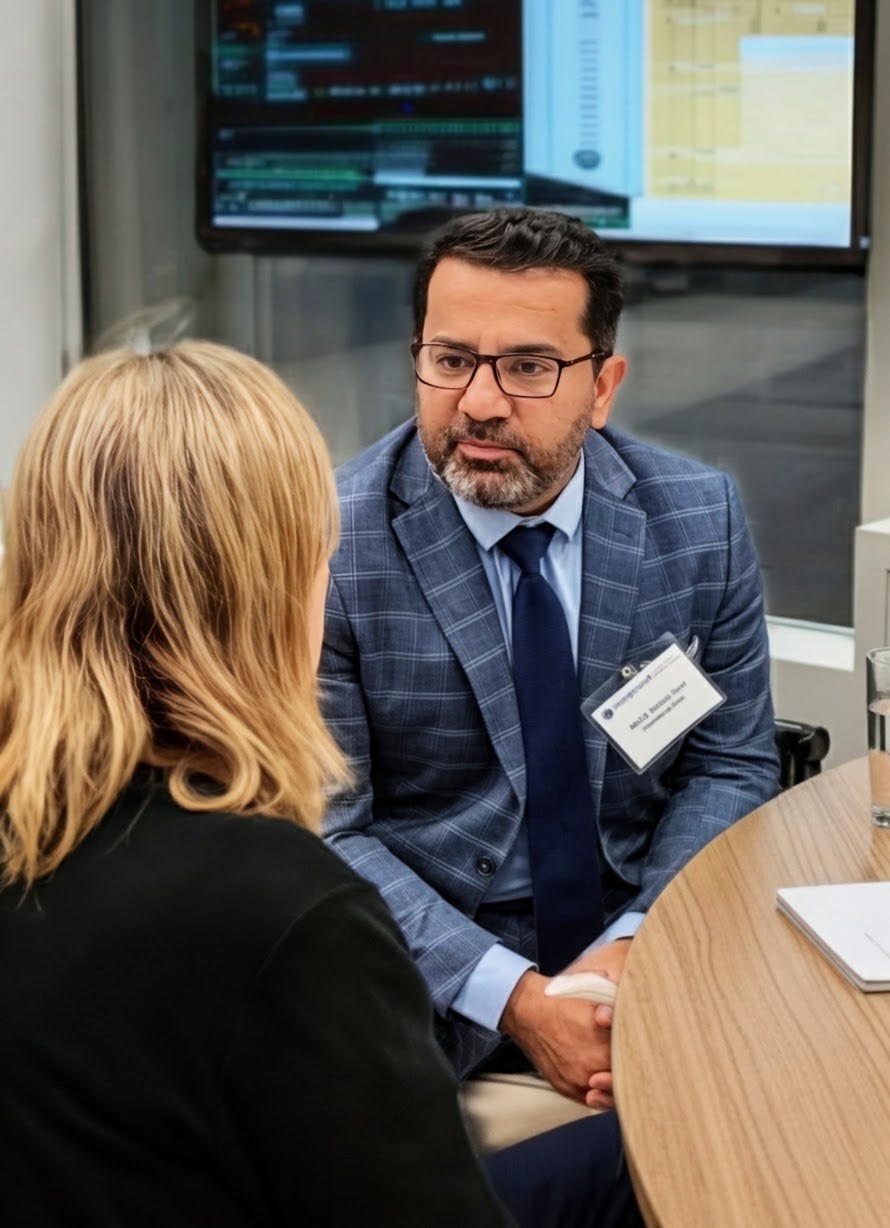
We recently had the chance to connect with Sani Abdul-Jabbar and have shared our conversation below.
Hi Sani, thank you for taking the time to reflect back on your journey with us. I think our readers are in for a real treat. There is so much we can all learn from each other and so thank you again for opening up with us. Let’s get into it: What do the first 90 minutes of your day look like?
The honest answer is, it evolves. But the intent never changes.
The first 90 minutes of my day are about preparing my body, mind, and spirit to win the day before the day starts winning me.
Lately, it looks like this.
I start simple. A glass of water, a spoon of peanut butter, and a cup of coffee. Nothing glamorous. Just fuel. I have found that the smallest rituals, repeated consistently, build the strongest foundations.
Then I move. Thirty minutes of calisthenics. No fancy equipment, no scrolling between sets. Just bodyweight training and breath. Movement clears the noise. It is amazing how many “complex” business problems start to look solvable once your heart rate is up and your mind is calm.
Here is where it gets interesting.
I have built AI agents that curate and synthesize global news every morning across business, technology, and geopolitics, especially anything that could impact our international trading activity. They do not just collect headlines. They extract implications, outline strategic angles, and frame risks and opportunities specific to our business model. The output is delivered as a 30-minute audio briefing.
So while I am training, I am effectively in a personalized executive briefing prepared by my own AI research team. It feels like having a think tank in your headphones.
After the workout, I take a warm shower that ends with a short cold blast. That final 30 seconds is less about temperature and more about discipline. It is a reminder that discomfort is temporary and controllable. Entrepreneurship and global trade both test your resilience, so you may as well practice it daily.
Breakfast is protein-heavy. During that time, I am not consuming more content. I am thinking. I mentally prioritize the day, pressure-test key decisions, and visualize the three outcomes that would make the day a success. I have learned that if you start reacting immediately to emails, you have already surrendered strategic control.
By the time those first 90 minutes are done, I am not rushing into the day. I am entering it intentionally.
It is not about productivity hacks. It is about alignment. When the body is energized, the mind is informed, and the priorities are clear, execution becomes a lot simpler.
Can you briefly introduce yourself and share what makes you or your brand unique?
I’m Sani Abdul-Jabbar. At my core, I’m a strategy operator who builds at the intersection of technology, global trade, and transformation.
Over the past nearly two decades, I’ve led corporate strategy, AI initiatives, and large-scale operational improvements across Fortune 500 environments and entrepreneurial ventures. My career has taken me from boardrooms to factory floors, from trading desks to AI command centers. I’ve advised executive teams, worked with global brands, and built companies from the ground up. I’m as comfortable discussing enterprise architecture as I am negotiating supply terms across time zones.
Today, I lead two worlds that most people assume don’t belong together.
On one side, I run Green Global Trading, where we structure and execute complex international commodity transactions, particularly in energy and natural resources. It is a world that demands precision, disciplined risk management, legal rigor, and a constant awareness of how geopolitics can shift markets overnight.
On the other side, I cofounded VezTek USA in 2007, where we help organizations design and implement AI-first strategies. We build agentic AI systems, develop executive roadmaps, and modernize how decisions are made inside companies. It is not AI for the sake of headlines. It is AI directly tied to revenue growth, cost optimization, operational resilience, and long-term competitive advantage.
I’m also the author of Makers of Slender Knowledge, a bestselling book that explores the business and social implications of artificial intelligence. In it, I argue that AI cannot simply be powerful. It must be principled. Moral values should not be an afterthought layered on top of systems. They should be embedded in the foundation by default. If we are redesigning how decisions are made at scale, then we carry a responsibility to design them wisely.
What makes my story distinct is that I live in both strategy and execution. I can outline a board-level AI transformation agenda in the morning and pressure-test a commercial structure in the afternoon. That dual exposure keeps me practical. Ideas must survive contact with reality. If they cannot be operationalized, they are just well-worded slides.
I’m particularly passionate about what I call the Intelligent Enterprise, organizations that treat AI not as a tool bolted onto existing processes, but as a structural redesign of how work gets done. Moving from experimentation to durable advantage requires discipline, architecture, governance, and a willingness to rethink assumptions.
At the end of the day, I’m a builder. I build companies, build systems, and build partnerships. And occasionally, I build AI agents that read the news before I do. The common thread is this: the future belongs to leaders who think strategically, execute decisively, and stay curious enough to evolve before they are forced to.
Amazing, so let’s take a moment to go back in time. What breaks the bonds between people—and what restores them?
I’ve come to believe that bonds rarely break because of one dramatic event. They break quietly.
In business, in personal and familial relationships, in partnerships, even between nations, relationships erode the same way steel rusts. Slowly. Through small misalignments that go unaddressed.
Early in my career, one of my mentors gave me advice that has stayed with me ever since. He said, “Design everything you do to build trust. Never to erode it. And before you make a decision, ask yourself one question: Will this strengthen trust, or weaken it?”
It sounded simple. Almost obvious. It is neither.
What breaks bonds most often is not malice. It is misalignment.
Unspoken expectations.
Incentives that drift apart.
Ego stepping in where purpose should lead.
Avoiding hard conversations because they are uncomfortable.
In business, I have seen deals collapse not because the economics were wrong, but because transparency was delayed by a few days. I have seen partnerships fracture because someone needed to be right instead of needing to solve the problem. In personal and family life, the same dynamics show up with different vocabulary.
Trust erodes when words and actions stop matching.
When clarity is replaced with assumption.
When short-term comfort wins over long-term integrity.
What restores bonds is surprisingly consistent across contexts.
Radical clarity.
Accountability without defensiveness.
Realigning incentives so both sides win.
And most importantly, consistency over time.
Trust is rarely rebuilt through grand gestures. It is rebuilt through small promises kept repeatedly.
In my work in international trade, trust is the invisible currency behind every transaction. In AI strategy, trust becomes even more profound. We are building systems that make decisions at scale. If trust is not embedded in the architecture, the system may function, but it will not endure.
The same is true for relationships.
I try, imperfectly but intentionally, to run decisions through that old mentor’s filter. Will this strengthen trust or weaken it? If the answer is the latter, even slightly, I reconsider.
Bonds break when alignment fades and ego rises. They are restored when clarity, accountability, and shared purpose return.
Whether you’re structuring a global transaction, building an AI enterprise, or navigating personal and family relationships, the principle remains the same: protect trust as if it were capital. Because in many ways, it is.
What did suffering teach you that success never could?
Success is a generous teacher. It builds confidence and momentum. Sometimes it even convinces you that you’re in control.
Suffering is a different kind of teacher. Less generous. Far more precise.
During the early days of COVID, one of our largest customers abruptly paused their project due to uncertainty. Almost overnight, the rest of the sales pipeline went quiet. Existing clients began holding payments. Understandably so. But that didn’t make payroll any less real. My fear was simple and human: keeping the lights on at home and at work. Keeping my team employed mattered deeply to me.
That season taught me endurance. I couldn’t control the market, but I could control my response. I focused on staying creative, looking for alternative revenue paths, tightening operations, and protecting my mental and physical health. Discipline became strategy. Stability became leadership.
In global trade, I experienced a different version of the same lesson. When retaliatory tariffs were imposed on U.S. companies, some reaching as high as 144 percent, certain commodities became commercially unviable overnight. There was no spreadsheet that could solve that math. The environment had changed.
Again, the lesson was clear. Control what you can. Adapt creatively. Stay within your values. Pressure tempts shortcuts, but long-term credibility is more valuable than short-term relief.
Suffering taught me the difference between momentum and resilience. Success builds the resume. Difficulty builds the foundation. And foundations are what hold when conditions shift.
I wouldn’t seek hardship. But I wouldn’t discount what it revealed either. It replaced noise with clarity, ego with discipline, and confidence with conviction.
Next, maybe we can discuss some of your foundational philosophies and views? Where are smart people getting it totally wrong today?
Smart people are not getting it wrong because they lack intelligence. They’re getting it wrong because they’re optimizing around an outdated hierarchy.
Many of us were raised on some version of this pyramid: God, country, family. Duty before self. Sacrifice as virtue. Put yourself last and you are noble. It’s a powerful idea. It built institutions. It sustained movements. It created cohesion.
But it did not always create strong individuals.
What I’ve observed, and what one of my mentors helped me see clearly, is that the pyramid needs to be inverted.
He told me, “If you want to add value to the world, start by becoming structurally strong yourself.”
At the foundation should be health. Physical, mental, and spiritual. If your body is depleted, your mind foggy, or your spirit fractured, you are operating at reduced capacity. Energy is not a luxury. It is strategy.
The second layer is wealth. Not just money, though money matters. Wealth includes knowledge, skills, experience, and optionality. Financial strength gives you freedom of decision. Optionality strengthens integrity. It is much easier to stand by your values when you are not financially cornered.
Only then come relationships. Family, partnerships, community, society at large. When built on health and stability, relationships are nourished rather than strained. You show up grounded instead of reactive.
The traditional model often produces burnout disguised as dedication, financial fragility framed as humility, and neglected health justified as responsibility. People try to pour from an empty cup and then wonder why resentment leaks out.
The inversion is not selfish. It is structural design. Strong individuals create strong families. Strong families create strong societies. The order matters.
Where I see smart people miscalculating today is in optimizing for status before stability. They chase visibility before vitality. They sacrifice long-term capacity for short-term optics.
We are very good at solving complex systems in business and technology. We are less disciplined about architecting our own lives.
If your foundation is cracked, the structure above it will eventually show the strain. Intelligence is powerful. But without the right order of priorities, even smart people build on unstable ground.
Thank you so much for all of your openness so far. Maybe we can close with a future oriented question. Are you doing what you were born to do—or what you were told to do?
That’s a powerful question.
I come from a healthcare family. My father is a healthcare professional, and in our ancestral culture, the first-born son is often expected to follow in his father’s footsteps. The path was more or less drawn for me early: medicine. The assumption was not malicious. It was honorable. It was tradition. It was stability.
For a while, I walked that path.
Then came high school biology and a frog dissection. Somewhere between the scalpel and the formaldehyde, I had a very clear realization: medicine was noble, but it wasn’t mine. I respected it. I just didn’t belong in it.
What genuinely fascinated me was something else entirely. International business. Technology. Global systems. I was drawn to how markets moved, how innovation reshaped industries, how ideas crossed borders faster than planes ever could.
Choosing that path was not frictionless. Going against family expectations never is. I decided to study international business, both in the United States and abroad, and built my career at the intersection of technology, global trade, and strategy. It was exciting, intellectually alive, and completely outside the script that had been prepared for me.
For years, I quietly assumed my parents never fully approved. That’s part of the emotional cost of choosing your own direction. You carry a small question mark in the background.
Then, later in life, I read my father’s autobiography. In it, he wrote that he was ultimately glad I did not follow the path chosen for me by tradition, and that I chose my own. In a way, as Sinatra would say, I did it my way.
That moment meant more than any title or transaction ever could.
At this stage in my life, I have no regrets about the choices I made around my career. I’m grateful for the foundation my family gave me. Discipline. Work ethic. Service. But fulfillment came from aligning my work with my natural curiosity and conviction.
Honoring your roots does not require replicating them. Sometimes the best way to respect where you come from is to build boldly from it.
Contact Info:
- Website: https://veztekusa.com/
- Linkedin: https://www.linkedin.com/in/sani
Popular
-

Portraits of the Valley
-

LA’s Most Inspiring Stories
-

Rick Norris Learned That Building a Successful Business Means Building a Life You Actually Want to Live
-

How Olivia Rush Turned Survival Into a Mission to Help Others Keep Going
-

How Bibi Goldstein Is Helping Entrepreneurs Reclaim Their Time by Embracing the Power of Delegation
-

Victoria Hasson is Redefining Voice Coaching Through Community and Collaboration


