




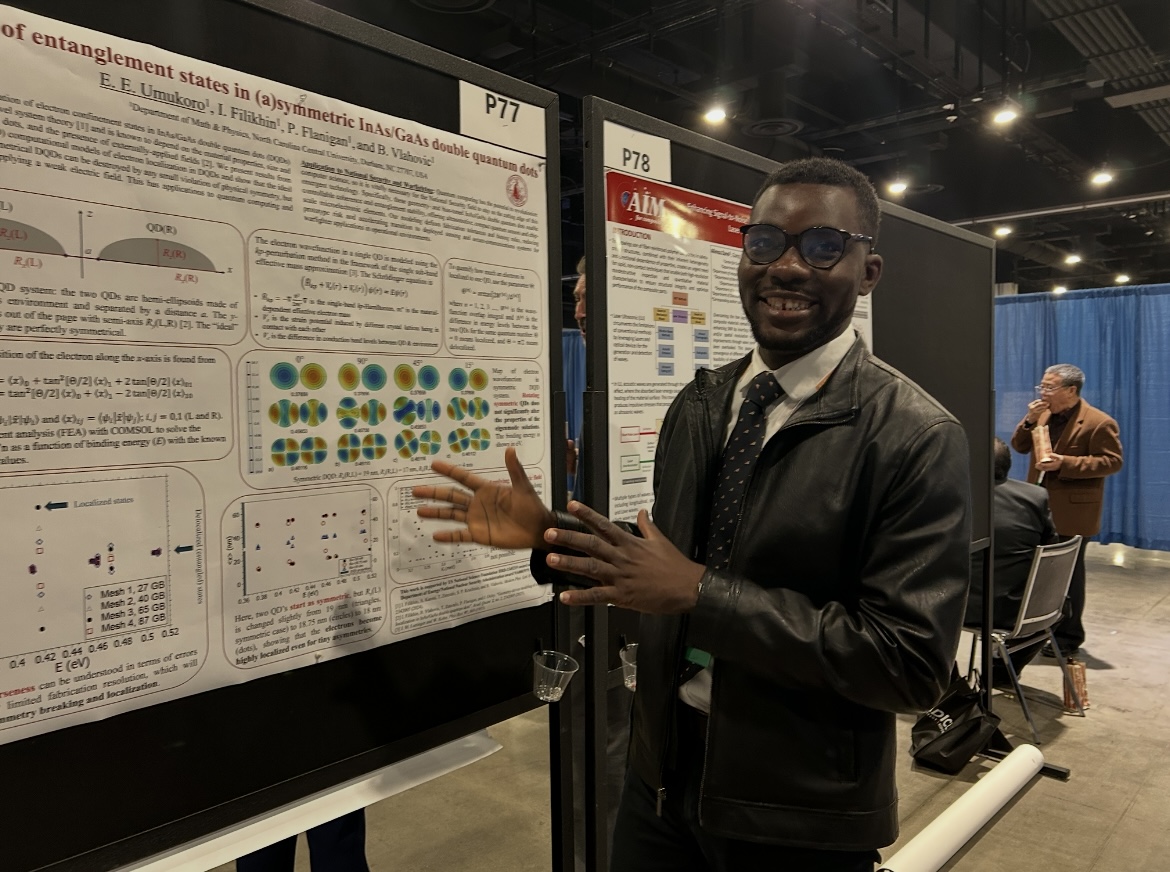
Today we’d like to introduce you to Emmanuel Umukoro.
Emmanuel, we appreciate you taking the time to share your story with us today. Where does your story begin?
My story has been anything but linear; it’s been shaped by curiosity, risk, and a willingness to start over in pursuit of something bigger.
I grew up in Nigeria, where I developed an early interest in science seeing my father was a Physics teacher for nearly three decades. That curiosity eventually led me into the tech industry in Dubai, where I worked on software systems and product development. While I enjoyed the work, I started to feel that I was contributing to the present, but not necessarily building the future. That realization pushed me to take a step back and ask myself a difficult question: What kind of problems do I want to dedicate my life to solving?
That question led me to quantum computing.
I became fascinated by the idea that the next revolution in computing wouldn’t just be faster machines, but entirely new ways of processing information. Acting on that conviction, I made the decision to leave my career and move to the United States to pursue graduate studies in physics at North Carolina Central University.
At NCCU, I began working on Double Quantum Dot systems, using computational models to understand how quantum particles behave under different conditions. It was exciting, but I quickly realized there was a gap between simulation and real-world implementation. I didn’t just want to study quantum systems, I wanted to help build them.
That realization became a turning point. I pushed beyond the limitations of my immediate environment and sought out opportunities to gain experimental experience. That effort led me to a collaboration with researchers at Duke University’s Pratt School of Engineering, where I now work on engineering quantum-relevant materials, including defect states in diamond. Being able to connect theory with hands-on experimentation has fundamentally transformed how I approach research.
Along the way, I’ve also presented my work at conferences, participated in programs like the IBM QSIM and Duke STAQ summer schools, and even served as a judge at a multi-institutional research symposium. Each of these experiences has reinforced my commitment to growing within this field.
Looking back, my journey from Nigeria to Dubai to the U.S., from tech into physics, has been driven by a simple idea: if the future of computing is being built right now, I want to be part of shaping it. And today, through my research in quantum systems, I feel like I’m finally working at that frontier.
Can you talk to us a bit about the challenges and lessons you’ve learned along the way. Looking back would you say it’s been easy or smooth in retrospect?
The hardest moment came when I decided to leave a familiar and stable career in Dubai to pursue quantum physics in the U.S. I had built a life around technology work that was tangible and immediately rewarding. Walking away from that to start over as a graduate student felt like leaping into open air with no guarantee of where I’d land. There were days I questioned whether I had made a mistake; whether I was too old, too far removed from formal physics, or simply chasing a dream I wasn’t qualified for.
The first year of graduate school humbled me. I was surrounded by classmates who had come straight from undergraduate physics programs with years of lab experience. I, on the other hand, had to re‑learn calculus, teach myself quantum mechanics from the ground up, and sit in front of simulation code that refused to work. There was a period when every step forward felt like two steps back.
Another struggle was bridging the gap between computation and experiment. I started in quantum research doing simulations in Double Quantum Dot models that ran beautifully on a screen. But when I realized I wanted to actually build things, I had no training in cleanroom fabrication, laser systems, or materials characterization. I had to knock on doors, ask for chances I wasn’t yet qualified for, and accept that I would fail publicly before I succeeded.
The breakthrough came when I sorted out collaborations and eventually struck a collaboration with Duke’s Pratt School of Engineering. That meant learning new instrumentation, spending hours troubleshooting laser alignments, and making mistakes in front of experienced researchers. It was uncomfortable, but it taught me that growth lives on the other side of discomfort.
Looking back, the obstacles were never just technical. They were about believing I deserved to be in rooms where I was the least experienced person, and choosing to stay anyway. That’s a lesson I carry with me now, whether I’m working in the lab or mentoring undergraduates through the DREAM STEM program. The road may not have been smooth, but each bump taught me something I couldn’t have learned any other way.
Can you tell our readers more about what you do and what you think sets you apart from others?
At its core, my work sits at the intersection of physics, materials science, and the future of computing. I focus on quantum systems; specifically how we can design, simulate, and ultimately build the physical structures that will power quantum computers.
My research began with Double Quantum Dot systems, where I used computational models to study how electrons behave in confined quantum environments. These systems are important because they can act as the building blocks of quantum bits, or qubits. That work gave me a strong theoretical foundation, but I didn’t want to stop at simulation—I wanted to understand how these systems behave in real materials.
That curiosity led me into materials research, including work on metal-doped carbon nanotubes for gas sensing applications. While that project sits slightly outside quantum computing, it strengthened my ability to design and analyze nanoscale systems—skills that are directly transferable to quantum device engineering.
Currently, through my collaboration with Duke University’s Pratt School of Engineering, I’m working on experimental systems involving defect states in diamond—structures that are incredibly promising for quantum technologies because of their stability and coherence properties. This work allows me to bridge theory and experiment, which is where I believe some of the most important breakthroughs will happen.
What sets me apart, I think, is the breadth of my background. I didn’t come to quantum research through a straight line. I’ve built software, run a startup, worked in e-commerce, and co-founded education initiatives. That means I approach my scientific work differently. I’m always asking: how does this become useful? I care about reproducibility, about scalability, about whether the technique I’m developing in the lab could one day be part of a real device.
I’ve also made a conscious effort to grow beyond the classroom and lab; attending summer schools funded by the National Science Foundation at the IBM One office in New York organized by RQS and Duke’s Quantum Ideas Summer School organized by STAQ, presenting my work at multiple industries and academic conferences, and even serving as a judge at a large multi-institutional research symposium. Those experiences have helped me develop both technical depth and a broader view of where the field is heading.
What I’m most proud of isn’t just a single project, it’s the trajectory. Going from having limited exposure to quantum computing to actively contributing to research and collaborating across institutions is something I don’t take lightly. It represents persistence, growth, and a commitment to being part of building the future of computing.
Ultimately, what drives me is the conviction that quantum technology will transform how we secure information, process data, and sense the world. I want to be someone who not only contributes to that transformation in the lab but also helps guide how it reaches people—safely, equitably, and with real impact. I want my work to help make quantum technologies practical at scale. We’re still early in this field, and that’s what excites me most—the opportunity to help shape what comes next.
Alright so before we go can you talk to us a bit about how people can work with you, collaborate with you or support you?
I’m at a stage where the fastest way for me to grow is through direct engagement. If you’re working on quantum materials, defect engineering, or related R&D, especially in a lab or industry setting, I’d welcome an internship opportunity to contribute and learn alongside your team.
Funding for conferences and specialized training also makes a real difference. Those spaces have been where I’ve made connections and picked up skills I couldn’t get anywhere else.
And if you’re pursuing research that aligns with what I do—laser processing, diamond defects, quantum entanglement, materials characterization, or quantum device fabrication, I’d be genuinely interested in collaborating or contributing however I can. I’m always looking for ways to put my hands‑on experience to work on problems that matter.
Contact Info:
Image Credits
Emmanuel Umukoro Presenting and showcasing Quantum Computing Research
Popular
-

Cedar Boschan on Elevating Black Music Rights and Driving Urgent Conversations Around Credit, Equity, and Artist Protection
-

Portraits of the Valley
-

LA’s Most Inspiring Stories
-

Robin Olive on Building an Inclusive Performing Arts Movement and Expanding Opportunities for Every Student
-

Que Johnson on Building Brands That Last: From Visibility to True Market Authority
-

Christina Wren Steps Into the Director’s Chair to Tell Stories That Feel Like Home


