


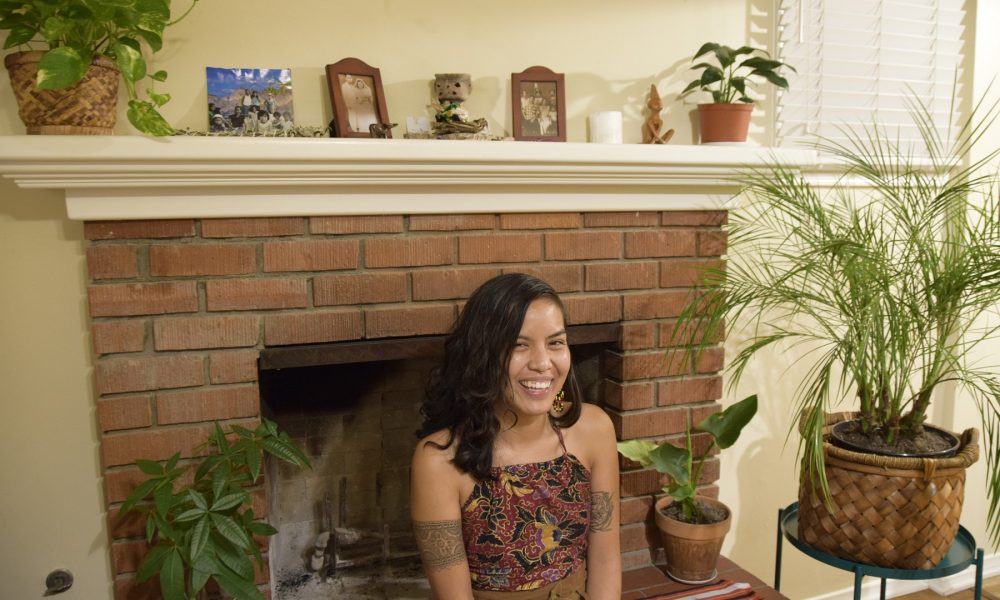
Hi Kei, please kick things off for us with an introduction to yourself and your story.
Returning to self has been the biggest driving force in my story. As a Filipina-American, I have been conditioned to self-hate and conform to Western standards of success, culture, and beauty. It took a long time for me to feel grounded and whole in my being. I always had a natural resistance to the norm. I often felt like the black sheep in my family and peer circles because of that truth. I have felt a lot of hiya—shame in Tagalog—for being a queer, brown woman because of both familial and societal beliefs. I was always taught to play it safe, conform, stay small, and be quiet for the sake of others. I realized how confined I was trying to live up to these standards and not living for myself was no longer an option for me. It took years of inner work—with the support of my closest loved ones and comrades—for me to develop unconditional love for myself, my truths, and all of the complex layers of my being. I started to embrace the intricacies that authentically made me the person that I am.
I am a proud Pinay with Ilokana and Ybanag roots from the Northern region of Luzon, Philippines. I come from a line of resilient, strong, powerful ancestors whose Bayanihan Spirit still lives on through my work. I cherish my symbiotic relationship with the land that continues to nourish and take care of us with love and respect. I turn to the plant medicine wisdom that is embedded in my DNA. I strive to connect to the matriarchal line that has uplifted, protected, and guided me even though we have never met in this lifetime. I bask in my sun-kissed brown skin that was passed down to me through generations. I prioritize the deep healing and decolonizing work as kapwa in the diaspora, reclaiming and remembering our ancestral ways. I sustain my love for my motherland—The Philippines—and find the courage and strength to fight for the struggles of Pilipinx people and all people through grassroots organizing. I am deeply and unapologetically in love with a radical, non-binary, queer spirit. All of these truths fill my heart with joy that I center my life around.
Embracing my truths led me to finally listen to my call to be a birth doula. We had bouts of cable television as a kid and, when I was four years old, I found myself watching a lot of Discovery Health and TLC. I was intrigued by all of the shows that were about pregnant people giving birth and knew at a very young age that I wanted to go into birth work. I have so many photos of myself as a kid holding a baby doll and have always felt a deep connection to children. The calling to birth work was stagnant for over twenty years as I dappled in many other disciplines—Women and Gender Studies, Psychology, Journalism, Environmental Studies, Horticulture, and Sustainability. All of these subjects have influenced my sense of self and intrinsic values. I worked 40+ hours a week for over ten years in food, hospitality, and management while living paycheck to paycheck. I continually found myself unfulfilled and depleted because I was not happy with what I was doing and I knew that I needed a change. My friend eventually helped me get the courage to leave my management job and I decided to seriously look into doula work because it was always a desire that resurfaced when I was questioning my life path.
At the time, in 2017, I only knew of the more institutionalized ways to become a doula which was very expensive, intensive, and a predominantly White space. With no other known options, I signed up for a training in Huntington Beach, put down my deposit, and started my required readings while waiting for the training to start even though my intuition knew it wasn’t right. A few weeks later, I was having coffee with another friend while on a lunch break and shared about my upcoming venture. She became deeply concerned about my choice. I remember her telling me how important it was that I was taught by another POC and that she just so happened to come across a flyer on Instagram for the first People of Color Doula Training in Long Beach. I had no idea that spaces like that existed, let alone in my hometown. The POC training felt perfectly aligned with me and it was exactly what I was looking for. I felt seen and supported in this work during my training and became part of the Birth Workers of Color Collective. I was surrounded by powerful and loving brown and Black birth workers that shared the struggle of being a POC in this work. By honoring myself as a Pilipina, I started diving into my ancestral work, relationships to plant allies, and deep healing. This fearless dive into my life work and self work was the beginning of Kasama Culture—my collection of work as a birth worker, doula, medicine maker, community organizer, artist, and chef. Three and a half years later, the Kasama Culture community support has grown even as it continues to evolve and shift.
Would you say it’s been a smooth road, and if not what are some of the biggest challenges you’ve faced along the way?
I always tell people that I feel like I’ve lived ten lives! My path has not been easy and I’ve had a long, rough road of lessons upon lessons in my 28 years of life. Not only have I physically moved over twenty times, I’ve also mentally and emotionally evolved and grown in tremendous ways. A lot of my struggles come from being the daughter of immigrants and being raised by a single, working class mother. In a world that doesn’t advocate for or support people like my family, I have had to learn how to navigate this world on my own with a lot of trial and error. I had to learn to trust myself, practice good discernment, set boundaries even when it was hard, and constantly readjust in order to survive many hard situations. I had to take risks and forgive myself when I made mistakes. I’ve had to sit in a lot of hard truths. It has all part of my path to self and, as difficult as it has been, I am grateful for how my story continues to unfold.
I have also been reprimanded for not taking the traditional route that my parents and family have dreamed of for me—studying at a university, pursuing a 40 hour a week career with a 401k and medical benefits, being with a cis-man, and so much more. I have had to truly accept myself, build confidence, and push away the flood of disappointment that I felt because I didn’t fit the mold of what a Pilipina “should” be. It also took a lot of time and searching to find a queer, POC community that I trusted in both life and work. I now have the support system that I have always dreamed about through my chosen family of peers, mentors, and friends. Their deep, unconditional love for me and my well-being means so much. They’re intuitive, mindful, supportive, critical (in all the best ways), and hold mirrors that help in my continued growth.
Lastly, it takes a lot of time to build trust in the community when you’re doing such sacred work like being a doula. It is such an intimate line of work that is predominantly an energy exchange between you and your client during one of the most vulnerable times in their life. I also always want to ensure that I am doing things in a good way while being as authentic and honest as possible. Back in the day as a newer doula, I had trouble getting clients because I wasn’t “experienced” enough. Now, three years later, this has shifted and people are reaching out to me because they have been following my work for a while or they’ve heard of me through word of mouth and recommendations. I trust that the clients I’m meant to serve will flow my way and that the energies I’m meant to work with will align with mine.
Alright, so let’s switch gears a bit and talk business. What should we know about your work?
Kasama Culture is the name I chose to represent many different avenues of my work. The name is very intentional—”kasama” meaning companion, friend, or togetherness. Collective life and working together, inspired by the Bayanihan Spirit, is the core of my work. The Bayanihan Spirit is a concept in Pilipino culture that revolves around community cooperation to achieve a goal that is for the people. It is inspired by the kababayan, community in Tagalog, coming together to help move ancestral homes called nipa huts from one location to another. Community would lift entire homes made of bamboo and coconut leaves and relocate it to its destination. I hope that, through these values that Kasama Culture upholds, we can start dismantling individualism by striving towards interdependence and collectivism.
I embrace all of my interests under the name Kasama Culture because they all embody me and how I want to serve my community. In my work, I am first and foremost a birth doula– a traditional birth worker or birth coach– that supports people in their pregnancy journey during their prenatal, birth, and postpartum. I unapologetically center and affirm the LGBTQ+, Black, POC, low-income, and marginalized communities through sliding scale pricing so that having a doula is financially accessible to them as they need the support the most. I help co-create a space for my clients to feel safe, grounded, and supported. I help advocate for the birth that they want and provide education for them to make decisions for their family. I also continue to build friendships with a lot of them after our time working together, become a Tita—aunty in Tagalog—to their children, and watch them grow up.
Aside from my doula work, I am also a grassroots community organizer in Long Beach, chef for my pop-up kitchen Kasama Culture Kusina, herbal medicine maker, and artist. Last October, I added two more offerings— I started curating a pop-up shop at my house where artists and makers can share their offerings and I also started guiding new doulas in their path to birth work. Kasama Culture is always evolving and I am the most proud that I have worked hard to create a community through my work. This isn’t just for me. It is for all of us. My work is centered on the people and the needs of the community. I am proud that I have co-created a space where we can connect and be in relation with one another whether it is through being part of someone’s pregnancy journey, feeding people a traditional Pilipino dish, or writing about the struggle of the Pilipino people in the Philippines and diaspora. I play all of the roles in my business—administration, operations, product development, marketing, graphic design, and so much more. I am proud that I can do this work while living in my truth and trust that I am contributing in a good way. I feel that I was placed on this Earth as a vessel to do the work of decolonizing and reclaiming Pilipinx traditions through these many realms, not only for myself but for my future children and community. There aren’t a lot of Pilipinxs in this work in general and I think that is what truly sets me apart from others. I feel a sense of responsibility to advocate for my Pilipinx community— immigrants, migrants, and Fil-Ams alike—and create a space where we feel safe, seen, and heard. I do that by, what my kasama calls, “warm brook energy”. I am a true Pisces— grounded, empathetic, go-with-the-flow, calm, and inviting. I meet people where they are at and hold space for them. I am a natural giver and it brings me joy to be of service to others. I truly hope that I am making my ancestors proud.
Are there any books, apps, podcasts or blogs that help you do your best?
There are a lot of resources that have supported my work and life. If I had to choose a handful that I constantly return to:
– The Radical Doula Guide by Miriam Zoila Pérez. My go-to read to remember how birth work is political and how issues of race, class, gender, immigration, and much more affects our clients and our work.
– Letters to a Young Brown Girl by Barbara Jane Reyes. A book of poems that I recently added to my collection. Its words reflect my own truths as a Pilipina that I’ve kept to myself. They make me feel seen and heard.
– Bruha Baddies Podcast. A podcast started by two Pinays, Jean and Rose, in Nevada to create a space for Pilipinx people to be in conversation around our shared narratives, covering a wide range of topics like Philippine history, beauty standards, and queerness.
– Kapwa Tarot Deck created by Jana Lynne “JL” Umipig. A tarot deck filled with hand drawn images of Pilipino significance, inspired by the ancestral healing work of JL. I had a hard time connecting to tarot because I didn’t resonate with other decks. JL’s Kapwa Tarot Deck has been a wonderful source of centering, guidance, and remembering self and my ancestors.
Contact Info:
- Email: kasamaculture@gmail.com
- Instagram: @kasamaculture and @kasamaculturekusina


Image Credits
Kareen Coyoca, Kei Karayan, Gregory Suzuki
Popular
-

Inside the Future of Search: Robb Fahrion on Building a Global Team and Leading the Rise of GEO
-

From Supporting Local Boutiques to Building Brand Partnerships: Cinthia Jensen’s Creative Marketing Journey
-

Building Community Through Curiosity: Nathanial and Samantha Rowe on the Vision Behind UNEARTHED
-

Portraits of the Valley
-

LA’s Most Inspiring Stories
-
Building Creative Bridges: Torrey Tayenaka on Community, Collaboration, and the Future of Sparkhouse