


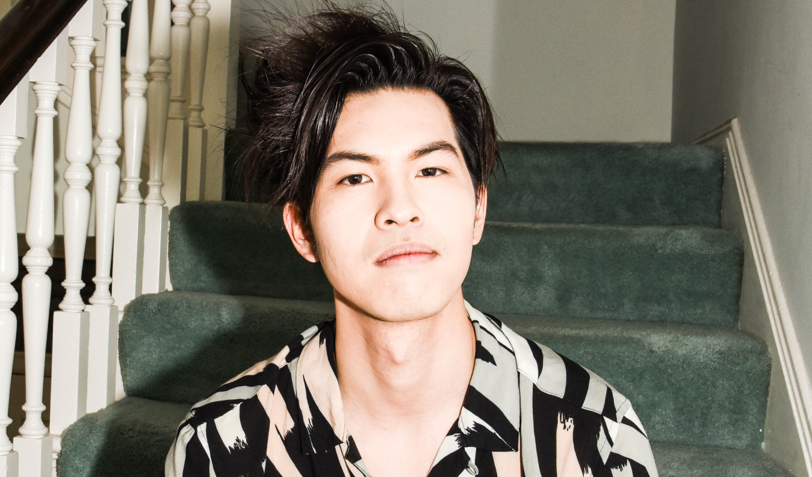
Today we’d like to introduce you to Kurt Sanchez Kanazawa.
Thanks for sharing your story with us Kurt. So, let’s start at the beginning and we can move on from there.
I’m an actor, Juilliard-trained opera singer, fluent Italian speaker, stick-shifting valet driver, and a Los Angeles native, born and raised, though both of my parents are from the Hawaii (the islands of Oahu and Kauai). I went to Warner Avenue Elementary, then Palms Middle School, then Harvard-Westlake School. Throughout my childhood, I was really focused on and great at extracurricular activities, especially jazz alto sax (played at Jazz Bakery, Catalina Bar and Grill), choir singing, basketball (yup, Japanese League, shout out to V.J.C.C. and the Venice Magic! + one proud year of high school ball), peer support groups, and theatre (playing the lead role of “Hamlet Q Jones”, a rock musical adaptation of Shakespeare, to sold-out crowds and five-star reviews at the Edinburgh Fringe Festival). Anything that tested your ability to stand-up in front of a crowd or interact with people, I’ve always felt comfortable doing. A small thing I was quite proud of was a choir I founded called “Community Singers” which still exists today at my high school. It’s a volunteer community service choir that performs a cappella in elderly homes and hospitals, especially during the holidays and though out the school year – inspired by my grandmother, Shimeji Kanazawa, and her legacy of giving to the elderly through Project Dana, founded at the Moili’ili Buddhist Hongwanji in Honolulu. It brings me a lot of joy that a little Aloha Spirit and music is still shared today with the community of Los Angeles.
Great, so let’s dig a little deeper into the story – has it been an easy path overall and if not, what were the challenges you’ve had to overcome?
I went to The Juilliard School for my Graduate Diploma in Vocal Arts. After a busy final semester including a week-long gig in Miami Beach and a well-reviewed opera performance in a lead role at Juilliard – all of which boded well for future career success – I started to feel sort of tired and strange in my middle voice, but my high notes and low notes were fine. I figured I was just over excited for some high-profile contacts I had coming up after graduation, including offers at Teatro alla Scala in Milan (the largest theater in Italy) through my agent and the Festival d’Aix-en-Provence in France on my own. So, I put myself on vocal rest for a week, and then that turned into almost a month of complete silence, just to be extra careful.
However, the day before I was supposed to leave for Italy, I went to see a doctor for what I thought would be some simple check-up with vocal exercises or a massage. But, this doctor wouldn’t let me leave the room. Then, after three hours, she said, “You’re going to hate me, and you’re going to feel like someone just died, but you’re never going to sing again.” She diagnosed me with a rare neurological condition called Vocal Dystonia, a genetic opera-career-ending condition from which there is no cure – but which needed to be confirmed by a neurologist. I was in total shock, and broke down crying. But, furious and in complete denial, I was determined to prove this doctor was wrong or else be the first-ever case that would come back from this professionally. And so I got on the plane the next day and left for Italy. Eventually, I received a third medical opinion from a neurologist in Padova, confirming the diagnosis…who had also recommended some modern therapies, none of which had proven to be successful including Botox injections into the throat, and it was just all awful. I was in a dark tailspin at this point, making up false excuses for canceled performances, keeping my agent, mentors, singing colleagues, close friends, and even family, everyone in the dark about my condition, and just trying to find an escape by working out in the gym. It was like my identity had gotten so caught up in my singing, I just couldn’t imagine a life without it. I deleted my Facebook and immersed myself in a completely new, anonymous life in Italy.
I was living at the time in the little town of Soleto (population 5,000) in Puglia. Soleto saved me. The worst moment of my life became simultaneously an incredibly therapeutic moment as well – simply picking olives in the fall with the townsfolk, or gathering wild arugula just after the November rains, and then strawberries, “more”, and sweet wild figs in the hot, humid summers, the BEACH…life was also so much cheaper and economical than New York that’s for sure, and it was easier to assimilate get around town, especially once I figured out how to drive a stick shift – I was also the only Asian person some of the townspeople had ever seen in real life I think, and they were so welcoming and warm to me everywhere I went on my bike, on a train, or walking home from the gym through a town festival or the end of evening mass or a band playing the “pizzica” – the traditional dance music of Salento. However, after enrolling in a frustrating Italian-only speaking iPhone programming degree in Lecce (though I did proudly design an app in Italian), I decided it was time to go back home to Los Angeles. I was in Rome, staying with an Aunt from Hawaii about to head home, when on a late afternoon, in a shaded Roman alleyway, an Italian woman started talking with me. She asked why I was fluent in Italian. I told her it was a long, long story. She said that she was a Casting Director for Film and TV, and in her opinion, my “look” could really work here. Shortly thereafter, I was cast in an Italian soap opera called Provaci Ancora Prof! as Ichiro (a Japanese taboo artist who speaks fluent Italian with a Japanese accent) and began getting print modeling jobs and even a couple of national commercials.
So, then I stayed in Italy another year, working as a screen actor and print model. But in 2017, while noticing more and more that actors from American TV shows like Elementary’s Lucy Liu kept showing up on my screen in Italy (dubbed of course), I decided I should come back home, because A) I speak English and B) it was too weird to be beginning an on-screen TV/Film acting career in Rome, when I was born and raised in L.A. and had never thought to pursue that as a child – probably because I never grew up with any male role models doing that who were successful screen actors and Asian. It’s exciting to be back home right now though. I’ve had some incredible opportunities to work alongside veteran film/TV Asian-American actors who I am now hopelessly star-struck by every time I get to stand next to them, including Gedde Watanabe, Jeanne Sakata, Tim Dang, Suzy Nakamura, Keiko Agena, June Angela, Angela Lin, Kahyun Kim, Ping Wu, Marilyn Tokuda, Krista Marie Yu, the Ishibashi Sisters (Brittany, Brianna, and Brooke), and so many, many more. I’m just in awe of how much they have endured and accomplished to get English-speaking on-screen Asians to this moment for film and TV, and constantly grateful and definitely looking ahead to the day that I might be able to leave behind an even wider path of narrative possibilities and broken stereotypes for the next generation to continuing shattering, or at least make good fun of relentlessly!
We’d love to hear more about your work and what you are currently focused on. What else should we know?
I still sing, though typically more hybrid pop-opera style or musical theater now, or just straight-up Marvin Gaye too, and I speak four languages fluently (Italian, French, and Japanese), as well as basic German conversationally because of my opera background. I also speak some Mandarin Chinese, thanks to opera as well, because I lived in Beijing and toured for over three years with the ISINGBEIJING project, now known as the I Sing! Festival, run by Metropolitan Opera singer Hao Jiang Tian. We were singing in concerts with orchestra at the NCPA Music Center, in front of 2,000+ audience members, and simultaneously broadcast live on national CCTV to the entire country – China is a crazy, awesome place – so many stories. I also can speak some Hawaiian Pidgin thanks to my huge local Hawaii family here in LA, and summers spent with my grandparents in Hawaii. I think my singing and language fluency has helped me a lot in my brief acting career, thus far.
I also love to read, and sit on the Ojai Playwrights Reading Committee, where I have also acted for the past two years in two plays that also happened to feature some operatic or pop singing – Alice Tuan’s “Cocks Crow” and Kimber Lee’s “Untitled F*ck M*ss S**gon Play”. I just believe that the only way Asian-Americans will find a voice is to lift up Asian-American writers and support their new works with joy, risk-taking, and total open-mindedness. { S T R } Sunday Table Reads, a table reading series I produce with Skylar Schock, is another outlet where I’m able to support that mission statement. At { S T R } we bring diverse writers and actors together to table read original screenplays and stage-plays ranging from TV pilots to shorts to two-act stage dramas and provide structured feedback based on the Liz Lerman method to writers who are often hearing their own words out loud for the first time. Of the 35 works we developed last year in 2018, over 50% of our writer’s new screenplays/stage plays went on to further development at Hulu, Netflix, and ICM, as well as Ojai Playwrights Conference, The Kennedy Center, and the Fade To Black festival. Two of our short film scripts have recently gone into actual production as well, including “Batfished” a hilarious vampire comedy by James Tang, which was just released on StudioADI’s YouTube Channel, as well as the supernatural dark comedy “She Had it Coming” by Anna Keizer, with a directorial debut by Gedde Watanabe (Sixteen Candles), in which I also play the co-starring lead, Ethan Tanaka, an 18-year old ghost – we just wrapped shooting last month, and I am really excited about this project especially for the diversity of the cast and the proportion of female-identifying crew.
I’m also fourth-generation Japanese-American from my father. Telling stories from that diaspora is extremely important to me, especially from my late Grandmother’s perspective, who was known as “The Florence Nightingale of Hawaii” for her efforts during WWII as chief liaison between the Swedish Consulate (who had taken over the Japanese Consulate) and the Japanese internment camps, to make sure the Geneva Conventions were being upheld during the war. Her experience as a nisei Japanese-American from Hawaii is a unique model of American thinking that I look forward to sharing with the world – especially because at the time when she was working in Honolulu that fateful morning in December 1941, nearly 40% of the island’s population was actually Japanese, which is why internment did not happen on as wide a scale as it did on the mainland USA – there was an intrinsic trust of the majority community in Hawaii, which sadly did not exist in the scape-goat and racist hysteria of mainland America.
An upcoming project I’m also looking forward to is a VR project for the Japanese American National Museum’s permanent collection, where I play Stanley Hayami – a brilliant, artistic, and elegiac young man born in Los Angeles, who was interned in Heart Mountain, and then tragically killed in Italy as a volunteer fighter for the famed 442nd Battalion – the most decorated military unit in US history. I look forward to shooting this unique VR piece in September with Nonny de la Peña and Emblematic Group (SXSW, Venice Film Festival, Sundance Film Festival) and telling many, many more stories like Stanley’s and my Grandmother’s. I’m also third-generation Filipino-American from my mother, and my grandfather and grandmother’s family came over to Hawaii from Ilocos for plantation work in Kauai and Oahu. To this day, I am still always shocked and thrilled to find Filipinos in every single city I go around the world, from Paris to San Francisco to Rome to Honolulu. The Filipino Diaspora is an international phenomena that is too rarely talked about or documented on film, and I hope to bring their stories and experience, as well as unique light-hearted humor and simultaneous melodrama, to light in the future as well.
Do you look back particularly fondly on any memories from childhood?
Both of my parents are huge LA Lakers fans, and they actually named me “Kurt” after Kurt Rambis because of how great of hustler, team-player, and collaborator he was during the showtime Magic Johnson era. I was a baby at this exact moment, so I don’t actually remember this, but apparently, after a game, my parents brought me down to the court of the Coliseum and held me up to Kurt Rambis. They told him that they had named their son after him, to which Kurt Rambis made a strange face, and replied, “why?”. Such a humble guy, with great glasses and short-shorts… love that story.
Contact Info:
- Website: https://www.kurtkanazawa.com


 Image Credit:
David Vassalli, Peggy Ryan, LATW, Nathan McMahon, Keiko Agena, Kahyun Kim, Gedde Watanabe, Skylar Schock, Jared Fleming.
Suggest a story: VoyageLA is built on recommendations from the community; it’s how we uncover hidden gems, so if you or someone you know deserves recognition please let us know here.
Popular
-
What is something outside of work that is bringing you joy lately?
-
Local Highlighter Series
-
What did suffering teach you that success never could?
-
What are you most proud of building — that nobody sees?
-

Who were you before the world told you who you had to be?
-

If you could say one kind thing to your younger self, what would it be?