


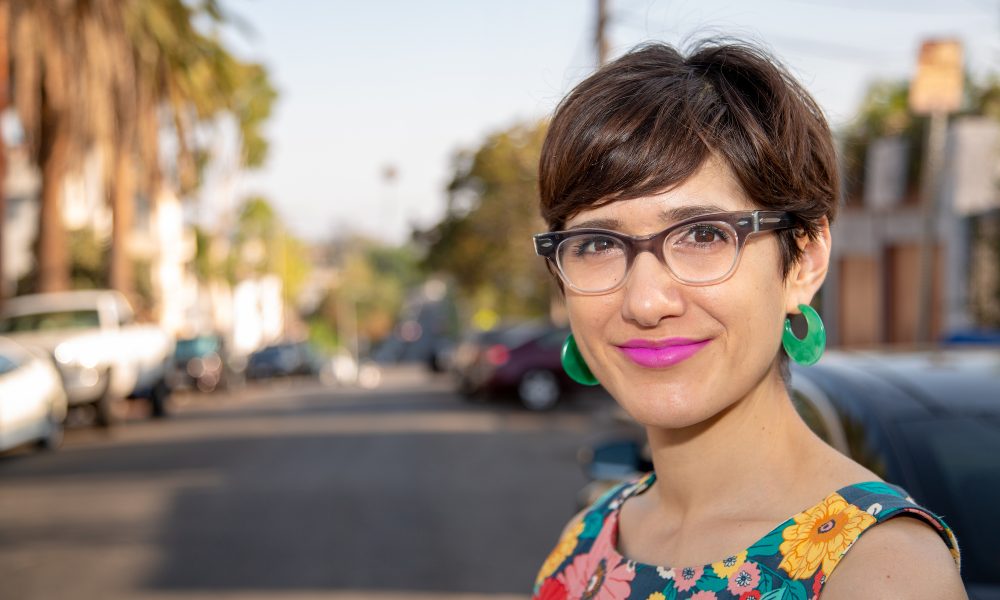
Today we’d like to introduce you to Julia Prescott.
Julia, can you briefly walk us through your story – how you started and how you got to where you are today.
I’ve been lurking around LA comedy since 2009. Doing stand-up and sketch and producing various kinds of comedy shows to varying degrees of success. I used to always joke that producing live shows in LA was like throwing a birthday party for yourself every week, where you exert so much energy just trying to get confirmations from people, working every angle you can to maintain engagement, and then the day of the show hits and all you can think about is, “I hope people come to my birthday!”. If they don’t, you kick your feet and go, “Oh well, we’ll get ’em next time.” If they do, then you savor that glory for about as long as the show lasts, then wake up the next morning with organizational amnesia, diving right back into the grind again.
Because of this, and because of the oversaturation of live comedy shows out here, I was on the hunt for something slightly different. Something that would provide entertainment, but also entice a different kind of audience with something a bit more positive and proactive.
I had been working with the staff at Meltdown Comics (RIP forever), and talking about what shows they may be interested in putting up. There was a whole chunk of time in the afternoon that wasn’t being used — the time before their primetime 8pm and 10pm shows. They had some history with hosting panels, but I pitched them the idea of doing a monthly in that afternoon chunk that covered a hyperspecific topic for helping folks get their foot in the door for the Entertainment Industry.
I went to film school, been through a good handful of panels and lectures myself, but I never fully walked away with the kind of marching orders I longed for. Everything would always have this super general message of, “Just follow your passion!” or if a writer was on the panel and they were asked how they made their first sale, they’d usually say something like, “I just had a script!”. Not helpful, you know? (and yes, for the record, this advice would often come from a SWM. Even less helpful).
So the JP Lecture Series was born (JP ’cause I’m Julia Prescott, you get it). I started centering every show around a central question: How Do You Get a Writing Job? How Do You Break into Comedy Directing? How Do You Get Representation? Each panel I’d round out with as many diverse voices that I could find. For our first one, our panel was a murderer’s row featuring Megan Amram, Laurie Kilmartin, Vanessa Ramos and Haley Mancini. We’ve done ones featuring Simpsons showrunners, writers from The Onion, done a Rick and Morty writer’s panel TWICE, hosted a panel of development execs dissecting what makes a good pitch meeting, done ANOTHER panel with show creators where THEY described what makes a good pitch meeting, the list goes on and on.
I’m now in my 4th year of producing the show and I’m happy to say that every lecture has raised the bar higher and higher for not only the quality of the discussion and advice but the after-glow of the audience as they go back to their cars with a full notebook of notes. I also along the way realized how much I enjoy hosting this kind of thing and will admit that from time to time, the topics and panels themselves feels slightly indulgent. I’m such a fan of these folks, and I’m just as curious as the audience, too. Sometimes I’ll structure my moderating questions around talking points I know the audience will wanna hear, sometimes I just ask what I’m personally interested in hearing about, too.
I’m so happy I found this niche path to living in LA comedy, and I wanna keep doing the show as long as they’ll have me.
Great, so let’s dig a little deeper into the story – has it been an easy path overall and if not, what were the challenges you’ve had to overcome?
I would say my challenges mostly exist within navigating LA comedy as a whole. As mentioned previously, it can be difficult to figure out what LA audiences will give a shit about — and that’s not to say that you should sell yourself out and just pander to the public. I always give the advice of sticking to what vibes for you and trusting that your audiences will come.
When it comes to producing LA comedy, I think you need to have a very low bar for success. If you get even 20 people to show up, holy shit. I’ve performed and produced more shows than I can count whose audience was literally the other comedians waiting to perform. Then there’s the shows out there that I lovingly call, “performing on a burning viking ship” or perhaps “Titanic band gigs”. Those are the ones where it feels like you’re going down with the cause, whether it’s an unruly crowd who doesn’t give a shit about you or a silent crowd who doesn’t give a shit about you. You have to develop stamina to go out there and not care as much, and just trust that tomorrow’s another day.
In regards to the JP Lecture Series specifically, my challenge is consistently forming a line-up that I think will not only be interesting to our audiences but will be gettable within the timeline I have to book and promote. I try to balance my line-ups with diversity, but that doesn’t always work out with busy people’s schedules. I also try to get folks with name recognition that can excite audiences, but of course, if they’re show running a primetime series at the moment, they don’t often have a ton of extra time to come out to Silver Lake and sit in a black box theatre.
That being said, producing the JP Lecture Series has been the smoothest process I’ve ever had in producing live comedy. Maybe because it mostly isn’t “a comedy show” and is more of an educational lecture with a comedic slant. I really try and maintain our shows in having a consistent pattern of real, practical advice and also provide audiences with resources they can use immediately after the show to ensure they’re making tomorrow the first day of the rest of their lives, so to speak. This Industry is so unnecessarily cagey about “giving away the secrets”, so I try to shatter through that as much as possible.
Is there a characteristic or quality that you feel is essential to success?
You know, just the definition of “success” has been something that I’ve lamented and struggled over for — I wanna say most of my adult life. I grew up as a super type-A ambitious perfectionist kid. This was great when I was crushing creative writing assignments, not so great when I was steadily setting a bar for myself that contained hyper-specifics that were just beyond my realm of control, and when I didn’t hit them at the time I thought I would, it was absolutely crippling to my sense of self and motivation. I’ve always been an overachiever, which is why I think I got my quarter-life crisis early — at age 23 when I was unemployed after my first lucky bout as a staff writer for a Cartoon Network show. I remember thinking at that time, “I’ve done it! I’m ready! I’m on the other side!” Because so much of my life in film school and internships told me a story about how it’s all about getting that first writing credit, then it’s smooth sailing. Well, it wasn’t. I think I went a full year without working as a writer in any kind of regard, and I had to swallow a lot of my pride and expectations and go back into the entry-level work force feeling like a failure. I’m proud that I stuck with it and kept writing so that the next time an opportunity came up I had something to show, but I’d be lying if I said my sense of self didn’t take a massive hit.
I used to define success as having credits. Working (and working a lot) within your dream title. Having money to support yourself and then some. Feeling as if you’re not hanging by a thread at all times. Success to me was being known in my industry and making a name for myself and never feeling like I needed to hike up that hill again, that I needed to prove myself as much as I did when I was in my early twenties. I know now that the reality of working in this industry is that you’re never not hustling, even if you do have credits under your belt, even if people do know your name and know your work — you’re gonna be hustling just as hard if not harder as when you were 22, to when you’re 42. Being a working writer is constantly leading a conversation about yourself. When I was 22, I was in the process of proving that I was worthy of being a working writer at all, that I had any semblance of talent. Now in my 30’s, I feel like it’s out there that I’m talented — but talented only in select genres. My process of “proving myself” now exists in convincing people to take chances on me to do something different, for different audiences, with different ideas I’ve never explored professionally before. It’s the same process as it’s always been for me in a lot of ways, the specifics just change.
To go back to your specific question, I think the qualities you need to be truly successful in a creative career in Los Angeles is to know what your strengths are, and lean into them. To know that true success doesn’t hinge on the hyper-specifics you set for yourself at an age where you’re too ignorant and inexperienced to know the full reality of it. To not think that if you don’t get an immediate staff job on a big primetime show at a certain age, then surely you’re drifting behind. There’s no real timeline to any of this, and if your peers or folks that started this process after you seem to blast past you in their trajectory, it has absolutely nothing to do with you. I used to spend a lot of time comparing and despairing, and I still struggle with that to this day, but I have to keep reminding myself that other people’s success is not a comment on mine, and that my opportunities are coming, it’s just a matter of waiting it out.
I think you have to hinge your milestones on something that isn’t in the hands of someone else, too. Shift your mindset to what will make YOU proud and make YOU feel successful. Finishing a pilot is successful to me. Carving time in my daily life to be creative with no strings attached (meaning it’s not for work or a pitch, etc) is successful to me. There’s something my husband Mike (who’s so insanely talented and cool and kind and cheerleads me when I need it and is everything you can ask for in a partner and more) (and also leant his brilliance to shows like Big Mouth on Netflix as one of their supervising directors) — there’s something he always tells me that helps put everything in perspective for me: “Think about the people you look up to the most, the people you get inspired by the most. People like Amy Sedaris, or Lizzy Cooperman or Chris Fleming or Natalie Palamides or Courtney Parauso who are just out there doing their thing in such great, wild, wonderful ways. Imagine if they quit, and how hard you would take it.” Because the truth is of course, we all have imposter syndrome, and we all have doubts, but there’s always going to be people out there who witness you putting yourself out there — if you remain true to who you are and you take creative risks, and you follow your strengths — those are the people that matter. That’s who your audience is. And they would be devastated if you quit, just as I would be devastated if any of those people quit.
I think about that a lot as I’m going through my hard times. And to be cheesy, my husband always says this with a coda of, “You were one of my favorite comedy people before we met, and I would be devastated if you had quit.”
It’s funny, I literally just got rejected from a writing job on Friday — one that I was really excited about and one I had been waiting to hear back from for over a month. Before I received word back, I kept thinking, “Okay, this is the next chapter. Here we go, success train leaving the tracks.” But then I didn’t get it, and sure, yeah, I cried, but it was more of a cathartic cry. Because I know it’ll just free me up for another path I can’t see yet, and other lessons I haven’t learned yet, and that nothing is the way we plan it. Success is just learning to appreciate that part of the process.
Pricing:
- Our shows are always $8 in advance and $10 on the day! Which when you consider the cost of film school…
Contact Info:
- Address: Lyric Hyperion Theatre
2106 Hyperion Ave. Los Angeles, CA 90027 - Website: lyrichyperion.com
- Phone: (323) 928-2299
- Email: [email protected]
- Instagram: juliaprescott
- Facebook: https://www.facebook.com/jplectureseries/
- Twitter: twitter.com/juliaprescott/


Image Credit:
John-Michael Bond, Mike L. Mayfield
Suggest a story: VoyageLA is built on recommendations from the community; it’s how we uncover hidden gems, so if you or someone you know deserves recognition please let us know here.
Popular
-

What is something outside of work that is bringing you joy lately?
-

Local Highlighter Series
-
What did suffering teach you that success never could?
-

What are you most proud of building — that nobody sees?
-

Who were you before the world told you who you had to be?
-

If you could say one kind thing to your younger self, what would it be?