



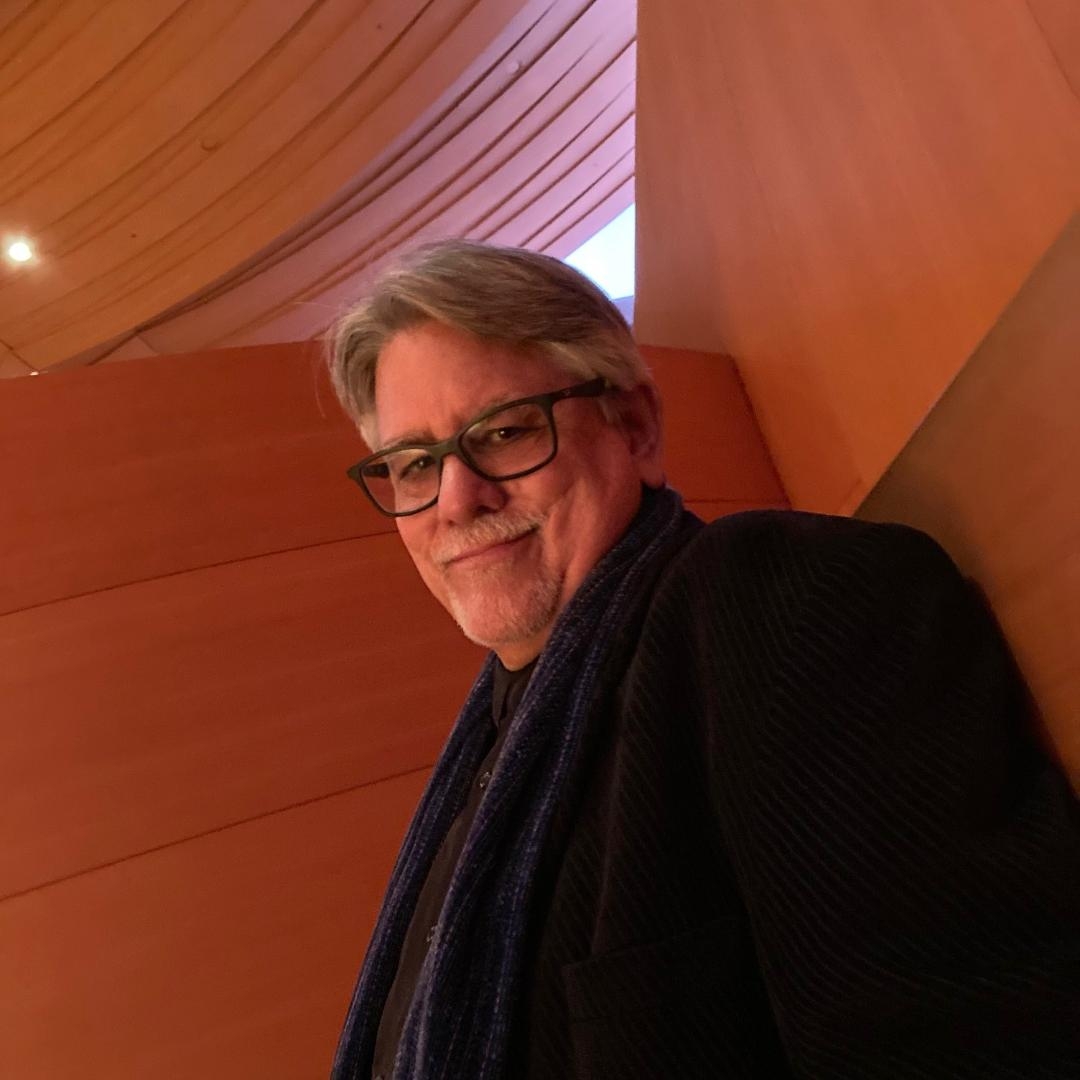
Today we’d like to introduce you to Steven Paul Leiva.
Hi Steven Paul, thanks for joining us today. We’d love for you to start by introducing yourself.
The real question is how I got started several times, since I’ve had several occupations. But during these jobs, I always thought of myself as a writer, so I’ll start there. After three years of taking drama classes in high school, acting in several productions, I came out not, as one might expect, wanting to be an actor, but wanting to be a writer. I didn’t want to perform other people’s words; I wanted to create the words that told the story. As a happy reader, I realized that for me, the most beautiful landscape in the world was not a gorgeous valley or a stunning mountain range, but a white page filled with black letters forming words that had been laid down rationally to make a coherent story about interesting people. Filling up blank pages with those words was all I wanted to do.
Unfortunately, life doesn’t always let you do what you want, so I found myself married too young, with a newborn, and a job selling major appliances in Orange County. This went on for several years, but finally broke apart with a divorce from both wife and job. I took this as a great opportunity and secured a job writing for Neworld: The Multicultural Magazine of the Arts, published by the Inner City Cultural Center in Los Angeles. And later for The Cinemaphile, a tabloid dedicated to movies, past and present. I was writing and finding joy in it, but I wasn’t being paid. However, I did make contacts in the arts and film, and, eventually, one led to a job as the executive secretary of a film animation association, working side by side with its president, the great June Foray, the voice-over actress best known as the voice of Rocky the Flying Squirrel. This job eventually led to another as an animation programmer for the 1978 Los Angeles International Film Exhibition (Filmex), the greatest film festival L.A. has ever known, and now, sadly, almost forgotten. After Filmex, I used the contacts I made there to start a one-person publicity company, specializing in small animation studios, including Chuck Jones Enterprises, Bill Melendez Productions, and Richard Williams Productions. Chuck was the great Looney Tunes director of Bugs Bunny and Daffy Duck, then making TV specials. Bill directed all the Charlie Brown TV specials, and Richard was an Academy Award winner who later directed the animation for Who Framed Roger Rabbit?
In these jobs, there was a fair amount of writing, but not the writing I truly wanted to do. So, in my spare time—usually midnight to three a.m.—I started working on my first novel. But working with animators gave me a passionate love for the art of animated films. I just wanted to see animation grow up and do productions that were more interesting and challenging than just kiddie shows and talking animals, which was where the art form was pretty much stuck at that time in America. If I wanted to see that happen, my only choice was to become a producer. I started looking for projects I could promote and secure the funding for, and in 1980, I met a young animator named Brad Bird. He wanted to do an animated feature based on Will Eisner’s great comic book character, The Spirit. The Spirit was what I dubbed a superhero film noir, miles away from kiddie entertainment. I was thrilled. One of the people I met because of my work at Filmex was Gary Kurtz, the producer of American Graffiti and the first two Star Wars films. He had left Lucasfilm and now had his own production company. I sold the project to him, and I was on board as a producer. Gary also hired me as his director of animation development, tasked with assembling American animation talent for a co-production with a Japanese animation company. It was based on another comic strip, Winsor McCay’s early-20th-century Little Nemo in Slumberland.
This production, which we called Nemo, took me to Japan for a year, along with my assistant, Amanda, whom I married and remain happily married to to this day. Unfortunately, the film we were trying to craft with the Japanese never came together, and I left the production, as Gary did soon after. Sadly, we were never able to get a major studio to fund The Spirit. It was just too radical for the Hollywood powers-that-be, who thought of animation features as either old Disney flicks or the Care Bears.
After returning from Japan, I worked for a couple of small live-action production companies for the rest of the 1980s, but I reconnected with Chuck Jones and, in 1990, we formed Chuck Jones Productions. I served for 2 years as the company’s president and produced an animated segment for the Warner Bros. comedy Stay Tuned with John Ritter and Pam Dawber. After I left CJP, I formed a company with director Jerry Rees. We were contracted by Jaws producer Richard Zanuck of The Zanuck Company and Alan Ladd, Jr, CEO of MGM, to produce an animated feature based on the classic Betty Boop character. Sadly, after three months of storyboarding the film, Ladd was booted out of MGM, and the new guy killed the project.
Rees-Leiva Productions had self-generated projects we wanted to make, and we were shopping them around Hollywood when, in 1995, we were hired by Warner Bros. and Ivan Reitman to produce the animation for Space Jam, starring the very tall Michael Jordan and the relatively short Bugs Bunny. It was a rush production that needed to finish before Jordan had to go back to playing basketball. I put together an animation studio for the production in three days over the phone, aligning three small animation studios, two in London and one in Ohio. Other studios joined us later, but these three got the ball rolling.
During this period, from 1975 to 1996, I wrote on my own time. I wrote a play, Made on the Moon, which I started while working for the Neworld arts magazine. A young group of London-based actors produced it for the 1996 Edinburgh Festival Fringe, which was a dream come true. It received a 4-Star review from The Scotsman newspaper. But back in America, the play kept just missing being produced, including an off-Broadway run in New York. It was disappointment after disappointment. Eventually, I turned the piece into a novella, which I’ve included in my book Extraordinary Voyages. I also wrote a novel, Blood is Pretty, a satiric Hollywood thriller featuring my hero, The Fixxer, and its sequel, Hollywood is an All-Volunteer Army.
As my time working in Hollywood was marked by more disappointments than successes, and I was never able to work on a film project of my own, I was getting sour about the industry. Rees and I continued to try to set up something of our own from 1996 to 2000, but nothing happened. The last thing I did in Hollywood was voicing the character of Scott, the owner of a snow dome store, in Oscar (Steve) Moore’s Academy Award short-listed (coming in the top ten) animated short, “The Indescribable Nth”, which is available for viewing on Vimeo (https://tinyurl.com/ywy37c4f).
The best thing I got out of working in Hollywood was meeting, working with, and getting to know Ray Bradbury, one of our great American authors. In 2010, I created and produced Ray Bradbury Week in Los Angeles. It was so designated by the Mayor and City Council of Los Angeles, and was a week-long series of events celebrating Ray’s 90th birthday and his work. I also lobbied the City Council to name the Los Angeles downtown intersection of Fifth & Flower RAY BRADBURY SQUARE.
As the 21st century began, I decided to focus solely on my first love: writing prose fiction. Since then, I have published fourteen novels. I started out publishing through several small publishers, but was convinced by a fellow author, the wonderful Jean Rabe (The Piper Blackwell Mysteries series), to strike out on my own, as new technologies now made it easy to publish and market your own books. This gives authors complete control over the publication of their works, with no gatekeepers second-guessing their intentions or, to be frank, mucking them up. I created my own imprint, Magpie Press, and got the other publishers to return the publishing rights to several of my novels. All my books are now available on Amazon as eBooks and in print, with a few as audiobooks, all published by Magpie Press.
With total freedom, I’ve been able to avoid being pigeon-holed into writing only one genre, as often happens in mainstream publishing. I have written thrillers, science fiction, fantasy, and contemporary mainstream fiction. If my books have a common denominator, it’s satire.
If my books are good, I’ll happily take all the credit. If my books are bad, I have no one to blame but myself. Fortunately, I have been happy with the response to my books by reviewers and readers, so I’m happy to take the credit.
Some might call it self-publishing, but I prefer to call it Indie Digital Publishing. After all, there is indie rock and there are indie films, so there is no reason why there shouldn’t be indie books. The five huge, gargantuan, mega-corporation book publishers shouldn’t have all the fun.
Can you talk to us a bit about the challenges and lessons you’ve learned along the way. Looking back would you say it’s been easy or smooth in retrospect?
The road has been relatively smooth. The potholes may have been surprising, even upsetting, but I always got back on the road, or found a new, better road.
Thanks for sharing that. So, maybe next you can tell us a bit more about your work?
The best way to answer this is to direct readers to the MY BOOKS page on my blog at https://emotionalrationalist.blogspot.com/p/my-books.html. But suffice it to say, I am a novelist writing in several genres. For me, the joy of art is in the doing. So I write to please myself. If I please readers, that’s a more-than-pleasant perk.
Can you tell us more about what you were like growing up?
Born in 1949, I grew up a typical 1950s kid in the SoCal city of Azusa. I played in the neighborhood alone or with friends with absolutely no adult supervision. But when the mothers stepped out onto their front porches and screamed out our names, screams that reverberated throughout the neighborhood, we knew to rush home posthaste—not that any of us knew what posthaste meant.
I was a good kid and rarely got into trouble. Except for the time my best friend and I tried to dig a tunnel from my backyard to his backyard, three houses away. We were quite romantic that way. We stopped after we had dug down about four feet; the romance of the venture was gone, and we were exhausted. However, we didn’t want to waste our hard work, so we filled the hole with water and jumped into it. This led to one of the few times I suffered corporal punishment by my parents, after which my cheeks were quite red. And I don’t mean in embarrassment.
My only real interest was reading. I started with DC superhero comic books, Superman being my favorite. And I’m pretty sure I was smitten with Supergirl. Later, I added Tom Swift, Jr., Tom Corbett, Space Cadet, and The Hardy Boys hardback books to my reading material, along with junior readers’ biographies of Davy Crockett and Daniel Boone and the like. Eventually, I graduated to the James Bond novels by Ian Fleming, the works of Ray Bradbury, and W. Somerset Maugham’s Of Human Bondage. Reading those three authors planted in me a great desire to write.
My parents bought a television set six months after I was born. So I grew up with TV not really as an interest of mine, but rather a glass-covered font of screen entertainment to worship. Each year, I memorized the prime time schedules of the three national networks as others might memorize Bible verses.
I was a Boy Scout, and, not surprisingly, the only merit badge I earned was in Library Science.
In my sophomore year of high school, I discovered Drama. I became active in the Drama Club, took Drama as an elective during my junior and senior years, and performed in several plays. It changed my life, turning me permanently into a ham and giving me a deep love of literature, adding plays to my reading lists. This experience gave me an even more profound desire to write my own words than I had had before. And so, I write, therefore, I am.
Contact Info:
- Website: https://emotionalrationalist.blogspot.com/
- Instagram: https://www.instagram.com/steven_paul_leiva/
- Facebook: https://www.facebook.com/steven.p.leiva/
- Youtube: https://www.youtube.com/@StevenPaulLeiva/videos
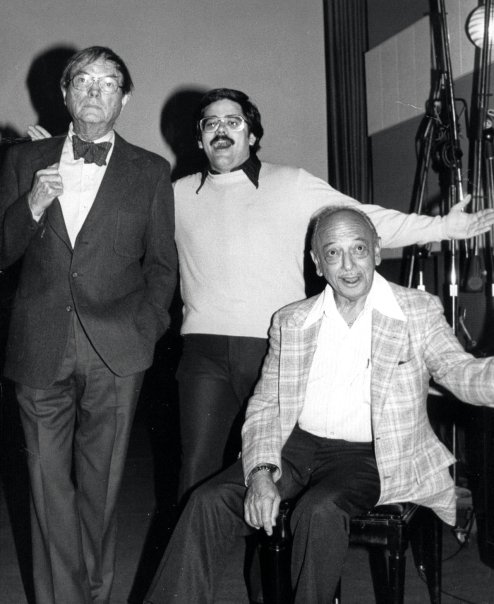
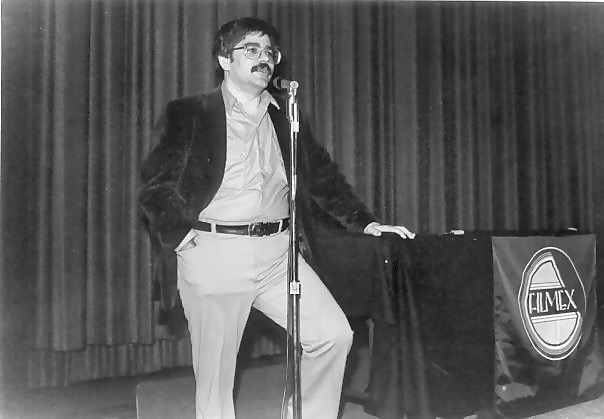
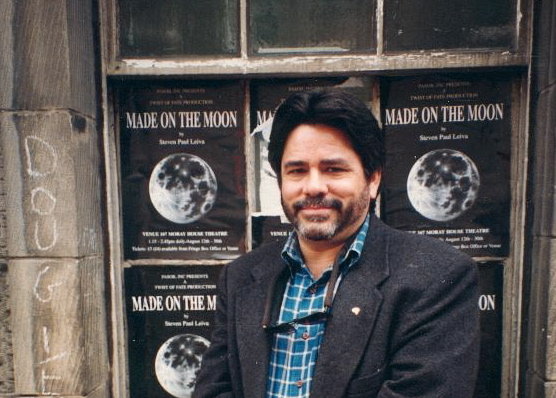
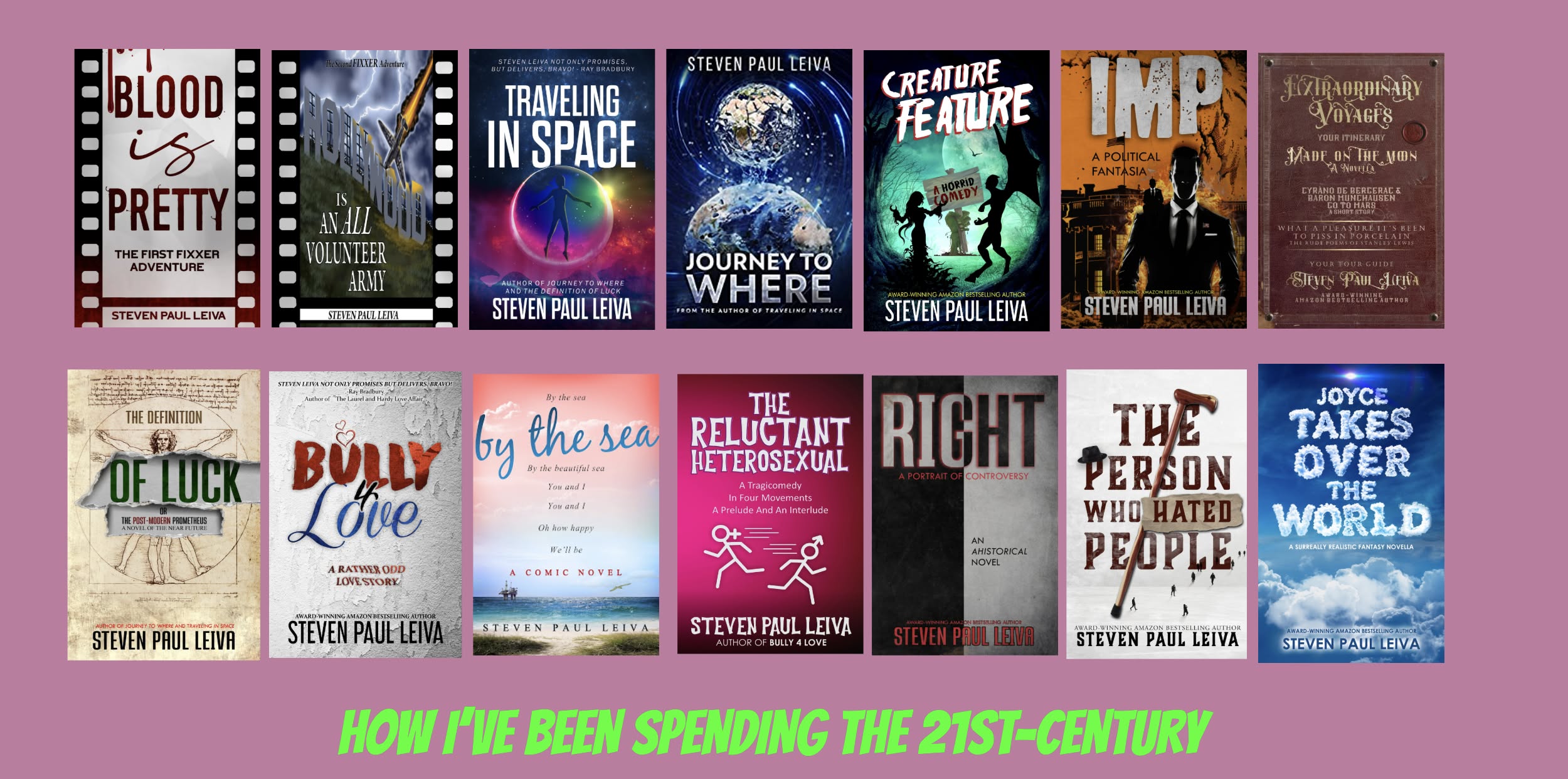
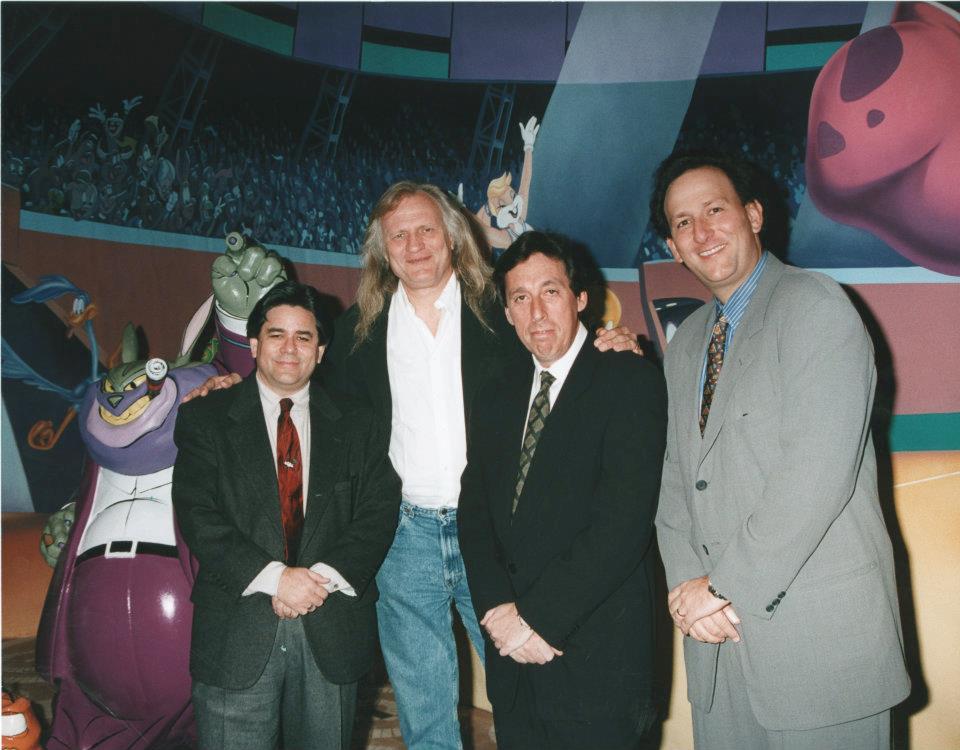
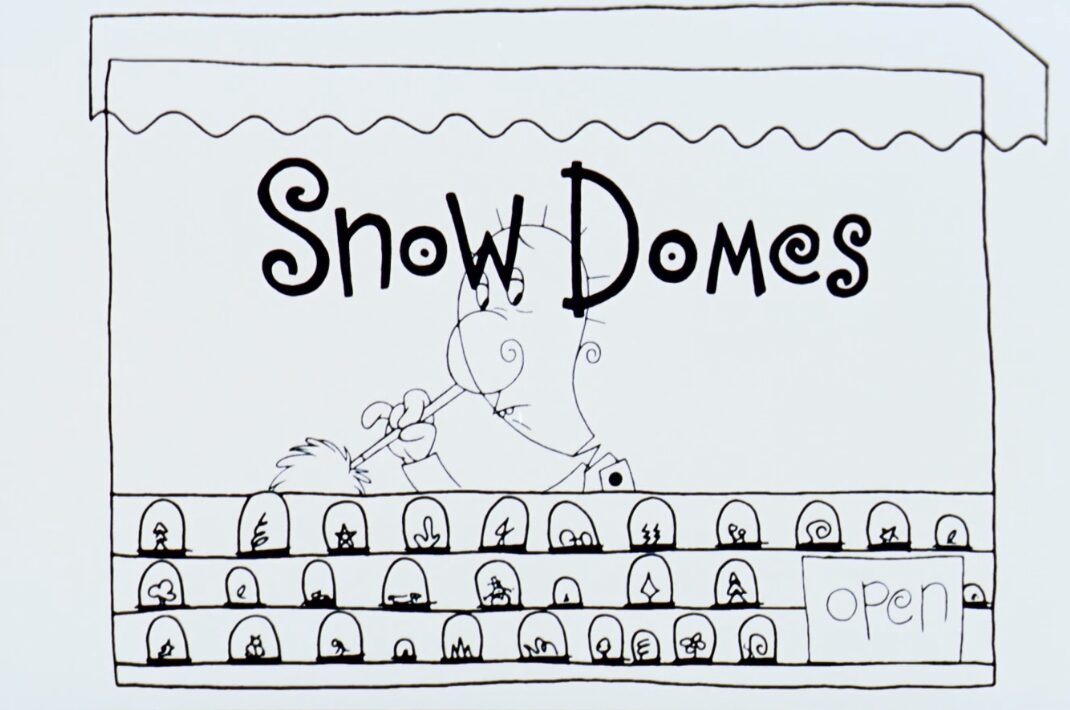
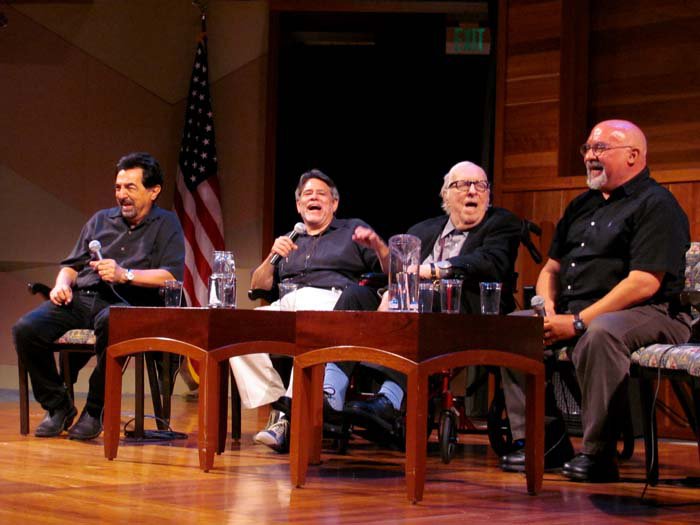
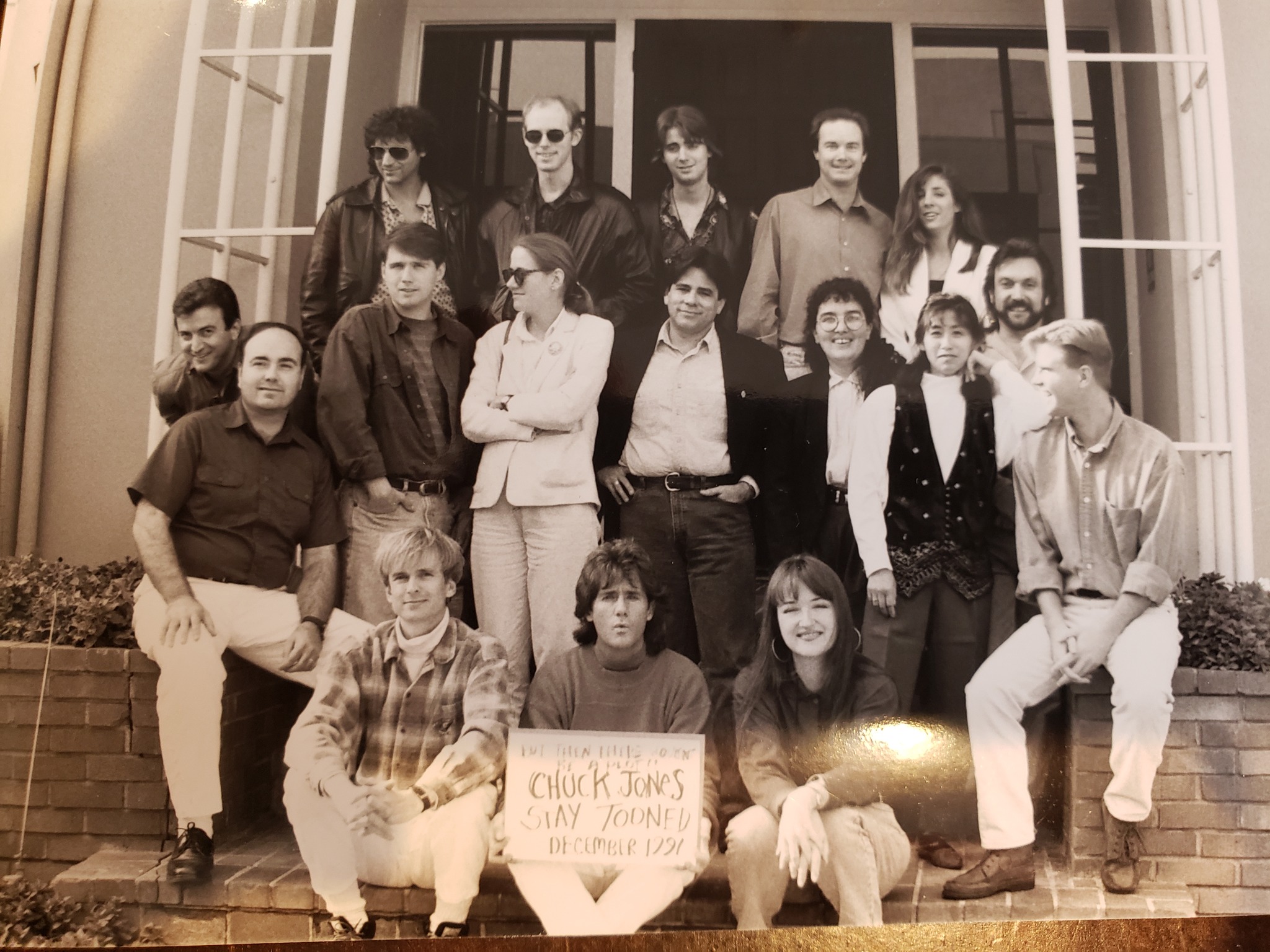
Image Credits
The photo of me should be labeled: Photo by Amanda Martin.
If you are going to caption the other photos, here are the captions I would suggest
1. Chuck Jones, Leiva, and Mel Blanc goofing off at a recording session.
2. Leiva is introducing a program he produced at the 1978 Filmex.
3. Leiva in front of the theater in Edinburgh, where his play, Made on the Moon, premiered in 1996 at the Edinburgh Festival Fringe.
4. Leiva’s books.
5. Leiva, director Joe Pytka, producer Ivan Reitman, and executive producer Ken Ross during the production of Space Jam.
6. A scene from “The Indescribable Nth” featuring Scott, the owner of a snow dome store, voiced by Leiva.
7. Actor Joe Mantegna, Leiva, Ray Bradbury, and director Stuart Gordon at a screening of The Wonderful Ice Cream Suit during Ray Bradbury Week in Los Angeles in 2010.
8. Leiva (in the center) and the animation crew working on an animated segment for Warner Bros.’ Stay Tuned.