



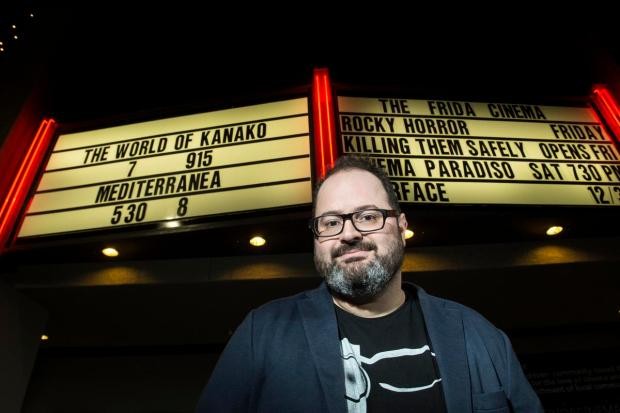
Today we’d like to introduce you to Logan Crow.
Logan, we appreciate you taking the time to share your story with us today. Where does your story begin?
As far back as I can remember, I’ve always loved movies. And not just the movies themselves, but going to the movies, talking about movies, movie posters, movie quotes, introducing people to movies, video stores, and of course, the movie theaters that offered me opportunities to escape into cinema. As a small kid, I assumed that meant I had filmmaking in my future, but the more I spent time in movie theaters, the more I realized it was more the culture of cinema itself, as an art form and as a community and conversation, that I felt acutely at home in. I grew up in Torrance, CA, and there was an art-house cinema in neighboring Hermosa Beach called The Bijou where I watched dozens of great films, and whose sudden closure devastated me.
As soon as I could get a driver’s license, it was off to the art houses in Los Angeles, and it was while volunteering at the American Cinematheque’s Egyptian Theater while going to college that I discovered an unlikely calling — essentially, taking my love for watching, sharing, discussing, and celebrating cinema, and creating a space for it. I’d spent my life being inspired by so many art house cinemas, and I found myself visualizing a place that was inspired by those things I loved most about them, complemented by a few ideas of my own. Of course, it’s not as easy as just opening up a cinema of one’s own, so I started by renting or partnering with some truly wonderful and supportive movie theaters to present cult and classic films — first the Vista in Silver Lake (under the cult cinema brand Mondo Celluloid), then Long Beach’s Art Theater, and a few films at L.A.’s Downtown Independent. I founded a non-profit called Long Beach Cinematheque, and for almost five years we not only programmed hundreds of great films but also started community events such as Long Beach Zombie Walk Music & Arts Festival and a series of classic film screenings at historic Sunnyside Cemetery.
Ultimately, all this work caught the attention of the landlord of the space that would become The Frida Cinema, and on a fateful 2013 day, he reached out to see if I’d be interested in running a cinema of my own. It was too much of a dream come true to pass up, even though it honestly came out of nowhere and, whereas I felt confident in my love for cinema, the arts, and community-building, running a space of my own would be something I’d have to immediately start figuring out from the ground up. I laid all those cards on the table, and fortunately I was given a chance: after just a few sleepless months, The Frida Cinema opened on February 21st, 2014. I am so proud of what The Frida has become over our first seven years and how our programming and impact continue to expand year after year. I’m aware that it’s almost too specifically a dream-come-true story and that it feels like some sort of contrived “if you built it they will come,” “visualize it and it’ll happen” inspirational yarn, and I certainly wasn’t consciously spending my life trying to “will my art house into being,” but that’s truly how the story went. I spent my life dreaming of a place that suddenly fell on my lap.
We all face challenges, but looking back would you describe it as a relatively smooth road?
The road has definitely been rocky, although I count my lucky stars that there’s never been a moment where I felt like I’d made a mistake or that it was time to close up shop. From time to time, I had to make some very extreme sacrifices, but they didn’t quite feel that way at the time — they were simply things I had to do to keep The Frida going, particularly during our first three years. Virtually every struggle had to do with money. Our programming is intentionally eclectic, curated from within with a focus on keeping our offerings as diverse as they are engaging, and we’ve always committed ourselves not to fall into the trap of going for “sure thing” programming at the risk of betraying our mission. Sure that’s admirable, but it’s also the sort of principled thinking that puts an accountant in the hospital. Fortunately, philanthropic support for The Frida began to increase after our first three years, and I think that was partly people discovering The Frida, but moreover, people truly realizing that what we claimed to set out to do wasn’t simply us blowing smoke. Our commitment to our mission has been steadfast and evidenced consistently by our programming, partnerships, and impact, and as supportive and appreciative feedback really started to build around The Frida, so did the fiscal support. We still find ourselves making some tough choices here and there due to lack of funding — particularly after this last year, as no doubt you can imagine — but we’ve come such a long way from how dire things used to be. (knocks on wood)
We’ve been impressed with The Frida Cinema, but for folks who might not be as familiar, what can you share with them about what you do and what sets you apart from others?
The Frida Cinema is proud to serve the County of Orange, CA, as its sole non-profit art-house cinema. Dubbed “Downtown Santa Ana’s cultural anchor” and “Orange County’s year-round film festival” by OC Weekly, The Frida is a two-screen art house cinema founded with the mission to “enrich, connect, and educate communities through the art of cinema.” A safe and supportive space for artists and arts patrons alike to amplify their visions, passions, and voices, with a core curatorial approach to its programming, The Frida provides its community access to international, independent, cult classic, documentary, LGBT, short, and remastered classic films, across a full spectrum of genres. The Frida also serves its Downtown Santa Ana community as a cultural institution, hosting rotating lobby art shows, civic presentations, panels and discussions, educational workshops, and so much more.
A regular partner to community arts, educational, and cause-based organizations and institutions, The Frida Cinema has served as a home and supportive partner for dozens of film festivals, from genre fests like Horrible Imaginings Film Festival to events showcasing the works of students from local elementary schools, high schools, and universities. The Frida Cinema has partnered with well over 150 local institutions, hosting events that raised funds and/or awareness for issues including human trafficking, homelessness, LGBT rights, suicide prevention, the humane treatment of animals, immigrants’ rights, and domestic violence. The Frida Cinema also hosts a popular multi-venue Pop-Up Drive-In series, as well as a streaming cinema platform that has hosted over 150 contemporary independent films.
Can you talk to us about how you think about risk?
In so many ways, The Frida Cinema’s history stands as a monument to the idea of risk-taking, but specifically, risk-taking is such a major and integral element of our approach to programming. Over the years, the theme of “risk-taking” has come up so many times as we look at a particular film or event and consider including it in our programming, in the sense of always landing on our commitment not to look at potential ticket sales, but rather potential impact. This started as early as our first year — there was a film that I became aware of called ‘White Shadow,’ which I very much wanted to program for a week. This was a film that was very off-the-radar, from Tanzania and in Swahili, concerning itself with the real-life plight of Albinos in certain regions of Africa who are hunted and murdered by local witch doctors who believe Albino body parts contain magical healing properties. I forget what other film we were considering for that same week, but I do remember it was the sort of film that was all but guaranteed to “get more butts in seats.” I just made it a point right then and there that we cannot allow ourselves to think that way; we are a mission-driven art house cinema, and if we feel that the experience of watching ‘White Shadow’ might serve to enrich and educate, then that’s the film we’re playing.
And we’ll hope for the best in terms of attendance, not only for our bottom-line but also in the hopes that as many people as possible will allow themselves the opportunity to step into this film and learn something fascinating about a world completely outside their own. So we ran ‘White Shadow,’ and although attendance was indeed light, I recall so many audience members commenting on how much the experience of watching that film moved them and how grateful they were that we would present such a film. About this and other similar programming decisions, I remember advocating to my Board that this sort of risk-taking was not only what The Frida had to base its foundation on, but moreover, that any ideas we had about a future Membership or Donor base would depend solely on how much we continued to align ourselves with our mission. In retrospect, ALL of this was a risk — what if I was wrong about the idea that earning faith and trust would ultimately translate to fiscal support? — but fortunately, if one were to read the sort of feedback and comments that often accompany donations that we receive, it’s precisely our commitment to taking programming risks that has earned so much of the faith and support that folks have placed on our organization.
Pricing:
- General admission is just $10,50, with discounts for students w/ID , children, military and veterans. Plus additional discounts for our Film Club Members!
Contact Info:
- Email: [email protected]
- Website: https://thefridacinema.org/
- Instagram: https://www.instagram.com/thefridacinema/
- Facebook: https://www.facebook.com/TheFridaCinema/
- Twitter: https://twitter.com/thefridacinema
- Youtube: https://www.youtube.com/c/thefridacinema
- Yelp: https://www.yelp.com/biz/the-frida-cinema-santa-ana


Popular
-

What is something outside of work that is bringing you joy lately?
-

Local Highlighter Series
-
What did suffering teach you that success never could?
-

What are you most proud of building — that nobody sees?
-

Who were you before the world told you who you had to be?
-

If you could say one kind thing to your younger self, what would it be?