




Dr. Dustin Willis shared their story and experiences with us recently and you can find our conversation below.
Hi Dustin, thank you so much for taking time out of your busy day to share your story, experiences and insights with our readers. Let’s jump right in with an interesting one: What do the first 90 minutes of your day look like?
Ever since coming back from the Paris 2024 Olympics, I’ve accidentally become an early morning person. It started with jet lag—I’d wake up at 4am staring at the ceiling—but instead of fighting it, I leaned in and built a routine around it.
I start with meditation to set my intention for the day, then move into is called “morning pages.” It’s basically a brain dump—just three pages of stream-of-consciousness writing to clear out all the noise ricocheting around in my head. I picked up the practice from The Artist’s Way and it’s been transformative. After that, I’ll read for a bit. Recently I burned through Octavia Butler’s The Parable of the Sower, which hit different given everything happening in the world right now.
Then I get into my workout—usually some weightlifting followed by either boxing or a run. The whole thing takes a couple hours, but honestly, it’s become sacred to me. It’s the only part of my day that’s just mine before the world is constantly clawing at me from every direction.
Can you briefly introduce yourself and share what makes you or your brand unique?
The last time I did one of these, I was focused on Arrows & Tulips—the brand I built around my son Dorian’s story. Now my attention has shifted to my own practice: Will is the Way.
The name is a play on my last name and the phrase “where there’s a will, there’s a way,” but it’s more than wordplay. After years in this profession, I kept seeing the same thing: people treated like broken machines instead of whole human beings. Physical therapy has become so transactional—shorter and shorter appointments, cookie-cutter protocols, providers barely making eye contact because they’re documenting on a computer.
I built Will is the Way on a different foundation: everyone has an athlete inside them, whether you’re recovering from surgery or training for something specific. My job isn’t to “fix” you—it’s to help you discover your own path forward. That requires actually seeing the person behind the pain, understanding what matters to them, and combining real expertise with genuine connection.
I call it The Willis Way: deep human connection meeting doctoral-level competence. I don’t just want to eliminate your pain. I want to help you find your will and forge your way back to whatever lights you up.
Appreciate your sharing that. Let’s talk about your life, growing up and some of topics and learnings around that. Who taught you the most about work?
My grandfather, Jesus Aguirre. He just passed away a few days ago, so this has been heavy on my mind.
I spent most of my childhood living with my grandparents, so he was the only real father figure I had until I started playing sports. He worked a factory job for more years than I’ve been alive—same place, same shift, every single day. 3am wake-up. Home in the late afternoon. I genuinely don’t remember him missing a day of work.
But here’s what sticks with me: I never once heard him complain. Not once. I know it was hard, grueling work, but he carried this quiet dignity about it. He’d immigrated here for a better life, and that job meant he could provide for his family. That was enough. He never let the weight of it show.
The thing everyone would tease him about was how early he’d fall asleep every evening. Family gatherings, parties, holidays—didn’t matter. By 7 or 8pm, he’d be nodding off in his chair. People would poke fun, make jokes about it. He’d just smile, never defensive, never bothered by it. Because he knew something they didn’t: those early mornings weren’t optional. They were his commitment.
And despite being exhausted—constantly exhausted—he was the one who drove me everywhere. Picking me up from school (which was on the other side of town). Football practice. Basketball games. Home again. Hours in the car, back and forth, day after day. He never made it seem like a burden. Never sighed or complained about the traffic or the distance. He just showed up.
That’s what he taught me about work: it’s not about the recognition or whether people understand your sacrifice. It’s about showing up for what matters, even when you’re tired. Even when no one’s watching. Even when people are making jokes because they don’t see the full picture.
Now when I’m exhausted after a long day but still have a client who needs me, or when I’m preparing material for students late into the night, I think about him. About those 3am mornings. About falling asleep in his chair while the family laughed. About driving me across town one more time without complaint.
He showed me that dignity in work doesn’t come from the job itself—it comes from the purpose you bring to it. And sometimes that purpose is as simple as making sure your grandson gets to where he needs or wants to be.
Was there ever a time you almost gave up?
Too many to count, but one stands out: failing out of undergrad.
For the longest time, I couldn’t even admit it. I’d tell people I came home because the university “wasn’t a good fit for me.” That was easier than the truth, which was that I was drowning and didn’t know how to ask for help.
Towards the end of high school, I developed an eating disorder. And because guys aren’t “supposed” to struggle with that, I hid it. My family eventually caught on and got me into therapy. One therapist suggested inpatient treatment, which terrified me so much that I learned to perform “better” instead of actually getting better. I got really good at faking it.
Then I went away to college, living in the dorms on my own for the first time, and everything spiraled out of control. I’d skip entire days of class to spend hours at the 24 Hour Fitness, trying to “work off” whatever I’d eaten. I was obsessed, anxious, and completely lost. Eventually, I failed out. The university told me I couldn’t come back.
The lowest point wasn’t the failing itself—it was sitting in that shame afterward, convinced I was too broken to recover from it. I’d let everyone down. I’d wasted the opportunity. And worst of all, I had to tell people the truth about why I was home.
But here’s what I learned: healing isn’t linear, and those thoughts never fully disappear. What changed wasn’t that I “got over it.” What changed was learning to work with my struggle instead of pretending it wasn’t there. I got help—real help this time. I faced it. And eventually, I applied to be readmitted to the same university. They let me back in, and I finished my degree.
Now when clients come to me carrying shame about their bodies, about their “failures,” about feeling broken—I get it. Not theoretically. I’ve lived in that darkness. And that’s exactly why I can help them find their way through. Because I know what it’s like to almost give up, and I know what it takes to come back.
Alright, so if you are open to it, let’s explore some philosophical questions that touch on your values and worldview. Is the public version of you the real you?
I try my hardest to make sure it is.
My PhD dissertation is actually about the healing power of compassionate connection, and here’s the core finding: we can’t truly connect with another person until we stop performing and start being present. Most of us operate on autopilot—shaped by what we think people want to see, wearing different masks for different situations. Professional mask at work. Tough mask at the gym. “Everything’s fine” mask with family.
But healing happens when we drop those masks and recognize our shared humanity. The messy parts. The struggles. The imperfect truth. That’s where real connection lives.
So I try to embody that. When I tell people I failed out of college, or that I’m covered in tattoos as solidarity with my son, or that I don’t have all the answers—that’s not oversharing. That’s me showing up as a whole person, because that’s what I ask my clients to do.
Early in my career, I’d keep perfect professional boundaries. Never share my story. Always be the “expert” with all the answers. But clients could feel the wall. They’d be guarded with me because I was guarded with them.
Now? I lead with vulnerability. Not to make it about me, but to create space for them to be real too. If I want someone to trust me with their truth, I have to offer mine first.
My philosophy is simple: don’t just explain authenticity—live it. Because people don’t care how much you know until they know how much you care. And they won’t know you care if you’re hiding behind a facade.
Okay, we’ve made it essentially to the end. One last question before you go. What light inside you have you been dimming?
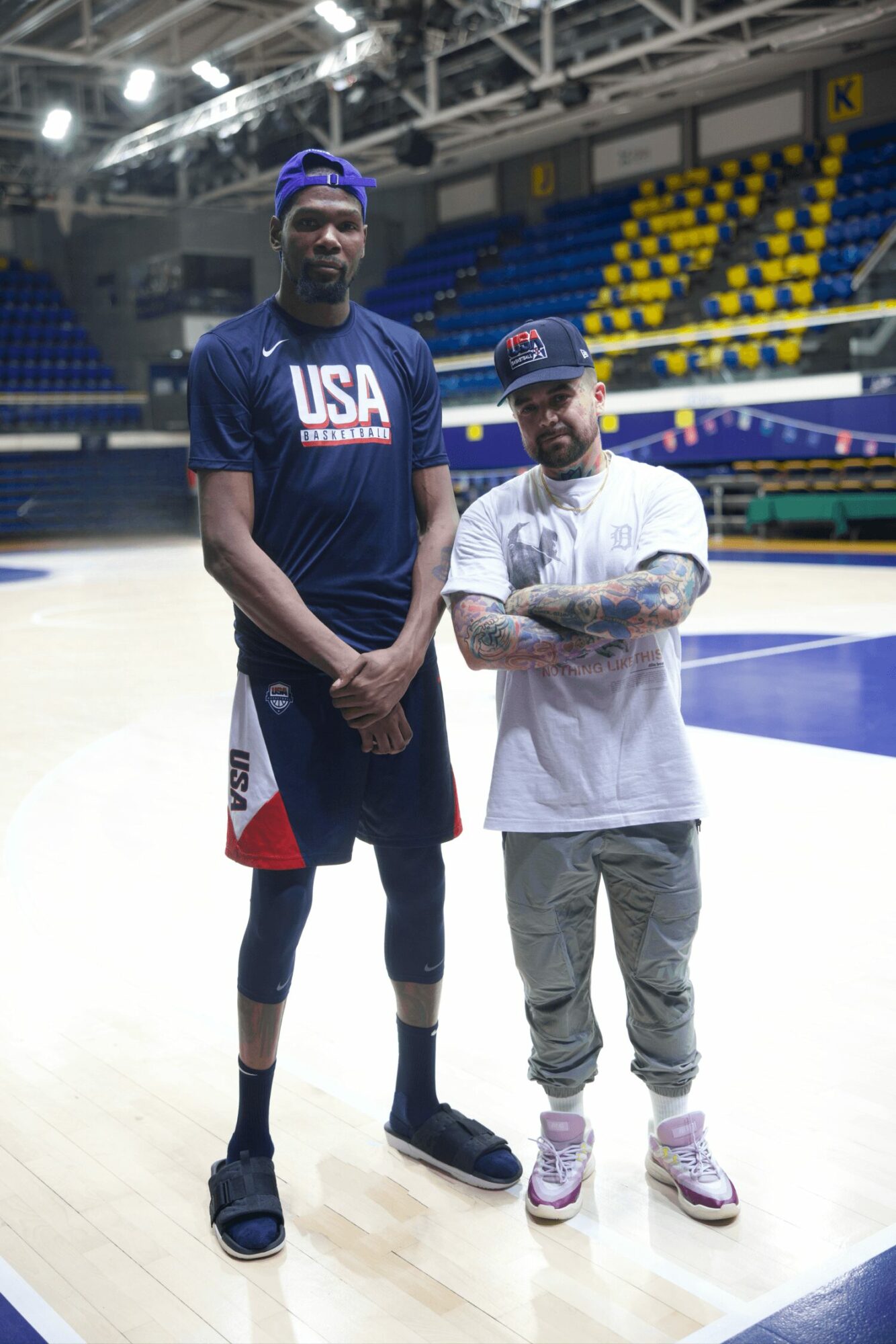
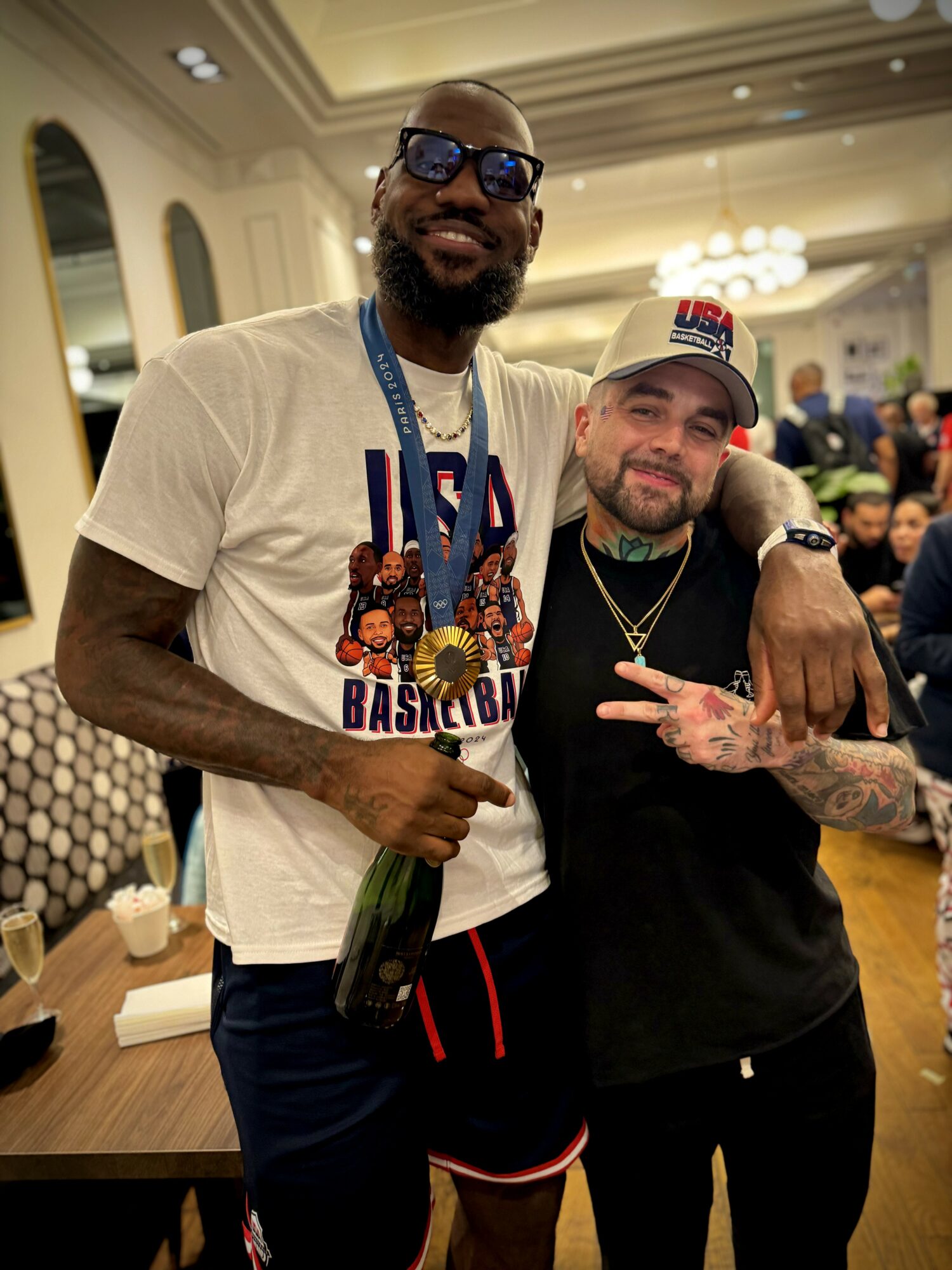
For a year, I was a PT consultant for the Los Angeles Lakers. Then this past summer, I served as the private physical therapist for Kevin Durant at the Paris 2024 Olympics. In those moments, I felt like I was shining as bright as I possibly could.
I remember standing on the sidelines during a Team USA practice in Paris, watching KD go through his routine, thinking “How did a kid from the Inland Empire (if you don’t know where that is, that’s kind of my point!) end up here?” It felt like the culmination of everything I’d worked for.
But here’s what I didn’t expect: after the closing ceremony, after the gold medal, after the Lakers role ended—I felt hollow.
I’d wrapped so much of my identity around those achievements. The prestige. The validation. The proof that I’d “made it.” When they ended, I wasn’t sure who I was anymore. If I wasn’t “the guy who worked with the Lakers” or “KD’s PT at the Olympics,” then what was I?
That’s when I realized I’d been dimming my own light. I was looking outward for definition when the real work was always about something else entirely.
A few weeks ago, I got a message from a former student. He wrote: “Lately my patients have been sharing a lot with me. And I owe a lot of it to you and what you taught us that goes beyond the medical model and seeing the human being and their lived experience in front of me. I’ve had patients open to me about suicide, depression, unemployment, financial insecurities, failed marriages/relationships. It’s so hard though because in the insurance model I’m now in, I only have so much time, so many words, and so many treatment interventions to implement. I do my best and make sure I’m filling my cup and making it bigger so I can continue to pour onto others. Thanks Dr. Willis for everything you have taught us. You have helped me save lives, be open to these convos, and make a real difference in people’s lives just by creating a safe space and letting them be heard.”
That message hit me harder than any Olympic moment. Because that’s my light—not the stages I’ve stood on, but the ripple effects I can’t even see. He’s out there creating safe spaces for people to be heard. He’s catching conversations about suicide that might’ve been missed. He’s doing the work I taught him, and teaching it to his patients, who will teach it to their families.
That’s where my light has always lived. Not in the spotlight, but in the quiet moments when a student realizes they have permission to care deeply. When they learn that seeing the whole person isn’t “soft”—it’s essential. When they go out into a broken healthcare system and choose connection anyway, even when insurance gives them 15 minutes and a protocol.
My worth isn’t in who I’ve worked with. It’s in people like him, doing work I’ll never see, with patients I’ll never meet, creating ripples I can’t measure. That’s the light I was dimming by chasing external validation.
Contact Info:
- Website: https://instagram.com/willistheway.ptp/
- Instagram: https://instagram.com/dwillofthe9/
- Linkedin: https://www.linkedin.com/in/dustin-willis-pt-dpt-phd-ocs-faaompt-2a76a1166

Popular
-

Portraits of the Valley
-

LA’s Most Inspiring Stories
-

Rick Norris Learned That Building a Successful Business Means Building a Life You Actually Want to Live
-

How Olivia Rush Turned Survival Into a Mission to Help Others Keep Going
-

How Bibi Goldstein Is Helping Entrepreneurs Reclaim Their Time by Embracing the Power of Delegation
-

Victoria Hasson is Redefining Voice Coaching Through Community and Collaboration


