



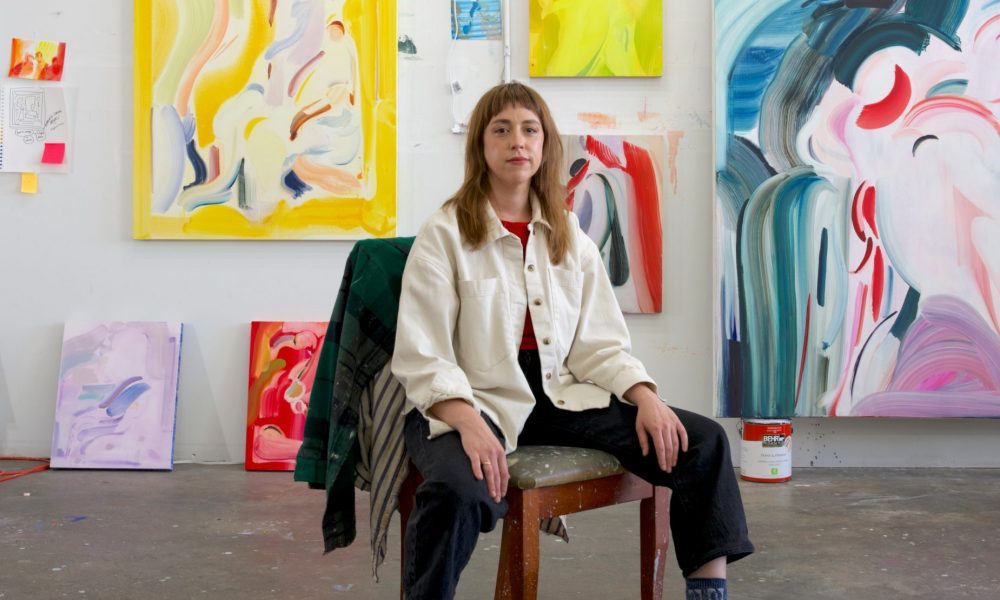
Today we’d like to introduce you to Amy MacKay.
Hi Amy, please kick things off for us with an introduction to yourself and your story.
It’s hard to know where one’s story starts exactly but I would say that at an early age, I knew that I loved art and teaching and that both offered different paths to connect to people and openly question the world together. I got my undergraduate degree at Bard College, which felt like a super informative experience in how I approach making work. It felt like a kind of magical place for weirdos of all forms. Even though I didn’t start as an art major, I ended up really falling in love with painting while I was there and have pretty much continued an ongoing relationship to visual art since. After graduating, I taught in an education non-profit in San Francisco for five years and later moved to Los Angeles in 2012, eventually going back to school for my MFA at UC Irvine. I found some incredible family there and it is through the support of the community I’ve acquired in all these spaces that I’ve gotten to where I am today.
I’m sure you wouldn’t say it’s been obstacle free, but so far would you say the journey have been a fairly smooth road?
Being an artist takes endurance. So much of the process is about grappling with doubt and it takes strength to stay present in the awkwardness of uncertainty. In my classes, I talk a lot about the power of vulnerability and the importance of embracing failure. One of the best pieces of advice I received from an old professor was to actually name your inner critic, like “Betty” or “Dave” or whatever. If they need to sit in the corner, you just tell “Dave” to sit in the corner, and then bring him back out only on your own terms.
Of course, not all obstacles are just about controlling inner voices. I’ve had times when my studio literally flooded with shit and times when I didn’t know how I was going to pay rent. Over the years, there have been countless moments when it felt like the world was testing my commitment. It’s in those times that I lean most on my friends, especially those in creative fields. We have a saying which is that “all boats ride with the tide”. When we start questioning ourselves, we try to be there to lift each other up and convince each other to keep going. Within this model, the path to success is built less on competition and more about creating resources and systems to share success mutually.
Appreciate you sharing that. What else should we know about what you do?
While my practice is rooted primarily in painting, I have a highly intensive (some would say crazy) research-based process: I stage group events and, drawing from written, photographic, and interview documentation, record the experience as paintings. I love working collaboratively because I feel like it offers a unique way of exploring memory and the gaps formed across a shared experience over time. I’m also curious how images influence this, how they affect our relationship to what we perceive as past and present and how that affects what we think is true. I think this is related to my larger interest in using abstract painting as a kind of document. I’m less interested in the recognizability of the people and places in the scene and instead try to privilege residual feelings and effects. Like – How hot was it? Are those characters in love? How excited did we feel? Were we grumpy? All of the elements – the fictional narratives and physical experiences – become material that guides the formal decisions for each painting. The paintings then become a document not only of the group event but my own experience of remembering and forgetting. The experience is highly physical, almost gymnastic, as additive and subtractive marks trace my working memory.
What are your plans for the future?
My mom passed away fairly recently and I’m in the process of revisiting an older body of work that I had started in 2016 when she was first diagnosed. The original project centered on themes of collectivity and healing and so it has become an interesting challenge to think about that experience with such distance as the narrative takes on new meaning in the wake of her loss. I’ll be excited to share some of that work in an upcoming group show at LA Beast Gallery this May.
I’m also in the process of devising a site-specific performance that will be the subject of my next series. I love thinking about the ways that particular environments influence the way groups of people interact, and I became obsessed with the idea of staging something around a body of water, with the audience either floating or partially submerged. I’m curious how this unusual setting might serve as a kind of an allegorical structure to think about themes of displacement and fluidity. But part of what I love most about this kind of research is being at the mercy of surprises and indeterminacy. It is always more exciting and complex than anything I could ever dream up entirely by myself.
Contact Info:
- Website: www.amymackay.com
- Instagram: @thisisamymackay


 Image Credits
Personal Photo – image credit Matt Savitsky In the studio – image credit Kim Garcia Hot Gel, 48″x 36″, oil on canvas, 2022 – image credit OF Studio Parade, 72″ x 60″, oil on canvas, 2022 – image credit OF Studio [Preparing the Cut], 109″ x 72″, oil on canvas, 2018 – image credit Jason Gowans Dear Echo Installation, University of California Irvine, 2018 – image credit Jason Gowans


