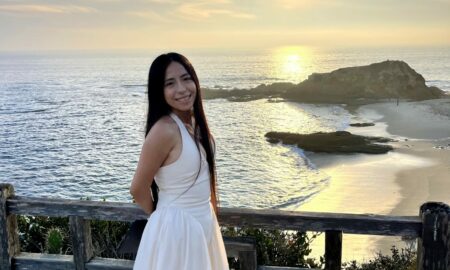




Today we’d like to introduce you to Ivana Dama.
Ivana, we’d love to hear your story and how you got to where you are today both personally and as an artist.
I was born and raised under the post-communist regime in Serbia shortly after the end of the civil war and during the time of NATO bombing. The tension between the former Yugoslavian countries was still undoubtedly present. Even though I was only a young child when the bombing began, images of the destruction still clearly permeate my mind. The memories of living in a small shelter with the sounds of bombs and vibrations have contributed to my interest in sound and space ranging from microscopic, architectural and satellite scale.
In 2016, I decided to move to the United States and pursue my education at a research institution that would allow me to experiment and work on improvisational projects. It was at UCLA when I realized that sound is an invariably important part of my work and when I become aware of how much power sound had when combined with the quiet world of visual arts. I have since begun to explore audio’s potential in my work.
We’d love to hear more about your art. What do you do and why and what do you hope others will take away from your work?
In my work, I explore the fusion of technology with traditional art practices by utilizing a variety of mediums including audiovisual installations, metal and wood engraving, sound performances as well as a range of open source software for creative coding. One of my recent projects featured metal-engraved satellite images of Serbia, from the first day of the 1999 NATO bombings to the last. My goal was not to show my perspective of the events but to highlight the viewpoint of the pilots flying over the country. Shortly after, I was working on a project where I presented enlarged, 10-foot-tall scans of an ant farm to compare a human’s interpretation of time with that of insects’, demonstrating my interest in working with dimensions of space to present new perspectives. I have also performed multiple times using a microscope and brain tissue as a musical instrument.
By manipulating parameters of the microscope’s camera, such as focus, brightness, and movement, I was able to trigger specific sound effects, like altered frequencies of different piano samples. Currently, I’m working on another project that also experiments with sound and challenges traditional ideas of how to play an instrument. The project incorporates a piano that people play by walking around, with notes and frequencies triggered by the geographical location of the walker. Similar to my microscope project, I was inspired to create an instrument that anyone can be in control of playing.
Do current events, local or global, affect your work and what you are focused on?
I believe that the role of the artist has always been focused on criticism of the world as it is. Throughout the centuries the art has responded to the current issues by challenging our perceptions and by integrating nonlinear and visual thinking. In my work, I like to refer to specific events from the past in order to find a venue for dealing with complexities and ambiguities of political systems and regimes. I also explore the ways to non-verbally respond to current events, and last year I collaborated with artist Clinton Van Arnam on a project called “Turbulence” where we used a collection of data from Hurricane Harvey to trigger both digital and analog synthesizers in order to create audio-visual installation at the Performing Arts Center in Santa Monica. This installation allowed us to address the issues of climate change and global warming in our work.
Do you have any events or exhibitions coming up? Where would one go to see more of your work? How can people support you and your artwork?
I recently performed at Barker Hangar’s Studio 106 and I’m hoping to participate in their future events. I’m studying Design Media Arts at UCLA’s School of Arts and Architecture and I’m presenting my projects throughout the year participating in group student shows and different events and symposiums on the campus including New Wight Gallery and Art Sci Gallery.
The best way to support my work is to attend some of the future events and I always share the details on my instagram @ivana.dama and my website www.ivanadama.com
Contact Info:
- Website: www.ivanadama.com
- Email: ivanadama@ucla.edu
- Instagram: www.instagram.com/ivana.dama


Image Credit:
Claire June Apana, Joshua White
Getting in touch: VoyageLA is built on recommendations from the community; it’s how we uncover hidden gems, so if you know someone who deserves recognition please let us know here.
Popular
-

What is something outside of work that is bringing you joy lately?
-

Local Highlighter Series
-
What did suffering teach you that success never could?
-

What are you most proud of building — that nobody sees?
-

Who were you before the world told you who you had to be?
-

If you could say one kind thing to your younger self, what would it be?