


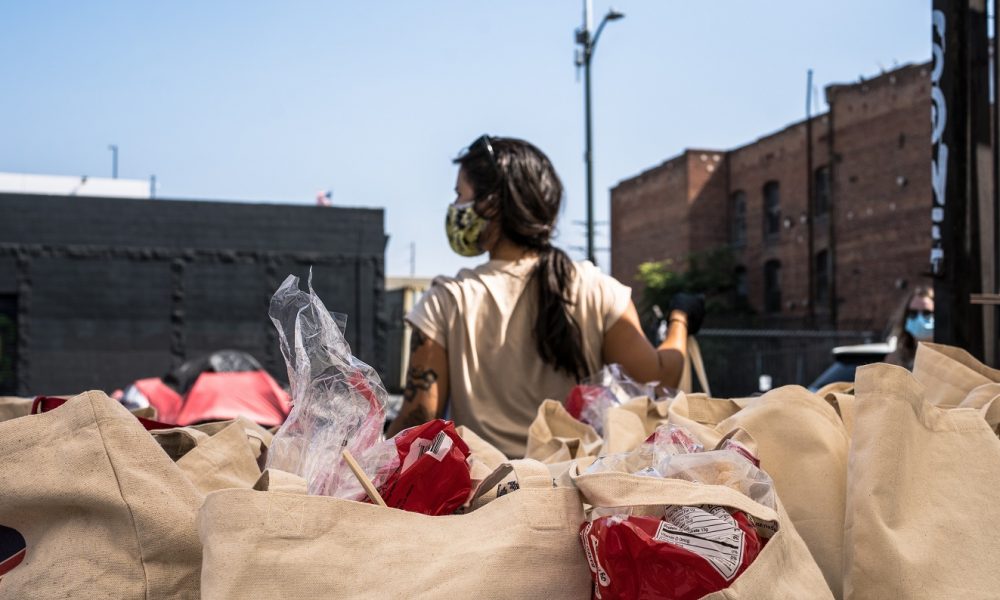
Today we’d like to introduce you to Chantael Duke.
Thanks for sharing your story with us Chantael. So, let’s start at the beginning and we can move on from there.
I was born in Japan and raised outside of Seattle, WA. As a first generation Japanese-American woman, food and culture have always been intrinsic to who I am. The identity that I’m represented by is heavily shaped and influenced by my relationship to food. My mother taught me the language of compassion through the act of feeding others. This something that I recognize in myself and is a driving force behind what I am in pursuit of today.
I only moved to Los Angeles three years ago, specifically to the Downtown neighborhood. It seems I discover something new about this city daily, which excites me. The diversity, with pockets of celebrated cultures and ethnicities all throughout the vast sprawl of this city, is what makes it special.
Living in Downtown Los Angeles, it’s impossible to ignore the ever-widening wealth gap. Similar to Seattle (in their case a result of the rise of companies like Amazon and the cataclysmic effects of modern day capitalism), homelessness is continuously rising. However, even having witnessed the state and rise of the unhoused populations in other cities, I have never witnessed anything like in Skid Row. Being a daily witness to this history and level of poverty and injustice led me to find opportunities to volunteer with businesses and organizations throughout the neighborhood. I first volunteered with Skid Row People’s Market through LA Food Policy Council’s “Healthy Neighborhood Market Network” (HNMN) initiative. This is where I met store owner Danny Park, who is also owner and founder of Skid Row Coffee. The work Danny does is and continues to be an inspiration to me. Danny worked with the HNMN to transform Skid Row People’s Market from a traditional corner store with mostly junk food options into a corner store committed to providing access to more nutritional foods and he continues to create opportunities for food accessibility for the residents of Skid Row.
The other space I found myself in was Los Angeles Community Action Network (LACAN), an organization committed to empowering those experiencing poverty to create and discover opportunities as well as have a voice in matters that affect them most. Since the start of the pandemic, LACAN has partnered with two other organizations, Eayikes and Polos Pantry and through this collaboration have effectively served over 30,000 meals to the residents of Skid Row. Volunteering weekly with them led me to a truly incredible family of activists and food justice advocates and I am now a part of LACAN’s Food and Wellness Collaborative where we are currently working on the 2020 Food Assessment, a study of the food landscape of Skid Row and its effects on the residents of this community. I feel really honored to now be a part of the work that I’ve admired for so long.
It’s difficult for me to pinpoint exactly when and where my passion for food justice began. I’ve been led down multiple pathways inspired by food-related roles within society, whether that is a brief stint as a lunch lady, working on farms, cooking on the line in a restaurant kitchen, commercial salmon fishing in Alaska, creating meals for postpartum women, or most recently, developing the concept for a grocery market and creative community space while organizing bi-weekly food distributions in Skid Row.
One aspect of food in the context of our modern day culture that I’ve never been able to shake is the exclusivity around eating and cooking well, that the power of nourishing not only our bodies but the nourishment and warmth that our souls receive through the act of cooking and sharing this space with others was and is limited to people with the income, knowledge and accessibility to provide this for themselves. So this is the place that I act from now. How do we make the power of food accessible, how do we create an inclusive platform that provides people, all people, with the ability to nurture their relationships to food while honoring our cultural identities in the process? If this pandemic has taught us anything, it is the undeniable reliance we have on each other, on our community and on the relationships we build and nurture. I believe that without the mutual aid efforts that have grown exponentially during this time, driven by care and compassion, we would be experiencing a much more devastated world.
Parallel to the work I’m participating in with the community, I am completing the Food Studies Graduate Program through UCLA. My hope is that this academic work along with real-world experiences and my unique history, will lead me toward a life fulfilled by feeding others.
Overall, has it been relatively smooth? If not, what were some of the struggles along the way?
I think it’s important to face challenges and adversities in life. Facing adversity helps with our own empathy toward others and this is one of the most crucial skills to move through life with. For me, personally, one of the greatest challenges I’ve always faced and now specifically in the development of my own business is belief in myself. Believing that I’m capable of actualizing this vision that feels so grand and ambitious and also believing that I’m capable of galvanizing people around this idea through the use of my voice. I’ve often been someone who would rather not be seen, so to now be the face and identity of something that in order to grow needs to reach more and more people can be quite scary. There’s a lot of egos to brush aside. I’m really grateful for the people that are supporting me in this now, they remind me daily of the importance and worth of what I’m trying to build.
On the other hand, there are of course many challenges in building something from the ground up! Which includes but are not limited to learning facets of business building and planning that I’ve never touched before and staying organized around the logistics and many details that go into building a brand all while keeping social integrity at the top of priorities. I’m hopeful though because there are a lot of people in my lane, each with their own skills and expression. I think most importantly, I need to focus on how best to lead because if I have people behind me, truly anything is possible.
Future City Pantry – what should we know? What do you do best? What sets you apart from the competition?
Future City Pantry as a business and community organization is still young, but I can tell you what I know.
Our mission is to shift the narrative within the food system. We aim to nurture all people’s relationship to food, regardless of race, gender, ethnicity, sexuality, income, place and history, by creating a space where food, land, farmer, harvester, consumer, and the pantry; the space that houses the food, coexist. What does our future city look like? Our future city is thriving, flourishing and collaborative and driven by mutual aide, driven by the belief that access to quality, affordable, nutrient-rich foods are a human right.
Future City Pantry plans to address food insecurity and the needs of the community by providing an inclusive space based on accessibility and affordability through a sustainable food system that maximizes community self-reliance and social justice. The vision for this is a full-service grocery market and creative community space.
We intend to transform the local food system through providing access to foods that are not monetarily exclusive through the divestment from corporate capitalistic control of the food industry. This divestment from big box stores and big agribusiness is in turn an investment toward our environment by honoring our reliance to it with a commitment to work toward regeneration rather than degradation of its finite resources. We strive to address the gaps within the pathways for food accessibility in the Downtown Los Angeles community and beyond, through education, by reigniting our relationships to food and sharing deep-rooted cultural traditions around the processing and preparation of foods.
Currently, we run a bi-weekly Free Food Market in the Skid Row neighborhood of Downtown LA to address a need within a community where there is limited access to quality foods. At this market, we provide fresh produce, prepared foods, pantry staples and dry goods, hygiene products, reusable masks, clothing, and water. All of which is primarily donated and 100% volunteer-run. Our Free Food Markets are a revolutionary act of breaking through systems that aim to serve few and leave millions behind hungry, while there remains an overabundance of resources left to waste. The most gratifying part of running these markets is the people we meet and the connections we make.
Through this effort, we hope to generate enough momentum to build a food resource through the development of a full-service food market that is viable and sustainable for Downtown LA. We believe there can be both economic development and integrity of social enterprise when used synergistically.
What sets us apart is our commitment to social integrity and the development of a business that is mutually beneficial to the workers that own and run the space as it is to the neighborhood and community we build our foundation within. Our intention will always be to reinvest back into the community and break apart the hierarchy within business structures.
What is “success” or “successful” for you?
I want to live a happy and fulfilled life complete with pleasure, joy and purpose. The bottom line is creating something sustainable for the world around me. If I can support my family enough to live a healthy life while supporting others and leaving a strong foundation to influence future generations, then I’d say I’ve reached the pinnacle of success.
For Future City Pantry, success looks like the moment I walk into a thriving and bustling food market where people from all walks of life are united, it looks like peering into the adjacent community space and witnessing the diversity and conversation around a long table, beyond that, a workshop where someone’s grandmother is teaching a group how to make a food rooted in the traditions of their culture. In these moments, I’ll have so much to savor.
Contact Info:
- Email: [email protected]
- Instagram: https://www.instagram.com/futurecitypantry/


Image Credit:
Joseph Mancha, Catalina Munoz, Sarah Ryu
Suggest a story: VoyageLA is built on recommendations from the community; it’s how we uncover hidden gems, so if you or someone you know deserves recognition please let us know here.
Popular
-

LA’s Most Inspiring Stories
-

Maagic Collins on Building a Fearless Publishing Platform for Truth, Advocacy, and Underrepresented Voices
-
Los Angeles Barea on Turning Green Superheroes into a Global Movement for Youth-Led Change
-

Trisha DuVivier on Bridging the Franchisor–Franchisee Divide with Workhero and “Franulate”
-

Portraits of the Valley
-
Cedar Boschan on Elevating Black Music Rights and Driving Urgent Conversations Around Credit, Equity, and Artist Protection