




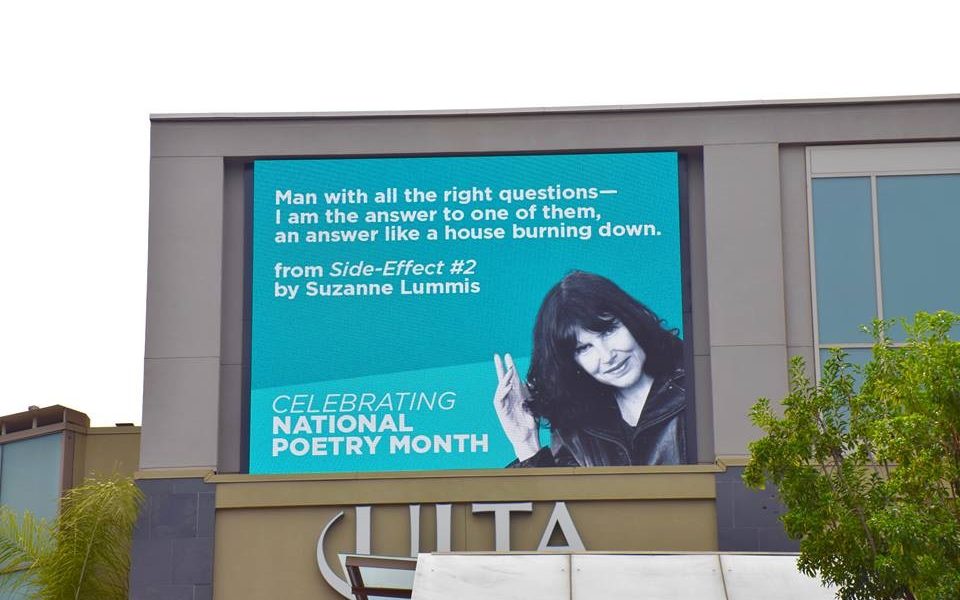
Today we’d like to introduce you to Suzanne Lummis.
Hi Suzanne, thanks for sharing your story with us. To start, maybe you can tell our readers some of your backstory.
You could say I come out of Poetry– serious background. I studied with the late Philip Levine and other notable teachers at what was then called Fresno State College–and out of Theater, out of Journalism, out of Arts Organizing. I co-founded the Los Angeles Poetry Festival and produced several festivals of literary events around the city from the late 80s through the aughts.
Or, you could say I come out of San Francisco, where I was born, out of Palermo, Sicily, the source of my earliest memories, out of the Sierra Nevada Mountains where I grew up, out of Berkeley where I went to High School–yes, Berkeley in the 60s–out of the San Joaquin Valley, where I went to college. Then I returned to San Francisco for a time, then moved to Los Angeles, where I’ve lived for decades. Though I didn’t arrive here until I was 27, never-the-less, I’m very much Out of Los Angeles.
Though I write in several areas, I’m principally known as a poet. I’m associated with the Stand up Poetry movement of the 90s whose principal advocates were Charles Webb and me, an often darkly humorous or absurdist poetry which negotiated between performance and literary poetry; the Fresno Poets (See Christopher Buckley’s tome, Naming the Lost; The Fresno Poets, re. what happened in one little writing program in the 60s into the 80); the Poets of Los Angeles; and, currently, Poetry Noir, an approach that draws from the mood, style, subject matter and sensibilities of hardboiled detective fiction and film noir.
Alright, so let’s dig a little deeper into the story – has it been an easy path overall and if not, what were the challenges you’ve had to overcome?
Does anyone answer Yes to this question? Has anyone ever? I can think of one person who sailed into success, who as a very young and extremely pretty actress–pretty in that fantasy California beach girl way–started getting major TV roles and was then cast as a regular in a popular series so fast she was barely ready for it, craft-wise. She had to learn on the job, really. It seemed a perfect irony that she was everywhere on TV when she was in the “Beginning” then “Intermediate” level of our acting workshop when we–my friends and I–were in the “Professional” level but were not, as the expression goes, “getting work.” Speaks to the meaninglessness of such rankings and the mystery of Hollywood. I read an interview where she said something to this effect, “People complain to me that I didn’t pay dues and actors Must pay dues. But why? Why go through all those years of struggle and rejection then wind up bitter and jaded.”
I liked what she said and liked her for saying it. Ye-ah! Who made it a rule that you Have to Pay Dues?
Later many years later, things got tough for her, so tough that her struggles made the tabloids, otherwise I wouldn’t know. – Made me wonder if it’s inevitable that Fate and Providence won’t extract their pound of flesh one way or the other.
The literary world’s like any other field, like sports, like the corporate world, and probably agriculture and forensic pathology. It comes with its own absurdities and share of injustices. It’s annoying, sometimes aggravating, but it’s the field I chose. Or maybe I moved to it natural as water on an incline. But sure as hell nobody badgered me into being a poet.
Can you tell our readers more about what you do and what you think sets you apart from others?
I didn’t mention my teaching, did I? I’ve taught for years through the UCLA Extension Writers’ Program, and many of these students come out of the community and tend to stay in town, or they travel far but retain an identification with Los Angeles. I also work with a great group of poets in series of Zoom sessions exploring poetry of the 20th century and beyond. Deep Poetry Knowledge it’s called, sometimes abbreviated DPK. I believe I’m credited with having influenced many poets associated with the city who’ve gone on to do some interesting things, make names for themselves and write some damn good poems. Hard to say to what extent a few classes influence poets’ lives and work, but I always say — Well, I didn’t ruin them anyway.
If anyone’s curious about my poetry and publications, there’s a long in-depth interview by a good fellow named Michael Caylo Baradi on the Los Angeles Public Library blog. Just put my name together with the words Noir Goldilocks.
What sets me apart from others? Most certainly, my angle on noir and ways that I wrap that into certain poems–though really only a few poems, now and then. I doubt there’s any such thing as a “noir poet,” really, though I’ve been called that. Instead, there are poets in the country–a few here and there–who occasionally, and consciously, can do some intriguing things with that style. Crime interests me since I’ve been on the losing end of some street crimes–not recently, some years back. I came away with an extremely poor opinion of criminals. The poet David Lehman, series editor of Best American Poetry, and I collaborated on a series in which each of us responded to particular films noir and noir themes. People can turn up some of those by searching my name together with Why Poets Love Noir.
Many also know me for my political engagement, and my current project–to be released next year–comes out of that. I’ve been fighting the one-term, once subpoenaed, twice impeached, catsup-throwing former president with all of the few powers available to me. A 2018-19 COLA (City of Los Angeles) fellowship, an endowment to influential artists, musicians and writers of the city, made it possible for me to evolve an unusual piece of writing. Tweets from Hell. I worked out each stanza in a Twitter window to make sure it didn’t go over 280 characters.
Pound called his Cantos “A poem containing history” — well, this is that, but maybe more tightly organized than the Cantos and, happily, at 18 or so pages, much shorter. It’s mordantly witty. That’s a thing no one should say about their own work; it’s off-putting. It’s in bad taste. It’s true, though — and in this Age of Lies, I’m feeling particular about truth. Everything else is going to have to take a backseat to truth, or maybe pile into the bed of the pickup truck.
Early 2023, I’m bringing it out as a 19th-century style political pamphlet–like Thomas Paine’s Common Sense. Actually, that was an 18th-century pamphlet. Or, like Martin Luther’s pamphlets, though those were 16th century. We’re going for something closer to the 19th-century look, best as we can manage it. Liz Camfiord, a noted presence in the Los Angeles poetry monde and also my assistant editor at The Pacific Coast Poetry Series/imprint of Beyond Baroque Books, is designing it. It’ll come out in a limited edition, numbered.
Any advice for finding a mentor or networking in general?
For poets, the workshop seems essential both for developing the writing, taking it to the next level–whatever that might be–for discovering new poets to read and be inspired by, and, certainly, for networking, not just networking but friendships. Now, some workshops focus largely on generating new work via writing prompts and so on but offer little in the way of craft-related feedback. That’s O.K., if someone just wants the pleasure of writing and being among others who write, and publishing’s not necessarily important. I notice some workshops do keep people stuck at more or less the same level–for years. A beginning poet might want to start with a generative workshop then, at some point, seek out one that’s more craft conscious.
One thing about the Los Angeles poetry community, it’s easy to find a place in it. It has so many circles and branches and little coteries and what-not.
As for what’s worked for me? I suppose the same thing that works in nearly every field. Knowing people. It’s not lost on me that I’ve been included in three prestigious Knopf “Everyman’s Library Pocket Poets” anthologies, you know those exquisite little themed poetry books every bookstore carries, but in each case the editor knew my poetry. Also, though, in each case the editor Liked my poetry. So, it seems a poet must 1) Develop her talent (or his), do the work, get good and then 2) Know people. As in most fields, Luck plays a terrifyingly big role.
Contact Info:


Image Credits
First shot (b&w): Penelope Torribio. Book cover (Lynx House Press). Painting: by Carol Colin. Shot with Raymond Chandler book: Arlene Karno. Book cover In Danger: (Roundhouse Press/Heyday Books). Billboard (photo on billboard by Rachael MacCampbell, shot of billboard by Elena Secota). Shot of me at Skirball (I don’t know!). Hands (Cece Peri).
Popular
-

What is the story you hope people tell about you when you’re gone?
-
What do the first 90 minutes of your day look like?
-

Local Highlighter Series
-

What did suffering teach you that success never could?
-

Who were you before the world told you who you had to be?
-

What are you most proud of building — that nobody sees?


