



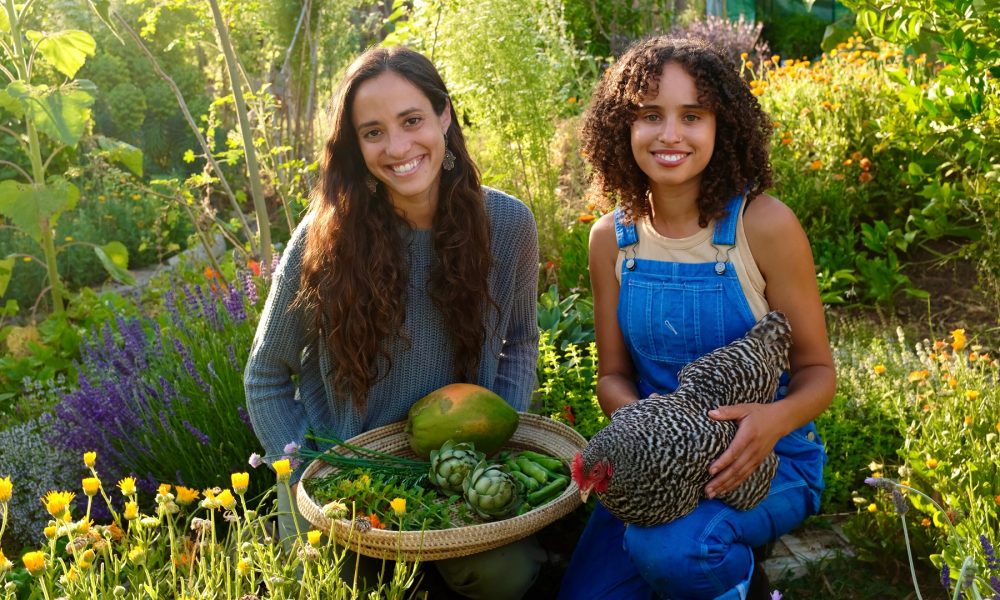
Today we’d like to introduce you to Nina Weithorn and Nina Anakar.
Hi Nina Weithorn, so excited to have you with us today. What can you tell us about your story?
Nina Weithorn – I’ve been working in the urban agriculture world for about eight years now. I didn’t grow up farming, but I always had an appreciation for fresh, local produce as a kid from frequenting Los Angeles farmers markets with my mother, who is an amazing cook. My first experiences with agriculture were as a college student in New York City, working at urban farms and nonprofits like The Brooklyn Grange, Edible Schoolyard Brooklyn, and Grow NYC. By the time I graduated, I knew that growing food was something that felt profoundly healing to me and was something I wanted to pursue. After graduating, I moved to the Big Island of Hawai’i to work as an elementary and middle school garden teacher. Tropical agriculture was something that was completely new to me and especially coming from NYC where the growing season is so short because of the winters, I was thrilled by the possibility of growing food year-round in the warm, humid climate. I experimented with growing plants like banana, papaya, turmeric, ginger, cardamom, etc.
I left Hawaii in 2018 and moved back to Los Angeles, where I worked for Fruitstitute, which specializes in holistic fruit tree care. During that same time, I also completed an Herbalism Apprenticeship through Green Wisdom Herbal Studies in Long Beach, CA. Learning about medicinal herbs, how they grow, and how they benefit the human body further solidified my passion for growing food and medicine. For the past two years, I’ve been working part-time installing and maintaining residential edible gardens around Los Angeles. When I started growing in the space that is now Ziza Urban Farm, it felt like an amalgamation of all of the knowledge I had gained from my past experiences. I use layouts of raised beds that I learned at rooftop farms in New York, methods of growing tropical plants from my time in Hawai’i and fruit tree pruning techniques from Fruitsitute. Since Nina A and I partnered over a year ago, I’ve been continuously cultivating Ziza Urban Farm and growing produce for Ziza Foods and our local community.
Nina Anakar – Nina Anakar works as a private chef and caterer in Los Angeles, cooking with flavors inspired by her Moroccan heritage and local California produce. Anakar has worked in food and hospitality for ten years and grew up cooking and gardening thanks to the expert home cooks in her family. She started her career working for restaurants and freelanced for top chefs and hospitality companies before deciding to leave her brand marketing career behind to work with her hands in cooking and hospitality. She spent extended time in Morocco taking cooking classes with women and connecting with her heritage’s cuisine. She then moved to California for cooking school (which she opted out of completing) and instead took on various restaurant apprenticeships and jobs, among them a Michelin-star Moroccan restaurant in San Francisco and a popular vegetable-focused restaurant in Los Angeles. Anakar also served as the Lead Chef for the nonprofit Akasa, which followed an Edible Schoolyard-type model in service of youth in East LA. Over the years, her own dinner parties and cooking for friends evolved within her community to requests for meal prep and catering, and so she’s been cooking full time for private clients, brands and parties in Los Angeles since 2018.
We met in 2019 after Nina A was asked to cook for the fundraiser of Nina W’s then employer, Fruitstitute. We connected over our love for the LA farmers’ markets, our awareness of how gardening and cooking can be healing practices, and the abundance of delicious and unique fruits in Southern California. Nina A started hiring Nina W for help cooking and sourcing local produce for her catering gigs and we learned that we worked really well together from those experiences. When we gained access to the space that is now Ziza Urban Farm, we began restoring the soil and planted fruit trees, medicinal and culinary herbs, vegetables, and flowers. Nina A now uses the food we grow to cook for our Ziza Foods pop ups, which features menu items inspired by her Moroccan heritage.
We all face challenges, but looking back would you describe it as a relatively smooth road?
Our initial intention when we started almost two years ago was to host “pop-up” dinners using ingredients grown on the farm, in-person gardening and cooking workshops, volunteer days, etc. When the pandemic began and social gatherings were no longer safe, we had to pivot… It’s hard to do work that is so community-focused (building a garden) and sensory (cooking) and not be able to physically engage with people. The pandemic, political and social unrest, and the very tangible and worsening effects of the climate crisis (e.g. unprecedented wildfires and temperatures in CA) has made the instability of our food system undeniable. There has been an increased awareness of the consequences of industrial agriculture in terms of the destruction of the planet, deteriorating human health, and unfair conditions for farm laborers and as a result, more people are buying locally and interested in growing their own food. These are issues that we both have been engaging with for years and it’s amazing to see them becoming more “mainstream”.
Can you tell our readers more about what you do and what you think sets you apart from others?
Working on Ziza has made us realize how quickly underutilized land with depleted soil can be transformed into an urban ecosystem capable of supporting wildlife and producing food and medicine. In 2019, we started transforming 2,000 square feet of residential land in Highland Park, Los Angeles into an urban farm/food forest. The space now has 25 fruit trees, 70+ varieties of vegetables, medicinal and culinary herbs, California natives, perennials, passion fruit and grapevines, dye plants, a nursery, a chicken coop and more. We’re also growing food in additional smaller spaces in our area to promote alternatives to lawns, pesticides, herbicides, and synthetic fertilizers and to share how urban farming can be done with a variety of resources.
In addition to connecting people with the possibility of growing delicious food and medicine, the primary focus of our farming initiative is soil restoration in our depleted urban environment. We’re practicing soil revival and growing techniques that Indigenous peoples have utilized for thousands of years before they were appropriated and renamed as the “modern” concepts of permaculture or regenerative agriculture. These methods, among many others, include cover cropping with nitrogen-fixing plants, employing companion planting strategies/polycultures, and adding organic material to the soil to increase fertility and support microbial life. We’ve built a hugelkultur, multiple systems for composting (including a three-bin compost, vermicompost, and in-ground trench compost using organic food scraps). We use no-till methods and have repurposed hundreds of cardboard boxes for sheet mulching.
Additionally, we interplant California native plants with our food crops. Not only are these plants drought-tolerant, but they also attract specific pollinators, which then pollinate our food crops as well, allowing for larger yields. We’ve seen amazing growth in our 2,000 square foot space and our goal is to use our urban garden as a teaching farm for urban and suburban gardeners at all knowledge levels to learn how to restore soil and ecosystems through methods such as composting and climate-appropriate gardening, as well as to share information on how to process, preserve and cook the food they can grow from scratch. Through our collaboration, we seek to experiment with how an urban garden and kitchen (both of any size!) can work together in a way that is restorative and nourishing to its workers, customers and the environment around them. Often foodservice kitchens and chefs are so separated from the land, where ingredients come from, so our work, especially through sensory experiences but also through online (and hopefully soon in-person) education, is to bridge that gap within the consciousness of our local community through the programming that we offer.
What do you like and dislike about the city?
Least: The way public green space is utilized. In so many of the landscapes in LA, plants and trees are an afterthought or completely disregarded. This also becomes a social and environmental justice issue as low-income communities tend to have fewer trees, less access to shade, and as a result, can be several degrees hotter in temperature compared to wealthier neighborhoods. Additionally, there will be so many times when I’m driving and I’ll see sprinkler systems spraying the sidewalk or street instead of the plants they are meant to irrigate. Given the fact that we are in a drought, it just feels reckless. There are so many vacant lots and empty parkways in LA, which means opportunities to plant drought-tolerant California native plants or grow food hyper-locally in ways that are community-based and restorative to the planet.
Best: The ability to grow food year-round and the abundance of produce at farmer’s markets.
Contact Info:
- Email: [email protected]
- Website: https://www.zizalosangeles.com
- Instagram: https://www.instagram.com/zizaurbanfarm/?hl=en ALSO https://www.instagram.com/zizafoods/


Image Credits:
Mikey van Beuren
Popular
-
Los Angeles Barea on Turning Green Superheroes into a Global Movement for Youth-Led Change
-

Trisha DuVivier on Bridging the Franchisor–Franchisee Divide with Workhero and “Franulate”
-

Portraits of the Valley
-

LA’s Most Inspiring Stories
-

Cedar Boschan on Elevating Black Music Rights and Driving Urgent Conversations Around Credit, Equity, and Artist Protection
-

Robin Olive on Building an Inclusive Performing Arts Movement and Expanding Opportunities for Every Student