


Today we’d like to introduce you to Felís Stella.
Alright, so thank you so much for sharing your story and insight with our readers. To kick things off, can you tell us a bit about how you got started?
I am an interdisciplinary artist and holistic chef. The path that got me here is as circuitous as it is straightforward.
I was born in the former Soviet Union, in the Republic of Moldavia, which is now called Moldova and has been a sovereign country since 1992. Growing up under the Soviet regime was no picnic, although as a young child I never felt that way. My parents had the uncanny ability of turning our grim reality into an adventure. For example, when our water, electricity AND heat would get shut off in the dead of frigid winters, my parents would say that we moved into a cave of an evil troll whose heart was frozen by the ice queen (Hans Christian Andersen fairytales were a big influence on my early childhood development). We had to light lots of candles and huddle around the tiny primus stove to make magical soup that would melt the troll’s heart and turn him into a prince who would bring back our electricity, heat and water. My mother would play with feeling Edvard Grieg’s “In the Hall of the Mountain King” on her upright piano for full effect. She was a brilliant pianist and piano teacher. From making up songs and poems while standing in line for hours to buy basic necessities, to wiping with the front page of Pravda (Truth) – a Communist daily newspaper – when toilet paper was out of stock in all stores, to seeing the world through a giant home library of books since travel abroad was forbidden, to making sumptuous feasts out of limited ingredients available in stores, to making music and art to brighten our otherwise homogenously grey quotidian existence.
I grew up in a family of artists and scientists, most of whom were also great cooks. My father taught me how to peel and fry potatoes when I was seven years old, and ever since I was aware of my existence, I observed my mother and grandmothers expertly chop, fillet, fry, bake, sauté, braise, pickle, preserve, simmer and whip by hand the limited ingredients available to the Soviet general populace into delectable and nourishing masterpieces. My grandpa Nathan was an engineer by day and master cheesemaker and fruit/vegetable pickler by night. My father fished and hunted small game regularly to literally put food on the table. He was a children’s dentist during the week but on weekends, he wrote poetry, photographed nature and his favorite subject – my mother – with his old Zenit. Every Summer, the hospital where he worked appointed him as squad leader of volunteers to go to the local collective farms and help the farmers pick their crops, be they grapes, apples, or damask roses. I recall my dad coming back from these trips with giant bags of roses. I could smell them long before he walked through the front door. My mom, in turn, would painstakingly remove every heavenly petal from each of the countless blooms that overflowed our kitchen and turned them into the most amazing jam I’ve ever tasted.
My inner world and creativity were nourished as exquisitely as my stomach. I began drawing at the age of two. Ever since I can remember myself, I always had a pencil, pen or marker in my hand. My mother – the piano maven – wanted me to follow in her footsteps, but although I did submit to her will and studied piano for three years, I didn’t love it as I loved to draw and paint. Her mother – my best friend and kindred spirit, Grandma Sarah — noticed my artistic aptitude early on and encouraged it by taking me to our local museums and showing me my first art books. Raphael and Rembrandt were her favorite painters. I recall leafing through a giant Rembrandt catalog whilst doing my business on the potty. Grandma was also a lover of theater, ballet and opera, and often took me to see local plays and concerts, as well as to rare visits by the Bolshoy Theatre ballet and opera. We lived in a paradox – no toilet paper or food in stores but art books and opera abound. My early cultural education at Grandma Sarah’s school of life left a lasting imprint. As early as age eight, I aspired to be an artist and theatrical set designer and painter. Thanks to her insistence on my formal artistic education, I was able to attend the city school of the arts for gifted children, where my all-time favorite teacher, Natalia Alekseevna Vasilyeva, taught me not only how to draw and paint still lifes and landscapes but also how to use what’s in my immediate surroundings as food for creativity. She taught me that my imagination can’t be limited by lack of available materials or government mandates of what’s allowed or not allowed; that great art can be made from sticks and leaves and scraps of newspaper found on the ground. She taught me that it’s a glorious thing to be myself – to not try to fit into anyone’s mold. This concept in and of itself was considered an act of defiance under the Soviet doctrine of blind conformity. Natalia Alekseevna taught me to be free and limitless in the limiting world of oppressive censorship and monotonous mediocrity; to depict the world the way I saw it, not as I was told to see it. Her loving lessons of wisdom are still with me today and inform my work and my daily life.
I’m sure you wouldn’t say it’s been obstacle free, but so far would you say the journey have been a fairly smooth road?
If growing up behind the Iron Curtain wasn’t hard enough, try doing it while being Jewish. My parents were spied on at their places of work by KGB moles planted to keep an eye on any potential dissidents, Jews in particular. While in middle school, I was harassed and singled out in class by my teachers for being Jewish and bullied and spat on by neighborhood kids for being “a filthy hook-nosed kike.” A kid once asked me on the playground how often I sawed off my horns because his mom told him that all kikes have devil horns, and they cut them off so no one would know who they are. I had extraordinarily little hope of receiving quality advanced education because the institutional Jewish quota allowed only a small percentage of Jewish students into colleges and universities (3-5%). This pervasive anti-Semitism had gotten so extreme by the late 80’s that Native Moldovans started organizing massive demonstrations at which they carried signs that read “Drown Russians in Jewish blood” and “Throw Russians across the river and Jews in the river.” It was no longer physically safe for my family to continue living there. With much trepidation, leaving our family, friends, and most of our possessions behind, my family and I had to emigrate from the USSR. I was 14…
Immigration isn’t for the faint of heart. To leave everything and everyone behind to brave a new strange world is not a decision one makes lightly. We had a few hundred dollars in our pockets and big hopes for a brighter future. Adjusting to my new life in Los Angeles was not easy. All my friends were left behind. I spoke no English. I was a noticeably young and innocent 14-year-old. My parents and I were, well, poor. Mom and dad had to find whatever jobs they could with their limited English. Our tiny apartment was furnished from the curbs of LA. I recall us saying how amazing America was that everyone was so rich they left perfectly good furniture on the street. I enrolled myself into High School since my English was only slightly better than my parents’. Once again, I was an outcast – this time not because I was Jewish but because I was poor and a foreigner. Kids made fun of my accent and my cheap clothes. But my art was there to help me build bridges between my inner world and my surroundings. My drawings and sketches helped me express myself and communicate with my classmates when my English failed me. My priority became to assimilate – to lose my accent, my culture, my roots. I wanted to be an American, whatever that meant. I studied hard and excelled academically. I was also fortunate to be selected to study mural making at the Social and Public Art Resource Center (SPARC) in Venice, where I went every Saturday by three buses. SPARC was my oasis – a place of refuge where other inner-city kids of different backgrounds were united by their love of art. I made friendships there that stood the test of time. SPARC is also where I had my first exhibition.
After graduating High School with honors I continued my art education at UCLA, where I double majored in art and psychology, as the study of human behavior interested me a great deal and helped feed my art. UCLA is where my artistic horizons expanded. Having been classically trained in formal realism back in the USSR, I was new to the world of conceptual art, performance, and multimedia art. After graduating UCLA with honors, I planned to continue my education when a sudden opportunity to work on a film project as a costumer changed my plans. Working in Hollywood was seductive. I worked as a costumer on a few films and then was given a chance to be a costume designer and art director on a young director’s master’s thesis film. From then on, I kept getting recommended as a costume designer, art director and eventually production designer for various film and video projects. Suddenly I remembered that the dream I had at age eight of becoming a set designer was coming true. I was working constantly without a break. Working film production was grueling. Work hours were punishing – 12 to at times 20-hour days. But I was having so much fun that I didn’t notice that my health was deteriorating. Long hours mixed with poor nutrition on and off the set (lots of coffee, cigarettes and junk food) were a recipe for disaster. And disaster surely struck.
At age 25, I was diagnosed with cancer. Suddenly, my world stood still. And almost overnight, I had a paradigm shift. I had to stop doing everything I loved in hopes of staying alive and regaining my health. Because what I loved turned out to be bad for my health. No more crazy workaholic hours. No more junk food. No more coffee and cigarettes. No more stress. Fortunately, my cancer was caught at an early stage and was removed surgically in its totality. But it left an indelible mark on my soul and my day-to-day existence. I started meditating and learning about nutrition and about how vital healthy organic food is for our health. I also began learning about how our food is systematically poisoned – first by toxic pesticides when it’s grown and then by toxic chemicals when it’s processed. I began questioning where my food comes from and scrutinizing labels. I began cooking healthy soups and salads and other dishes, like the ones my family made for me when I was growing up back in Soviet Moldova. I threw away all junk food and started eating less meat and dairy. I also started cooking healthy meals for friends and hosting gatherings. Suddenly, I was channeling my parents’ legendary feasts. I was going back to my roots. I also started cooking and delivering healthy organic meals to friends who were sick, some with cancer too. It was my way of expressing love and contributing towards their healing. My art evolved along with me. I started tackling issues of ecology and our relationship to nature and to each other. Today I can say with confidence that I am grateful to cancer because it saved my life. It brought me closer to myself – the true pure self that my old art teacher nurtured and protected way back when.
Can you tell our readers more about what you do and what you think sets you apart from others?
My two careers as an interdisciplinary artist and chef are closely interwoven. As an interdisciplinary and performance artist, my projects focus on human ecology and the indelible mark human beings had left and continue to leave on our planet and each other.
Some examples are performances I had done at the Getty Center and Los Angeles Contemporary Exhibitions (LACE). The Getty performances, titled “Getty Palm Shadow” and “Ice Baby,” are symbolic allusions to the systemic global deforestation and freshwater depletion.
In “Getty Palm Shadow” (photo below by Bartholomew Cooke), I dressed as a potted palm tree (palm tree oil farms are some of the largest contributors to the rainforest destruction and hence animal plant and insect extinction in equatorial countries) and followed Getty visitors around to shade them. Of course, when people think about shade no one ever thinks of palm trees. They are not even trees but oxymoronic weapons in the fast-food industry’s global army of darkness.
In “Ice Baby” (photo below by SK Riley), I dressed like a wealthy person, pushing a baby stroller around Getty grounds. In the stroller, instead of a baby, was a large block of ice donning a diaper to collect the melting water. At the end of the performance, I placed the remains of the ice baby into one of the fountains, symbolically giving it back to its mother, and wrung out the diaper to make sure that every drop was recycled. If only the diaper could be recycled. This project is a commentary on industrial farming aggressively polluting and depleting freshwater sources, contributing to aquatic species extinction and global warming. And, because we live in a capitalist society, large corporations are gradually privatizing natural water sources, making us pay for something that belongs to all of us and is a birthright of all living beings. It also alludes to the immense amounts of non-recyclable waste humans create, especially in the United States, polluting our oceans and our air by burning this toxic detritus.
My performance at LACE, titled “Give and Take,” was a reimagining of a performance by Suzanne Lacy and Barbara T. Smith, titled “Incorporate.” In “Give and Take” (photo below by Louis Vargas), my character, dressed in a hand-made raw linen dress, represented Mother Earth and my partner Ten Terrell’s character, dressed in a clean-cut designer suit, represented corrupt corporations and dirty industry. For the duration of the performance, Mother Earth kept hand-feeding the industrial mogul as well as any event attendees from the audience who asked to be fed pieces from a leg of lamb and various fruits and vegetables. As the performance progressed, the mogul and audience members started to reciprocate the gesture by feeding Mother Earth, signifying a possibility of hope for the future of our planet and all its inhabitants if all of us give more than we take.
My current project, titled “Break Bread – Break Chains,” will be a series of round table dinners held in various unconventional locales. At these dinners, members of disparate backgrounds and communities will come together by sharing food that represents them, their culture and their story. It is my hope that by a peaceful act of sharing a meal – the most basic and sincere expression of nurture, hospitality and love – chains of cultural, racial and ethnic stereotypes can be broken one small link at a time, replaced by loving ties of empathy, mutual respect, and shared goals. I began to conceptualize this project before the pandemic but had to put it on hold for over a year. Now that gatherings are making a gradual comeback, I can once again see this project back on the horizon.
Speaking of meals and gatherings. My company, Chez Felís, was born out of over a decade of gatherings I’ve hosted following in my parents’ footsteps, be they at a tiny apartment in North Hollywood or my current home in City Terrace. For years friends tried to convince me to open a restaurant (but no one offered seed money, of course) or start a catering company. Finally, in 2018 I took the leap and began catering private parties and providing craft services for small film and video art productions, thus coming back to the set, so to speak. And then Covid-19 struck, and my small catering enterprise along with the rest of the world came to a grinding halt. At that time, a friend of mine with multiple food allergies and various autoimmune health conditions asked if I would design a custom menu for him, considering all his dietary restrictions, and then deliver meals to his home every week. And thus, Chez Felís pivoted to a custom healthy organic meal delivery service basically overnight. Through word of mouth, I started delivering customized organic meals to clients with a wide range of physical ailments – from Crohn’s to cancer — as well as healthy folks who suddenly became frontline workers, homeschool teachers and caregivers, and had no time or energy to cook for themselves or their families. I can relate to my clients on many levels – as a cancer survivor, as someone who worked excruciatingly long hours, as someone who’s had to juggle many plates all at once and had to adapt to a drastically different life. Empathy is a big part of what I do. It’s not just about healthy food – it’s about hope, it’s about love, it’s about letting people know that they are not alone in this tough world.
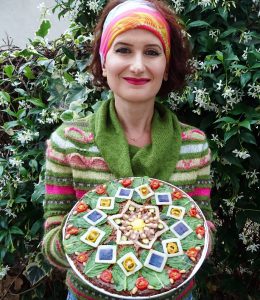
And now, as our country is gradually reopening, I will continue delivering healthy organic custom meals to those who want and need them and look forward to getting back to catering. I put a personal stamp on my food by going back to my roots, the same roots I wanted to forget back in High School. I bring to the table the culinary traditions and some signature dishes of my own family and my homeland – Moldova, whose cuisine is a mix of Mediterranean, Middle Eastern, and North and Eastern European influences. Most of my food is plant-based, and all ingredients are responsibly and sustainably grown. Many ingredients come from my own organic backyard garden – you can’t get fresher than that. And…NO PALM OIL EVER! I also sell homemade salad dressings and my specialty — rose petal jam, made from heirloom damask and tea roses I grow in my garden. Yes, the same jam my mom used to make as I watched in awe. The recipe for this heavenly preserve came from my great grandmother, whose name incidentally was Rose. It is a part of my family’s legacy. It survived two world wars, famines, the Holocaust, and Stalin’s Purge. You can taste the love that overcame all odds in every jar.
If you had to, what characteristic of yours would you give the most credit to?
I think it’s my resilience and ability to reinvent myself when the going gets tough. I survived the Soviet regime, immigration, and cancer. As the old adage goes – what doesn’t kill you makes you stronger. I’m still here. Like great grandma Rose’s jam.
Contact Info:
- Email: [email protected]
- Website: http://www.chezfelis.com
- Instagram: https://www.instagram.com/felisstella/
- Facebook: https://www.facebook.com/Fel%C3%ADs-Stella-Art-231983456852220
- Twitter: https://twitter.com/FelisStella2


Image Credits:
Jack Sullivan Felis Stella Justine Miranda Louis Vargas SK Riley Bartholomew Cooke
Popular
-

What is something outside of work that is bringing you joy lately?
-

Local Highlighter Series
-
What did suffering teach you that success never could?
-
What are you most proud of building — that nobody sees?
-
Who were you before the world told you who you had to be?
-

If you could say one kind thing to your younger self, what would it be?