


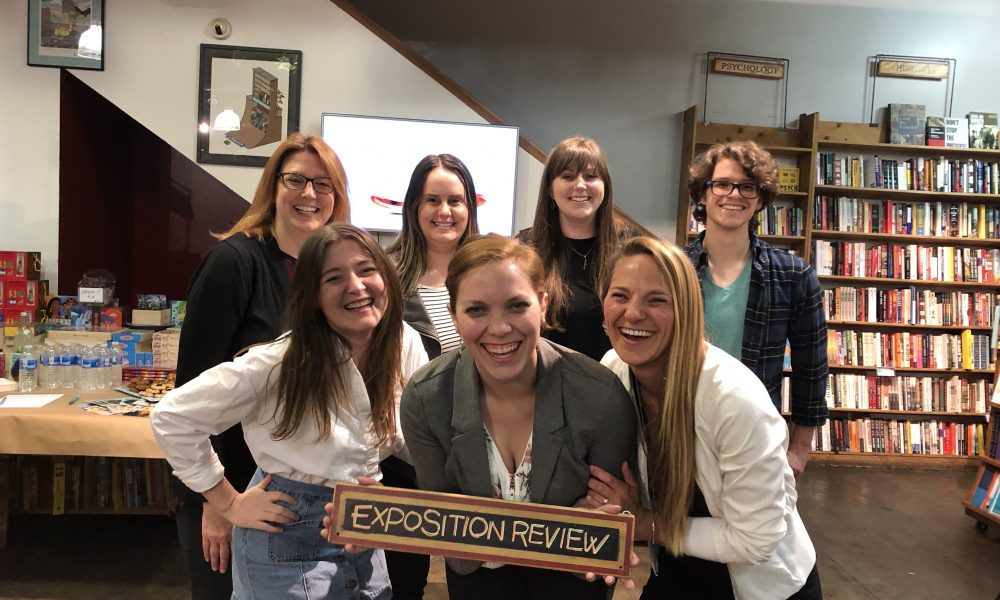
Today we’d like to introduce you to Lauren Gorski and Mellinda Hensley.
Thanks for sharing your story with us Lauren and Mellinda. So, let’s start at the beginning and we can move on from there.
Exposition Review evolved from a university-run print journal Southern California Review (SCR) under the University of Southern California’s Master of Professional Writing Program. In 2013, the university made a business decision to discontinue the MPW program after a 40+ year history. As students, we were devastated. Thankfully what should’ve been a somber ending (our last issue had the theme “Remnants”) ended up as the seed that grew into Expo. As the acting Editors-in-Chief of SCR, we sat down with the other editors and alumni of the program and asked, “What can we do here?” The answer was as terrifying as it was exciting: anything we wanted.
From there, we moved quickly. We wanted to keep the multi-genre spirit of the journal the same while expanding into a world that stretched beyond print. We hashed out our basic framework: We’d change our name to Exposition Review and go strictly online to cut out printing costs and highlight our ability to publish multi-genre work. We’d no longer be affiliated with the university. We’d establish ourselves as a fiscally-sponsored organization. As soon as we were financially able to, we’d pay our writers and lift up their work anyway we could.
Cut to five years later, and we’ve managed to do those things. We put out an issue every year, host a live launch party, and invite our readers to attend and share their work. We publish all sorts of content, from structured poetry to experimental html pieces. We pay writers through our Flash 405 contests and, for the first time this past year, for our annual issues.
Are we still learning, growing, changing? Absolutely. Even though we all do this unpaid and on our own time, this journal connects us all, and it’s something we’re passionate about.
Looking at the last physical copies of Southern California Review — some of which are sitting on our shelves now — it’s no surprise that the last theme we did in print was “Remnants.” We felt like scattered pieces, a small community of leftovers. But we came together and rebuilt, and that’ll always be something we’re thankful for. We’re so proud of where we came from, where we are now, and where we’re going.
Great, so let’s dig a little deeper into the story – has it been an easy path overall and if not, what were the challenges you’ve had to overcome?
It hasn’t been nearly as rough as it could’ve been — we had such a willing, dedicated team in those crucial, formative moments that really helped us solidify who we were and what we wanted as a journal. We definitely had a steep learning curve, but we also had a group of people who were passionate about different aspects of the journal — some of us wanted to be on the ground looking for great authors and pieces we could solicit, some of us were really interested in fundraising and finance, some of us were really organized in keeping track of submissions or hosting events; we all had a specific part to play.
Our main struggle in the beginning was figuring out a path to pay writers, which isn’t the norm. In fact, only 13% of independent literary journals are able to pay contributors outside of contests. We also made the decision not to have a subscriber-based model. Luckily, our decisions to become a fiscally-sponsored organization and be able to accept tax-deductible donations allowed us to meet our goal of paying all contributors of the annual issue with a rate of $35.00/piece. We aim to continue to grow this number for the future.
Our strength is that we have been as adaptable and open to change as possible. We meet once a year in an annual retreat to evaluate our previous year. What did we like? What would we change? What are our goals for next year, what about in the next five years? For us, sustainability is key.
Since our staff is volunteer-based, we also want to make space so that when major life events happen, that doesn’t throw off the groove of the entire journal. Some other journals lean on one or two main editors. At Expo, we have an editorial board that is further supported by editors, associate editors, and our readers. When one team member wants to take on more projects or less, they have the freedom to do so and creative encouragement to try something new if they have a passion to take Expo in a new direction. We even have a global presence with readers in the UK, Canada, and non-continental US. With that said, we do aim to improve the diversity of our volunteers and create more entry points to editor roles for those who are underrepresented in publishing.
Please tell us about Exposition Review.
Exposition Review is a multi-genre literary journal dedicated to literary work and art across forms. Through the years, we have been proud to publish voices that display the tenacity, diversity, and artistic community of Los Angeles and beyond. We are one of the few independent literary journals that pay contributors for their work (one of only 13% total!). In addition to paying contributors, we also are proud of our workshops, events, internship, and our focus on opportunity.
At Expo, we don’t see publication as the final part of the process. Our mission is to create opportunities for writers and artists to share their voices and to support the literary communities that have given us a home. After publication, we continue to promote contributors at events, on social media, and through literary nominations. We also participate in and produce podcasts, workshops for high school teens with our partnership with WriteGirl, and staged readings.
Some specific examples of how we are unique and what we have achieved since launching as Exposition Review in 2015, include…
– Publishing more than 200 pieces through our annual issues and Flash 405 contests across genres (fiction, nonfiction, poetry, stageplay, screenplay, experimental, artwork, comics, and hybrid forms).
– Paying all contributors of our annual issue, starting with Vol. V.
– Teaching free workshops to high school students and publishing their work.
– Mentoring new literary talent through guaranteed feedback and internships.
– Paying more than $3,500 to our Flash 405 contest winners.
– Hosting quarterly events and workshops, including a panel at the Association of Writers & Publishers Conference in 2020.
Any shoutouts? Who else deserves credit in this story – who has played a meaningful role?
In our early days, the USC-MPW family was pivotal in making Exposition Review a reality. Brighde Mullins, Prince Gomolvilas, and David Ulin helped us transition from the university system and graciously shared their advice and contacts along the way, giving us the confidence to become independent. David even became our Founding Editor-at-Large!
With the support of Fractured Atlas, our fiscal sponsor, and our donors, we have the ability to pay all of our contributors and ensure sustainability for years to come. Thanks to donors, we were also able to expand our reach outside of Los Angeles and participate in literary events in Northern California and Texas. Some of our favorite LA bookstores and writing collectives have generously given us their space to use for events as well: Skylight Books, the Hatchery, Chevalier Books, and Hennessey + Ingalls.
Overall, the entire volunteer team of interns, readers, editors, and our Editorial Board receives a majority of credit. Across our staff, there are many unique talents and skills that have allowed us to grow and expand beyond what a literary journal is expected to be. With a diverse passion for genres from our team, we have expanded our hybrid and experimental forms. And with our eyes on community-building, we have been intentional in our work to provide resources for feedback, free submissions, and writing workshops for writers.
For specific credit, our Editorial Board has been committed since inception and continues to work tirelessly behind the scenes. Brianna J.L. Smyk and Jessica June Rowe worked as the first Co-Editors-in-Chief, working hard to shape our voice on social media, schedule reading sessions, designing the website, and kicking off our first contests. Annlee Ellingson has helped develop and amplify work with WriteGirl and PEN America’s Emerging Voices Fellows. Rebecca Luxton has supported social media and fundraising strategy while encouraging new and experimental forms. Laura Rensing’s finance and fundraising leadership has allowed us to grow thoughtfully, and she also recently launched our latest project: the podcast Transposition. We (Lauren Gorski and Mellinda Hensley) have also led efforts in fundraising and development, producing events and creating content, while continuing to shape the legacy of Exposition Review along with our fellow editors. Many others also deserve credit from that first meeting in a conference room where we decided to not let the university-structure dictate our future, and we are so thankful for everyone that was involved.
Pricing:
- Free to Read
Contact Info:
- Website: www.expositionreview.com
- Email: expositionreview@gmail.com


Image Credit:
Exposition Review
Suggest a story: VoyageLA is built on recommendations from the community; it’s how we uncover hidden gems, so if you or someone you know deserves recognition please let us know here.
Popular
-

Robin Olive on Building an Inclusive Performing Arts Movement and Expanding Opportunities for Every Student
-

Portraits of the Valley
-

LA’s Most Inspiring Stories
-

Que Johnson on Building Brands That Last: From Visibility to True Market Authority
-

Christina Wren Steps Into the Director’s Chair to Tell Stories That Feel Like Home
-

JordanL on ‘Breathe,’ Belief, and Building a Movement Beyond the Music