


Today we’d like to introduce you to Areli Arellano.
Areli, please share your story with us. How did you get to where you are today?
Art was second nature to me, and at a very young age I knew I wanted to have a career in the arts. While in high school, I wanted to be a graphic designer, so I taught myself how to use Photoshop and Illustrator. I quickly developed a strong skill set and immersed myself into the world of digital art. In high school, I also took drawing classes, which is where I started to drift from digital art into fine art. My teacher encouraged me to continue drawing and I ended up taking drawing all four years. Although I had developed a new appreciation for drawing and painting, my mind was set on being a graphic designer.
After high school, I started college at my ‘dream school’ Art Center College of Design. One semester in, I realized I hated everything about graphic design. I was so tired of staring at a screen. I hated making work for clients and not for myself. My grades dropped and I was called into the dean’s office to discuss why they were so low. While meeting with the dean, we went over the portfolio I submitted as part of my application. He thought my graphic design was good, but not great, what he really liked were my illustrations. I left the meeting feeling very discouraged and lost. Although I enjoyed illustration, I couldn’t see myself getting a degree or starting a career with it. As a first-generation college student, I had no other resources and I panicked. A week after the meeting, I dropped out of Art Center without really thinking it through. There were still a few weeks left of the semester, so I had to pretend I was going to school for about a month. I was terrified of telling my parents what I did.
At this point, I was tired, and I just wanted to get back into a routine. Luckily for me Azusa Pacific University (APU) allowed me to transfer in the spring semester as a freshman. I enrolled for an Interdisciplinary Studio Arts degree. During my time at APU, I tried to explore as many mediums as I could. I began to find my artistic voice and developed a personal style. Out of all the classes I took, I enjoyed mixed media and sculpture the most. My professor and mentor Tamara Valdry said I should focus in on textile work because she thought it was my strongest work. For the remaining two years of my undergrad, I narrowed in on textile work as well as soft sculpture. Several of my professors were very excited to see my work develop in such a short time. With their help, I was able to place my work into smaller galleries for group shows. After graduating, I was contacted by different curators and was able to continue showing my work, now in more established galleries.
Has it been a smooth road?
It definitely was not a smooth road. There were several challenges along the way. One of the biggest issues for me was being a first-generation student. I often felt alone and wanted to quit several times. I also didn’t have the luxury of financial security. At one point during undergrad I was working three different jobs to try and cover my expenses. I had an internship at a gallery, an on campus job, and a part-time job at a frozen yogurt place. Having so much stress on top of class definitely hindered my work. I felt like I was never doing enough because I didn’t have the money to really invest in my craft. Without a support-system, becoming an artist full time felt impossible. Not a lot of my family understood why I switched majors and schools, they thought I was being careless.
Aside from the academics, there was also tension being one of the few students of color at a majority white school. I struggled with my identity, which was reflected in my art. I desperately wanted to connect to my culture, one which I was so ashamed of in high school. My art began to focus on Latinx culture because I wanted everyone to know about it. I wanted my work to scream Mexican/Mexican-American. Although it was a good sentiment, I was going about it the wrong way. Looking back at my old work is really funny to me (lots of hot-cheeto and mexican flag work). I can see just how much I was longing for some kind of identity. I was trying to overcompensate for the years I had lost, and it unfortunately narrowed me into a box again. It took a while for me to break out of what I thought was ‘Mexican Art.’ It wasn’t until I stumbled upon Runsy (Esperanza Rosas/@runsyyy) that my work began to mature. She did a TEDx talk titled ‘Expanding the Spectrum of Mexican Art’ that really got me out of that mind-set. My art didn’t have to look a certain way so I could show off my culture. Realizing this really pushed me to expand my art which in turn helped me create my best work.
Even though I feel secure in myself and my work, I still face challenges as an artist. Being a woman artist, AND woman of color makes things harder. The art world, although changing, is still very male centered. A lot of galleries do not make an effort to include woman artists or artists of color. We have to work twice as hard to get taken seriously. Additionally, because I am so young, many galleries won’t even bother to look at my work. It’s another barrier that I have to break through, but I am happy to do it. The artists before me did it, and unfortunately the cycle repeats, so now this generation of women artists have to break free again.
We’d love to hear more about your work and what you are currently focused on. What else should we know?
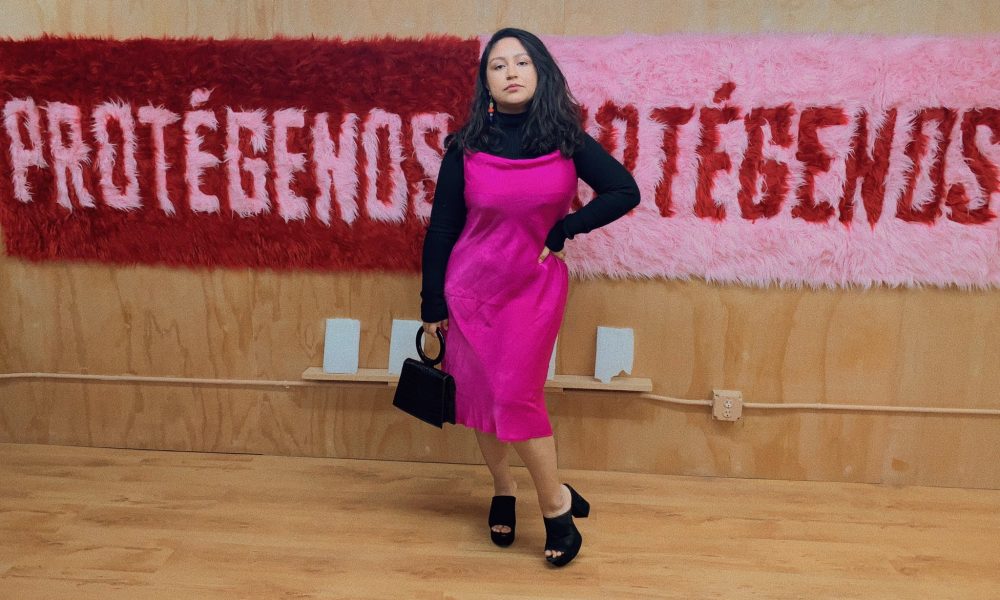
I am a multidisciplinary artist with a focus on textile and soft sculpture. My work delves into social justice issues revolving around gender and race. I like to create a juxtaposition between the hard, sometimes uncomfortable topics with bright colors and soft materials. Some of the topics I cover include racism, sexism, gentrification, and systemic oppression. I use bright colors and texture to draw viewers in, while the message behind my work offers a place for reflection once they are fully captivated. I want my work to create safe spaces for people of color, specifically women of color. I want them to feel seen and heard. So many times we are told our issues are not real or not important. My work calls out those issues and puts them at the forefront. I also want my work to challenge those in positions of power and privilege to begin to take action.
I have also recently worked with photographers and film-makers as a creative director. I love working on set, building an image from the ground up. I’ve done styling, art direction, production design. If I could try every single art-medium there is, I would! Collaborating with other artists in different industries has been a great time.
How do you think the industry will change over the next decade?
I think there is a huge shift happening currently in the art world. Back then, there was really only one way to be a ‘successful’ artist: you had to be represented by a gallery. There was such an emphasis on where your work was displayed and who was buying it. With the rise of social media, artists don’t have to rely on galleries, they can just post their work online. Without that barrier restricting artists, I think it allows us to have freedom to create whatever we want. We now have autonomy and don’t have to rely on a gallery to sell our work. This opens up the opportunities for marginalized artists and puts the power back into the artist’s hands. I don’t think galleries will ever become obsolete, because they do have play an important role. However, I wouldn’t be surprised if there is a big restructuring of how business is handled in the upcoming years.
On the other hand, social media also changed the way we view art. Now, people are looking for the perfect Instagrammable experience. This has caused a rise in pop-up galleries and exhibits. Artists or galleries may feel pressured to morph their practice to try to go ‘viral’. Of course, great artists and galleries don’t really care about that – but it’s definitely an incentive to keep your social media up to date and really engage with the online art community.
Contact Info:
- Website: areliarellano.com
- Email: [email protected]
- Instagram: instagram.com/yosoyareli


 Image Credit:
Rakeem Cunningham (only images with wooden wall/background)
Suggest a story: VoyageLA is built on recommendations from the community; it’s how we uncover hidden gems, so if you or someone you know deserves recognition please let us know here.
Popular
-

Local Highlighter Series
-

If you could say one kind thing to your younger self, what would it be?
-

Who taught you the most about work?
-
What is something outside of work that is bringing you joy lately?
-

Have any recent moments made you laugh or feel proud?
-

What fear has held you back the most in your life?